Contrary to their name, blue jays are not actually blue. In fact, almost all blue animals we observe lack the pigment entirely. This colour we see comes from a variety of structural mechanisms causing optical interference, impacting how we see this colour with no actual blue pigment used.
Colour is produced when pigments absorb the wavelengths of visible light. The remaining transmitted or reflected light is what determines the colours that viewers will perceive. As photon energy will follow Equation 1, a shorter wavelength will carry a larger amount of energy per photon. Since blue is an extremely rare pigment to exist in nature, most organisms perceived as blue are rather a structural optical phenomenon instead of a typically assumed pigment (Bagnara et al. 2007).
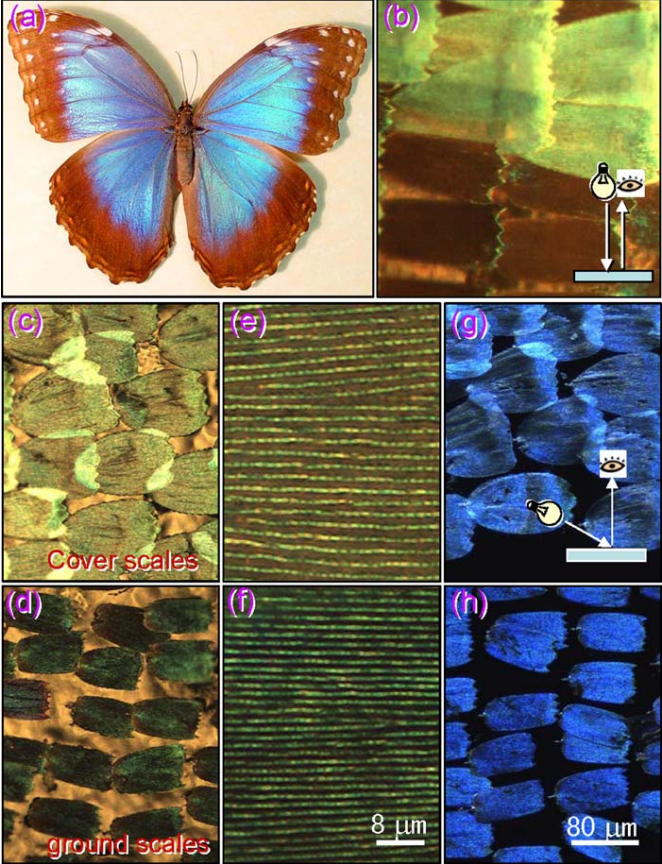
Observed structural blue can occur when small structures on the organism’s surface interfere with light. For instance, Cyanocitta crisata (blue jay) feathers hold small melanin and keratin molecules that arrange with surrounding air in a nanoscale network to scatter blue wavelengths (Parnell et al. 2015). Conversely, Morpho peleides (blue morpho butterflies) have an entirely different mechanism (Figure 1). Layered scale framework and ridges on their wings are what reinforce certain colour wavelengths to the human eye, titled optical interference (Ding, Xu, and Wang 2009).
In Garrulus glandarius (the Eurasian jay), the blue on their feathers has structural layered scales sized approximately 150 nanometers, whereas the white areas are around 200 nanometers. This spacing causes a difference in their light scattering (Parnell et al. 2015). Likewise, the feathers on Argusianus argus (the great argus) have submicroscopic wrinkles about 385 nm apart and 125 nm deep, causing optical interference (Eliason et al. 2023). This quantitative data allows for explanation of how variance to structural dimensions influence optics. One note is that their effects depend much more on the individual geometry and arrangement of every structure.
Affecting an organism’s communication, attraction of partners, and camouflage, observed colour holds much influence. This is where natural selection takes place, favouring colour-influencing structures that will improve a species’ fitness in their habitat (Sun, Bhushan, and Tong 2013).
The study of structural colours allows the development of biomimetic materials used in optical sensing equipment, colour coatings, and anti-counterfeiting. More research is needed on structural colour variety with observed angle, requiring more intricate engineering (Sun, Bhushan, and Tong 2013).
In all, while blue animals may appear so, most of the time their colouration is a result of light interactions based on external/internal structures. The physics of this light interaction on a nanoscale leads to impacts for numerous species on an evolutionary level. Through more researching this phenomena, many technological advancements can be made inclusive of biomimetics.
Bibliography
Bagnara, Joseph T., Philip J. Fernandez, and Royozo Fujii. 2007. “On the Blue Coloration of Vertebrates†.” Pigment Cell Research 20 (1): 14–26. https://doi.org/10.1111/j.1600-0749.2006.00360.x.
Ding, Yong, Xu Sheng, and Wang Zhong Lin. 2009. “Structural Colors From Morpho Peleides Butterfly Wing Scales.” J. Appl. Phys. 106 (7): 074702. https://doi.org/10.1063/1.3239513.
Eliason, Chad M., Julia A. Clarke, and Suzanne Amador Kane. 2023. “Wrinkle Nanostructures Generate a Novel Form of Blue Structural Color in Great Argus Flight Feathers.” iScience 26 (1): 105912. https://doi.org/10.1016/j.isci.2022.105912.
Parnell, Andrew J., Adam L. Washington, Oleksandr O. Mykhaylyk, et al. 2015. “Spatially Modulated Structural Colour in Bird Feathers.” Scientific Reports 5 (1). https://doi.org/10.1038/srep18317.
Sun, Jiyu, Bhushan Bharat, and Jin Tong. 2013. “Structural Coloration in Nature.” RSC Adv. 3 (35): 14862–89. https://doi.org/10.1039/c3ra41096j.
Comments
5 Responses to “That’s Not Blue, That’s Optical Fraud: Nature’s Manipulation of Light to Perceived Colour”
Hey isci,
Researching natural and added pigments in Wine Science made me curious about how certain organisms’ colours appear when they lack their fundamental pigments. Connecting concepts from physics, chemistry, and biology, I explored this concept further.
Happy reading,
– Amy :))
Hi Amy,
Great job on this blog post! I really liked the topic and the connection to iSci. Please see below some comments if you agree 🙂
– I remember a comment on one of my blogs to avoid the use of rhetorical questions in blog posts. Maybe consider rewording the first question to something like: “blue jays, contrary to their name, are not actually blue”
– I think it’d be great if you were more consistent with capitalizations of the bird names, ie Blue Jay, Eurasian Jay, Great Argus). Not sure if blue is capitalized, but since you capitalized Eurasian, seemed more consistent
Other than that, really great job and happy editing:)
Janaya
Hey Janaya,
Thank you so much for this feedback! I removed the rhetoric as you suggested, but my research on the Chicago Manual of Style, 18th edition, says to keep Eurasian capitalized, as it refers to the Eurasia region as a proper noun (other animal names should be lowercase, as they are common nouns).
Thank you!
Hi Amy,
I really like this post… I heard about “fake blue” animals before and never really learned more, so it’s awesome to hear about it now!
“In fact, most of the animals we observe are not actually blue, meaning they lack the pigment entirely.” (Paragraph 1) – In my opinion, it’s a good punchy sentence but it’s a bit clunky. I would say that “most blue animals lack the pigment entirely” to get the same effect, just a bit shorter.
Also, I think the evolution addition is really good; I think it’d be nice to have a bit more information on that, but that’s personal preference.
Happy editing!
Emily Martin
Hey Emily,
Thank you so much for this feedback!
I’ve adjusted the blog accordingly.
– Amy:)