On October 5th, 2026, the Nobel Prize in Physiology and Medicine was jointly awarded to Karl Deisseroth of the Howard Hughes Medical Institute and Stanford University, USA, Peter Hegemann of Humboldt University of Berlin, Germany, and Georg Nagel of the University of Würzburg, Germany (Nobel Prize 2026). They were recognized for their work in and contributing to optogenetics (Naddaf et al. 2026), a research technique combining genetics and optics to control ion channels in selected cells in living tissue with light (Josselyn 2018). These accomplished laureates have marked a new era in neuroscience, one in which science fiction has become reality. Their impressive work represents a major advancement in understanding how neural circuits influence brain function including behaviour, memory, and emotion (Nobel Prize 2026).
The development begins with Hegemann and Nagel and their work in algal biology. They investigated Chlamydomonas reinhardtii, green algae that utilizes cilia, hair-like structures present on eukaryotic cells, to move in response to light (Dupuis and Merchant 2023). Using frog egg cells, Nagel injected copies of Chlamydomonas reinhardtii genes to isolate ion channels that opened when exposed to light (Figure 1), therefore proving previous foundational research by Hegemann (The Nobel Assembly at Karolinska Intsitutet 2026). This was channelrhodopsin, a light-sensitive protein that acts as an ion channel in the cell membrane, opening and allowing ions to pass through the membrane in response to the absorption of light. This process involves the absorption of blue light by the deprotonated retinylidene, which causes a conformational change that allows ions to flow through (Nagel et al. 2002). Although this discovery initially concerned a microscopic organism, particularly green algae, it had immense implications for neuroscience.
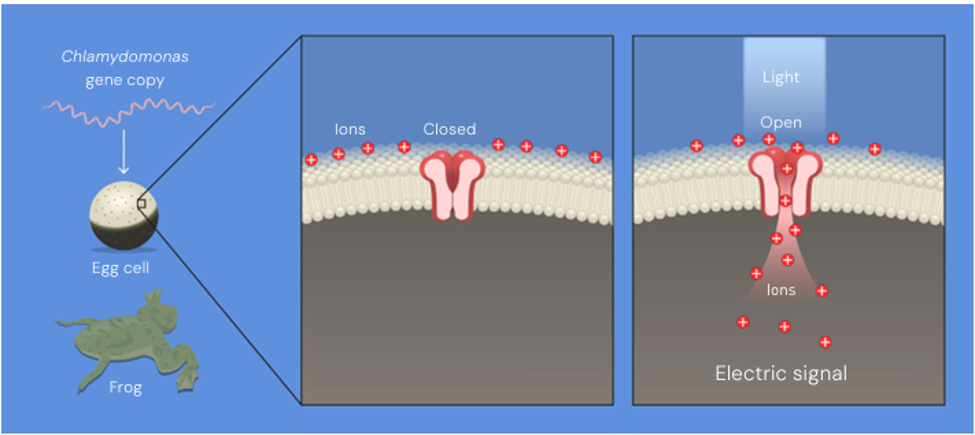
Following these discoveries, Deisseroth and his collaborators had the realization that channelrhodopsin could be introduced into neurons, specialized nerve cells that process and transmit information (Gautam 2017), allowing researchers to control their activity using light pulses (Nagel et al., 2003; Boyden et al., 2005)! By introducing genes encoding light-sensitive proteins into selected cells, scientists can make these cells respond to pulses of light, both inhibiting and activating neural signals. As a result, genetically defined neurons can be controlled with millisecond-scale precision (The Nobel Assembly at Karolinska Intsitutet 2026). Though the combination of genetic engineering with light, scientists could manipulate selected neural circuits and investigate their contributions to behaviour and subsequent biological function, including implications in medicine.
A major obstacle in the field of medicine is determining how specific cellular processes contribute to disease development and propagation. Optogenetics works to address the gap between observed abnormal brain activity and the actual determination of disease by allowing researchers to activate or inhibit specific neurons and observe the subsequent results. Therefore, it is then possible for scientists to establish relationships between neural activity and behavioural or biological function (Aravanis et al., 2007). This has distinct implication for medical research, specifically for neurological disorders, such as Parkinson’s, a progressive neurodegenerative disorder that primarily causes cognitive decline and deterioration of motor skills (Chaudhary et al. 2025).
Although this is the beginning of an incredibly exciting era, it is still just that: the beginning. Optogenetics is not yet an actual treatment for neurological disorders, and this process still has significant challenges. A lot of its current value lies in research, as optogenetic provides incredible opportunities to investigate how neural circuits function (Nobel Prize 2026).
References
“A Light-Sensitive Algal Protein Energised Neuroscience: Popular Science Background on the 2026 Nobel Prize in Physiology or Medicine.” 2026. Popular science background. Nobel Assembly at Karolinska Institutet, October 4. https://www.nobelprize.org/uploads/2026/10/popular-medicineprize2026.pdf.
Aravanis, Alexander M, Li-Ping Wang, Feng Zhang, et al. 2007. “An Optical Neural Interface:In Vivocontrol of Rodent Motor Cortex With Integrated Fiberoptic and Optogenetic Technology.” Journal of Neural Engineering 4 (3): S143–56. https://doi.org/10.1088/1741-2560/4/3/s02.
Boyden, Edward S, Feng Zhang, Ernst Bamberg, Georg Nagel, and Karl Deisseroth. 2005. “Millisecond-Timescale, Genetically Targeted Optical Control of Neural Activity.” Nature Neuroscience 8 (9): 1263–68. https://doi.org/10.1038/nn1525.
Chaudhary, Sameer A, Sapana Chaudhary, and Sakshi Rawat. 2025. “Understanding Parkinson’s Disease: Current Trends and Its Multifaceted Complications.” Frontiers in Aging Neuroscience 17: 1617106. https://doi.org/10.3389/fnagi.2025.1617106.
Dupuis, Sunnyjoy, and Sabeeha S. Merchant. 2023. “Chlamydomonas Reinhardtii: A Model for Photosynthesis and so Much More.” Nature Methods 20 (10): 1441–42. https://doi.org/10.1038/s41592-023-02023-6.
Gautam, Akash. 2017. “Nerve Cells.” Encyclopedia of Animal Cognition and Behavior, 1–3. https://doi.org/10.1007/978-3-319-47829-6_1282-1.
Josselyn, Sheena A. 2018. “The Past, Present and Future of Light-Gated Ion Channels and Optogenetics.” eLife 7 (October). https://doi.org/10.7554/elife.42367.
Naddaf, Miryam, and Ewen Callaway. 2026. “Medicine Nobel Awarded for Brain ‘Switch’ That Controls Neurons With Light.” Nature, October 5. https://www.nature.com/articles/d41586-026-03091-2.
Nagel, Georg, Doris Ollig, Markus Fuhrmann, et al. 2002. “Channelrhodopsin-1: A Light-Gated Proton Channel in Green Algae.” Science 296 (5577): 2395–98. https://doi.org/10.1126/science.1072068.
NobelPrize.Org. 2026. “Nobel Prize in Physiology or Medicine 2026.” https://www.nobelprize.org/prizes/medicine/2026/press-release/
The Nobel Assembly at Karolinska Institutet. 2026. Optogenetics: Discovery of a Neuronal Switch. https://www.nobelprize.org/uploads/2026/10/advanced-medicineprize2026.pdf.
Leave a Reply
You must be logged in to post a comment.