On October 5th, 2026, the Nobel Prize in Physiology and Medicine was jointly awarded to Karl Deisseroth of the Howard Hughes Medical Institute and Stanford University, USA, Peter Hegemann of Humboldt University of Berlin, Germany, and Georg Nagel of the University of Würzburg, Germany (Nobel Prize 2026). They were recognized for their work in and contributing to optogenetics, a research technique combining genetics and optics to control ion channels in selected cells in living tissue with light (Naddaf et al. 2026;Josselyn 2018). These accomplished laureates have marked a new era in neuroscience, one in which science fiction has become reality. Their impressive work represents a major advancement in understanding how neural circuits influence brain function including behaviour, memory, and emotion (Nobel Prize 2026).
The development begins with Hegemann and Nagel and their work in algal biology. They investigated Chlamydomonas reinhardtii, green algae that utilizes cilia, hair-like structures present on eukaryotic cells, to move in response to light (Dupuis and Merchant 2023). Using frog egg cells, Nagel injected copies of C. reinhardtii genes to isolate ion channels that opened when exposed to light (Figure 1), therefore proving previous foundational research by Hegemann (The Nobel Assembly at Karolinska Intsitutet 2026). What they found was channelrhodopsin, a light-sensitive protein that acts as an ion channel in the cell membrane, opening and allowing ions to pass through the membrane in response to the absorption of light. This process involves the absorption of blue light by the deprotonated retinylidene, which causes a conformational change that allows ions to flow through (Nagel et al. 2002). Although this discovery initially concerned a microscopic organism, particularly green algae, it had immense implications for neuroscience.
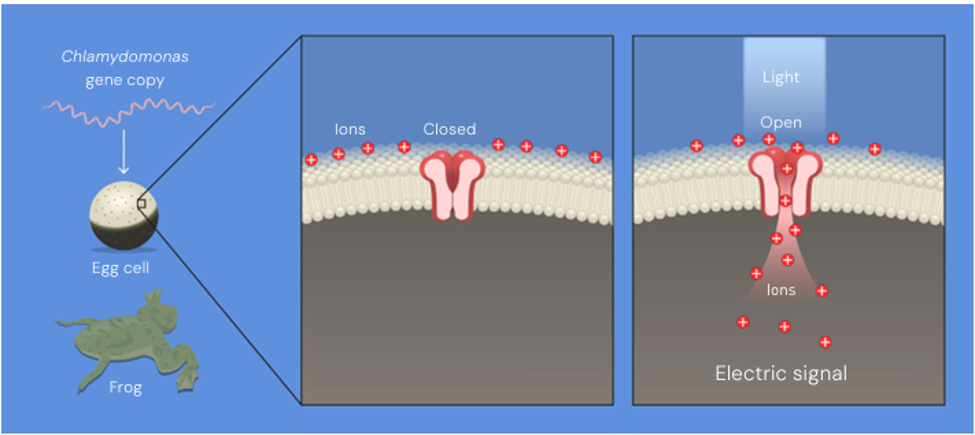
Following these discoveries, Deisseroth and his collaborators had the realization that channelrhodopsin could be introduced into neurons, specialized nerve cells that process and transmit information (Gautam 2017), allowing researchers to control their activity using light pulses (Nagel et al., 2003; Boyden et al., 2005). By introducing genes encoding light-sensitive proteins into selected cells, scientists can make these cells respond to pulses of light, both inhibiting and activating neural signals. As a result, genetically defined neurons can be controlled with millisecond-scale precision (The Nobel Assembly at Karolinska Intsitutet 2026). Through the combination of genetic engineering with light, scientists could manipulate selected neural circuits and investigate their contributions to behaviour and subsequent biological function, including implications in medicine.
A major obstacle in the field of medicine is determining how specific cellular processes contribute to disease development and propagation. Optogenetics works to address the gap between observed abnormal brain activity and the actual determination of disease by allowing researchers to activate or inhibit specific neurons and observe the subsequent results. Therefore, it is possible for scientists to establish relationships between neural activity and behavioural or biological function (Aravanis et al., 2007). This has distinct implication for medical research, specifically for neurological disorders, such as Parkinson’s, a progressive neurodegenerative disorder that primarily causes cognitive decline and deterioration of motor skills (Chaudhary et al. 2025).
Although this is the beginning of an incredibly exciting era, it is still just that: the beginning. Optogenetics is not yet an actual treatment for neurological disorders, and this process still has significant challenges. A lot of its current value lies in research, as optogenetic provides incredible opportunities to investigate how neural circuits function (Nobel Prize 2026).
References
“A Light-Sensitive Algal Protein Energised Neuroscience: Popular Science Background on the 2026 Nobel Prize in Physiology or Medicine.” 2026. Popular science background. Nobel Assembly at Karolinska Institutet, October 4. https://www.nobelprize.org/uploads/2026/10/popular-medicineprize2026.pdf.
Aravanis, Alexander M, Li-Ping Wang, Feng Zhang, et al. 2007. “An Optical Neural Interface:In Vivocontrol of Rodent Motor Cortex With Integrated Fiberoptic and Optogenetic Technology.” Journal of Neural Engineering 4 (3): S143–56. https://doi.org/10.1088/1741-2560/4/3/s02.
Boyden, Edward S, Feng Zhang, Ernst Bamberg, Georg Nagel, and Karl Deisseroth. 2005. “Millisecond-Timescale, Genetically Targeted Optical Control of Neural Activity.” Nature Neuroscience 8 (9): 1263–68. https://doi.org/10.1038/nn1525.
Chaudhary, Sameer A, Sapana Chaudhary, and Sakshi Rawat. 2025. “Understanding Parkinson’s Disease: Current Trends and Its Multifaceted Complications.” Frontiers in Aging Neuroscience 17: 1617106. https://doi.org/10.3389/fnagi.2025.1617106.
Dupuis, Sunnyjoy, and Sabeeha S. Merchant. 2023. “Chlamydomonas Reinhardtii: A Model for Photosynthesis and so Much More.” Nature Methods 20 (10): 1441–42. https://doi.org/10.1038/s41592-023-02023-6.
Gautam, Akash. 2017. “Nerve Cells.” Encyclopedia of Animal Cognition and Behavior, 1–3. https://doi.org/10.1007/978-3-319-47829-6_1282-1.
Josselyn, Sheena A. 2018. “The Past, Present and Future of Light-Gated Ion Channels and Optogenetics.” eLife 7 (October). https://doi.org/10.7554/elife.42367.
Naddaf, Miryam, and Ewen Callaway. 2026. “Medicine Nobel Awarded for Brain ‘Switch’ That Controls Neurons With Light.” Nature, October 5. https://www.nature.com/articles/d41586-026-03091-2.
Nagel, Georg, Doris Ollig, Markus Fuhrmann, et al. 2002. “Channelrhodopsin-1: A Light-Gated Proton Channel in Green Algae.” Science 296 (5577): 2395–98. https://doi.org/10.1126/science.1072068.
NobelPrize.Org. 2026. “Nobel Prize in Physiology or Medicine 2026.” https://www.nobelprize.org/prizes/medicine/2026/press-release/
The Nobel Assembly at Karolinska Institutet. 2026. Optogenetics: Discovery of a Neuronal Switch. https://www.nobelprize.org/uploads/2026/10/advanced-medicineprize2026.pdf.
Comments
9 Responses to “Shining a Light on the Brain: Optogenetics and Light-Gated Proton Channels”
Hi Ruby,
Great job on this blog post! I really like the hook and the topic is interesting too. Please see below a couple of suggestions, if you agree:
– don’t forget to attach your comment about why you chose this topic and how it connects to iSci fields:) it’s a requirement (haha) but it also adds a lot of relevant context to what you are talking about!
– first paragraph: try to avoid putting citations in the middle of sentences; it breaks the sentence flow. Instead, put both in-texts at the end: hey were recognized for their work in and contributing to optogenetics, a research technique combining genetics and optics to control ion channels in selected cells in living tissue with light (Naddaf et al. 2026; Josselyn 2018)
– second last paragraph: I would consider taking out the “then” in “Therefore, it is then possible for scientists” because I think the “therefore” already implies the same meaning.
Other than that, great job on this blog post! Happy editing:)
Janaya
Hey Janaya!
Thanks for the edits!!
I’ve commented now and fixed my writing/citation errors!
Ruby:)
Hi Ruby,
This was such an interesting blog post! You did a really good job simplifying complex (Nobel Prize worthy topics) into an easy to read format. Below are a few comments to help with your editing process:
– In your second paragraph, after referring to your organism once, you can abbreviate your writing of it. For example, instead of writing Chlamydomonas reinhardtii, you can write C. reinhardtii
– Make sure to include a reference in your figure caption. Also make sure you put the organism name in italics in the caption.
– In your third last paragraph, I believe you meant to write “Through” rather than “Though” in the last sentence
Happy editing!
Julianna
Hi Julianna!
Thanks for your comment:)
I’ve fixed my figure caption and implemented your other suggestions!
Ruby
Hey Ruby!
This was a really interesting topic to read! Here are some suggestions on how I think you could improve:
I would suggest expanding the explanation of channelrhodopsin to distinguish light-gated proton channels from other light-sensitive ion channels used in optogenetics. You stated the proton channels in the title, I think through explaining how the movement of different ions influences neuronal activity would strengthen and clarify your point and how it leads to broader applications in neuroscience.
Also I think it would be great if you were able to add on and expand the discussion of Parkinson’s disease by providing a specific example of how optogenetics can be used to investigate the neural circuits responsible for movement. I believe this would help readers better understand the practical significance of the technique and distinguish it between using optogenetics to study disease mechanisms and using it as a potential treatment.
Lastly, in your conclusion you acknowledge that optogenetics is not yet an established treatment for neurological disorders, I would suggest explaining some of the specific challenges that limit its clinical application (difficulties of delivering light to deep brain tissue and safely introducing light-sensitive proteins) and explain why further research is necessary to have a more well explained final claim.
Overall very well written and explained!
Aanya
Hi Anaya!
Thank you so much for your suggestions, I will definitely take them all into consideration when writing my final draft!
Ruby
Hi Ruby,
Fantastic blog post. I adore your writing style, and this is a fascinating and relevant neuroscience topic.
I have a few suggestions to kick your post up a notch:
P1S2: I would cite both your sources at the end of the sentence with a semicolon.
P2S4: You start this sentence with “This”, but it is unclear what “this” refers to. Perhaps you could rearrange this sentence to avoid this uncertainty, like this: “This light-sensitive protein acting as an ion channel in the cell membrane was channelrhodopsin, opening…”
P2S5: Add in which protein the conformational change is taking place, as it is slightly unclear.
Figure caption: I’m not sure “zooming in” is the most scientific term. Perhaps you could day “The up close images represent”, or something along those lines.
P3S1: You should have a period here instead of an exclamation mark. Also, put all three citations at the end of the sentence.
P5: Excellent conclusion.
Overall, well done! I look forward to reading the final draft 🙂
– Clara
Hey Clara!
Thanks for your suggestions, I’ve applied them all:))
Ruby
Hey iSci!
I decided to do my blog post on optogenetics because of the brief discussion we had in neuro!! I found it super interesting and wanted to do some more research!
Hope you like it:)
– Ruby