During midterm season, university students have a common habit of staying awake all night in hopes of retaining more information for an important test. The belief is that the more time spent studying, the more information is retained; therefore, the better performance on an evaluation (Hershner and Chervin 2014). Most students understand that repeated sleep loss is detrimental not only to academic performance, but also to physical and mental well-being with continued sleep loss. A common consensus is that sleep loss is not significant enough to affect students if done over a short length of time and that the benefits of studying outweigh the costs of missed sleep.
What most students don’t understand is that the functions of sleeping are not limited to tissue repair and immune defence reinforcement (Das et al. 2025; Irwin 2014). Sleep has the added benefit of removing chemical waste from the brain (Kaida et al. 2023). Sleep has also been proven to have a very strong role in memory functions as well, ranging from protecting memories from interference that causes humans to forget to memory consolidation, which is when the brain converts recent events into long-term memories (Rasch and Born 2013).
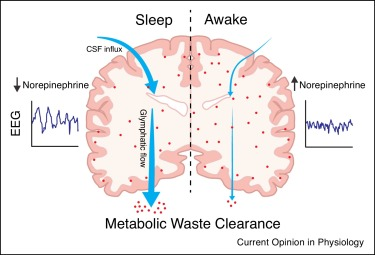
Figure 1: In NREM (non-rapid eye movement) sleep, cerebrospinal fluid (CSF) enters the brain and clears it of waste metabolites such as cellular and metabolic byproducts as part of the glymphatic system. There is a much smaller influx of CSF while awake, which affects the amount of waste removed accordingly (Haugland et al. 2020).
The glymphatic system is a perivascular network around the brain with the objective of bringing in nutrients and expelling waste from the brain (Kaida et al. 2023). Norepinephrine (NE), a stress hormone used in the fight-or-flight response, has been shown to suppress the function of the glymphatic system (Hauglund et al. 2020). Additionally, NE has been found in higher levels when awake compared to when asleep, as shown in Figure 1. During sleep, when NE levels decline, there is an expansion in the brain’s extracellular space (Reddy and Werf 2020), allowing for increased CSF to flow into the brain and remove waste, as shown in Figure 1. Impaired clearance has been linked to the neurodegenerative disease Alzheimers. Amyloid-beta and tau protein aggregations create plaques that lead to the brain degradation seen in Alzheimers disease (Reddy and Werf 2020). The glymphatic system removes these proteins, suggesting that there is a correlation between increased sleep and the prevention of brain degradation.
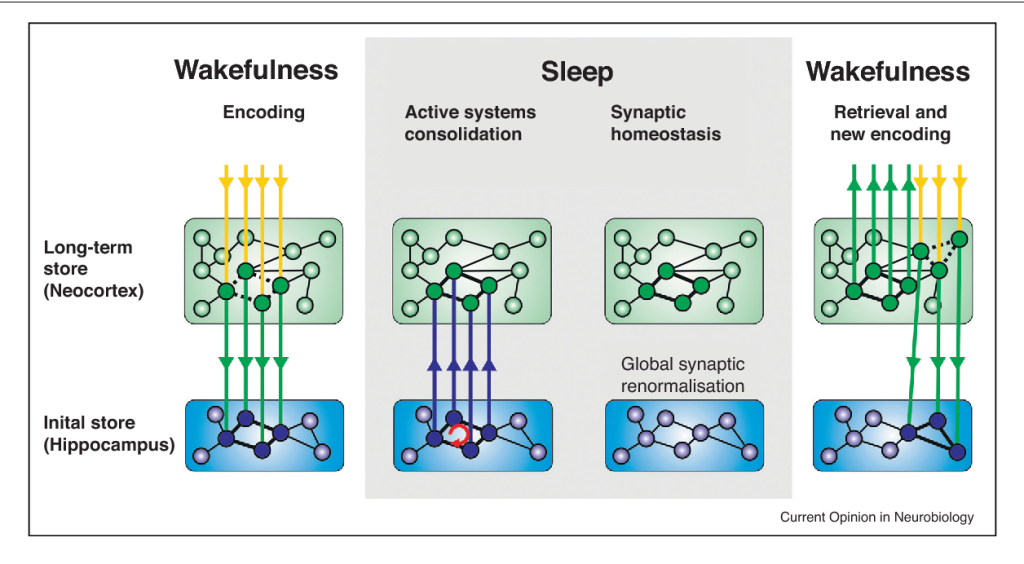
Figure 2: While awake, memories are initially stored in the hippocampus. During sleep, memories are consolidated and stored long-term in the neocortex to be retrieved when necessary. After consolidation, the hippocampus has more availability to store new memories, and the brain stabilizes the strength of its connections in a process called “synaptic homeostasis” (Feld and Born 2017).
REM (rapid-eye movement) sleep has been strongly theorized to contribute to memory consolidation. Evidence of the role of REM sleep in memory is shown in animal studies, where an increase in REM sleep followed a period of learning for rats, mice, and cats (Rasch and Born 2013). One theory is that memory reactivation during REM sleep may facilitate memory generalization and schematization, as shown in Figure 2. This is likely due to a higher level of the neurotransmitter acetylcholine, which is capable of regulating learning and memory, and weaker synchronization between the hippocampus and the neocortex during REM sleep being the optimal conditions for memory schema reconstruction (Kaida et al. 2023).
In conclusion, sacrificing sleep for studying is not beneficial. Rather than acquiring a temporary boost in course knowledge, the student forgoes knowledge consolidation and risks protein-plaque buildup that actively reduces memory storage capabilities over time (Reddy and Werf 2020). The best course of action during midterms might be to study regularly throughout the day and prioritize sleep to retain their knowledge.
Works Cited
Boyce, Richard, Sylvain Williams, and Antoine Adamantidis. “REM Sleep and Memory.” Current Opinion in Neurobiology 44 (June 2017): 167–77. https://doi.org/10.1016/j.conb.2017.05.001.
Das, Asish, Ravi Gupta, Farhanul Huda, Navin Kumar, Vijay Krishnan, and Somprakas Basu. “Effect of Sleep Quality on Wound Healing among Patients Undergoing Emergency Laparotomy: An Observational Study.” Journal of Clinical Sleep Medicine 21, no. 3 (2025): 503–12. https://doi.org/10.5664/jcsm.11442.
Feld, Gordon B., and Jan Born. “Sculpting Memory during Sleep: Concurrent Consolidation and Forgetting.” Current Opinion in Neurobiology 44 (June 2017): 20–27. https://doi.org/10.1016/j.conb.2017.02.012.
Hauglund, Natalie L., Chiara Pavan, and Maiken Nedergaard. “Cleaning the Sleeping Brain – the Potential Restorative Function of the Glymphatic System.” Current Opinion in Physiology 15 (June 2020): 1–6. https://doi.org/10.1016/j.cophys.2019.10.020.
Hershner, Shelley, and Ron Chervin. “Causes and Consequences of Sleepiness among College Students.” Nature and Science of Sleep, June 2014, 73. https://doi.org/10.2147/NSS.S62907.
Irwin, Michael R. “Why Sleep Is Important for Health: A Psychoneuroimmunology Perspective.” Annual Review of Psychology 66, no. 1 (2015): 143–72. https://doi.org/10.1146/annurev-psych-010213-115205.
Kaida, Kosuke, Ikue Mori, Ken Kihara, and Naoko Kaida. “The Function of REM and NREM Sleep on Memory Distortion and Consolidation.” Neurobiology of Learning and Memory 204 (October 2023): 107811. https://doi.org/10.1016/j.nlm.2023.107811.
Rasch, Björn, and Jan Born. “About Sleep’s Role in Memory.” Physiological Reviews 93, no. 2 (2013): 681–766. https://doi.org/10.1152/physrev.00032.2012.
Reddy, Oliver Cameron, and Ysbrand D. Van Der Werf. “The Sleeping Brain: Harnessing the Power of the Glymphatic System through Lifestyle Choices.” Brain Sciences 10, no. 11 (2020): 868. https://doi.org/10.3390/brainsci10110868.


Leave a Reply
You must be logged in to post a comment.