Normally, coffee is a magical thing. It gets us up in the morning, keeps us awake at night, and anytime in between it serves as a quick little pick-me-up. It gets a little strange, however, when some crazy blog poster decides to examine the drink through the lens of fluid mechanics – specifically, what happens when you spill a drop on your kitchen table. The liquid starts as a brown dome ruining your perfectly clean tablecloth (darn it). As it dries, however, nearly all the dark coffee grounds migrate to the outer edge, leaving a sharp perimeter ring surrounding a pale centre. Why doesn’t a spilled drop dry evenly?
The first half of the answer lies in fluid dynamics, and the culprit is geometry. When a coffee droplet lands on a table (or tablecloth), its outer perimeter – what actually contacts the table – gets snagged, or pinned, onto microscopic surface irregularities (Deegan et al. 1997). The perimeter has more surface area to evaporate than the surface, so as the droplet starts evaporating, water at the perimeter evaporates faster than water in the centre. Normally, a shrinking puddle would pull its edges inward. Because the perimeter is pinned, however, liquid from the interior must replenish the depleting exterior through capillary flow, sweeping nearly all of the dissolved coffee solids into the now-packed outer wall (Figure 1; Deegan et al. 1997).
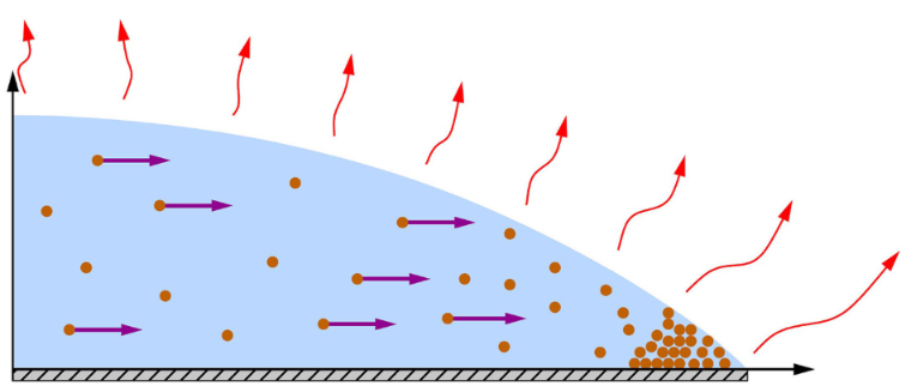
The second half is more chemistry-based. As liquid evaporates faster at a droplet’s edge, the cooling from evaporation creates a temperature and surface tension gradient across the drop. In many organic solvents, or even alcohol-water mixtures like wine, this gradient triggers an inward “Marangoni flow” that pulls water (and dissolved solids) back to the centre, which is the main reason that these liquids dry evenly (Hu and Larson 2006). This isn’t the case for water, however. Its ridiculously high surface tension acts as a high-energy state, and trace oils and natural surfactants from the roasted beans quickly float to the top to break that deadlock. Those compounds lock together to form a microscopic film, blocking the inward Marangoni current from recirculating the grounds (Hu and Larson 2006).
This “coffee-ring effect” is a headache for whoever has to clean the aforementioned spill up. It’s an even larger one for engineers working in the field of materials science, where it ruins the uniformity of inkjet printing, microelectronics coatings, and laboratory slides. For years, chemists have attempted to unpin the droplet edge by adding complex solvents or polishing surfaces, but neither were practical for the real world (Yunker et al. 2011). In fact, if the surfaces were polished enough then the dissolved particles would self-pin the droplet (Eral et al. 2011). How, then, does the industry counteract this effect? How about changing the shape of the suspended particles? While spherical coffee particles roll smoothly to the droplet’s edge and pack tightly, stretching those particles into football-like ellipsoids alters that behaviour. When these shapes reach the air-water interface, their unique shape bends the liquid membrane ever so slightly. When more particles reach the edge, they form a loose web instead of a tightly packed clump, allowing for near-uniform deposition and causing a nice, even dry (Yunker et al. 2011).
So, back to coffee. It’s the simplest thing we know that holds both water and large dissolved particles, and spills with both hold a surprising amount of depth. The next time you see such a spill, you’ll know that the fate of the puddle is much more complex than at first glance. Perhaps it’s true that coffee’s magical, no matter which angle you look at it.
References
Deegan, Robert D., Olgica Bakajin, Todd F. Dupont, Greb Huber, Sidney R. Nagel, and Thomas A. Witten. 1997. “Capillary Flow as the Cause of Ring Stains From Dried Liquid Drops.” Nature 389 (6653): 827–29. https://doi.org/10.1038/39827.
Eral, H. B., D. Mampallil Augustine, M. H. G. Duits, and F. Mugele. 2011. “Suppressing the Coffee Stain Effect: How to Control Colloidal Self-Assembly in Evaporating Drops Using Electrowetting.” Soft Matter 7 (10): 4954. https://doi.org/10.1039/c1sm05183k.
Hu, Hua, and Ronald G. Larson. 2006. “Marangoni Effect Reverses Coffee-Ring Depositions.” J. Phys. Chem. B 110 (14): 7090–94. https://doi.org/10.1021/jp0609232.
Moore, Madeleine, and Alexander Wray. 2024. “Evaporation and the Coffee Ring Effect for Noncircular Droplets.” Society for Industrial and Applied Mathematics, December 4. https://www.siam.org/publications/siam-news/articles/evaporation-and-the-coffee-ring-effect-for-noncircular-droplets/.
Yunker, Peter J., Tim Still, Matthew A. Lohr, and A. G. Yodh. 2011. “Suppression of the Coffee-Ring Effect by Shape-Dependent Capillary Interactions.” Nature 476 (7360): 308–11. https://doi.org/10.1038/nature10344.


Leave a Reply
You must be logged in to post a comment.