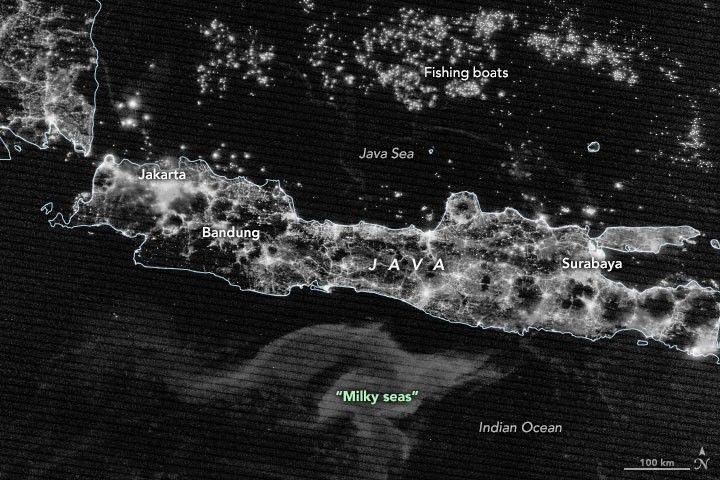
Would you believe if someone told you they just sailed “over a boundless plain of snow, or a sea of quicksilver”? Those were the words of Captain Kempthorne of the Moozuffer in 1849 when he sailed through a patch of the Arabian Sea (Hudson and Miller 2025). Fewer than 400 similar sightings have been logged in the 400 years since, each describing the same strange ocean water glowing a steady, even white at night, in every direction as far as a sailor could see (Hudson and Miller 2025). For most of that time, none of it counted to be a scientific truth. A single ship’s account from the middle of open water, with no way to check it against anything else, was just a sailing myth. Until when the curiosity of Steven Miller, an oceanographer at the U.S. Naval Research Laboratory, decided to check whether a weather satellite’s night-vision sensor was sensitive enough to catch a milky sea in the act (Miller et al. 2005). He found his test case in the SS Lima, a merchant ship that logged a six-hour crossing through a glowing patch off the Horn of Africa on January 25, 1995 (Miller et al. 2005). When he pulled the satellite imagery from that exact night, the ocean wasn’t black where it should have been instead there was a faint, comma-shaped smear nearly 5,500 square miles across (Figure 1), sitting precisely where the Lima’s logbook said it would (Miller et al. 2005).
So, what’s actually glowing? Bacteria closely related to Vibrio harveyi, running one specific reaction repeatedly. (Figure 2) Bacterial luciferase grabs onto a reduced flavin molecule (FMNH₂), a long-chain fatty aldehyde, and oxygen at once; when the aldehyde gets oxidized into a fatty acid, the energy that reaction would normally release as heat gets dumped into the flavin instead, which relaxes by kicking out a photon of blue-green light around 490 nanometers (Meighen 1991). The genes behind this, the lux operon, they encode the enzyme and a pathway that keeps regenerating the aldehyde fuel, so one cell can keep flashing indefinitely as long as it’s fed and has oxygen (Meighen 1991).

One glowing bacterium on its own is not discernible but when there are millions of them in the same area, you cannot miss them. What’s strange about milky seas is that billions of them switch on within the same hour, across an area that can top 100,000 square kilometers (Miller et al. 2021). They pull this off with quorum sensing: every cell constantly leaks a small signalling molecule into the water, and once enough cells are packed into the same space, the combined signal crosses a threshold and the whole population flips into glow mode together, like a crowd that all decided to clap at once (Miller and Bassler 2001).This synchronized glow is faint, faint enough that even reflected moonlight drowns it out, which is exactly why the low-light sensors built to spot it have to hunt on the darkest nights available (Miller et al. 2021) (Figure 1).
Proving the glow was real in 2005 did not answer why it happens, and that part is still up for debate. One leading idea is that the light works as bait: bright enough to pull in fish and zooplankton, which eat the bacteria and unknowingly carry them off into a new, nutrient-rich home in their gut (Zarubin et al. 2012). Nobody’s fully settled that, and nobody’s fully explained how a signal meant to work between neighbouring cells somehow scales up to synchronize a population spread across tens of thousands of square kilometers of open ocean (Miller et al. 2021). The newest attempt at an answer is a 2025 database pairing four centuries of ship logs with modern satellite detections, built specifically so researchers can start predicting where the next one shows up (Hudson and Miller 2025). A hundred and seventy-five years later, scientists still can’t fully tell you why the sea of quicksilver occurs.
References
Harrison, Peter L., Russell C. Babcock, Gordon D. Bull, J. K. Oliver, C. C. Wallace, and B. L. Willis. 1984. “Mass Spawning in Tropical Reef Corals.” Science 223 (4641): 1186–1189. https://doi.org/10.1126/science.223.4641.1186.
Hudson, Justin, and Steven D. Miller. 2025. “From Sailors to Satellites: A Curated Database of Bioluminescent Milky Seas Spanning 1600–Present.” Earth and Space Science 12 (4). https://doi.org/10.1029/2024EA004082.
Meighen, Edward A. 1991. “Molecular Biology of Bacterial Bioluminescence.” Microbiological Reviews 55 (1): 123–142. https://doi.org/10.1128/mr.55.1.123-142.1991.
Miller, Melissa B., and Bonnie L. Bassler. 2001. “Quorum Sensing in Bacteria.” Annual Review of Microbiology 55: 165–199. https://doi.org/10.1146/annurev.micro.55.1.165.
Miller, Steven D., Steven H. D. Haddock, Christopher D. Elvidge, and Thomas F. Lee. 2005. “Detection of a Bioluminescent Milky Sea from Space.” Proceedings of the National Academy of Sciences 102 (40): 14181–14184. https://doi.org/10.1073/pnas.0507253102.
Miller, Steven D., Steven H. D. Haddock, William C. Straka III, Clarissa A. Seaman, Christopher L. Combs, Mi Wang, Wanting Shi, and Sunhee Nam. 2021. “Honing in on Bioluminescent Milky Seas from Space.” Scientific Reports 11: 15443. https://doi.org/10.1038/s41598-021-94823-z.
Zarubin, M., S. Belkin, M. Ionescu, and A. Genin. 2012. “Bacterial Bioluminescence as a Lure for Marine Zooplankton and Fish.” Proceedings of the National Academy of Sciences 109 (3): 853–857. https://doi.org/10.1073/pnas.1116683109.


Leave a Reply
You must be logged in to post a comment.