The traditional narrative suggests that heterosexuality is the natural way of life in the animal kingdom, yet same-sex sexual behaviour (SSSB) has been documented in over 1500 different species (Gómez et al. 2023). However, it is important to recognize that SSSB is not the same as homosexuality, as this is a human cultural word and would be implementing our own human bias. SSSB is defined as courtship or genital contact between individuals of the same sex. A notable species is the bonobo (Pan paniscus), where SSSB occurs frequently. This raises the question of how and why bonobos evolved and maintained this behaviour despite the lack of direct reproductive benefits.
Bonobos, chimpanzees (Pan troglodytes), and humans had the same ancestor who lived approximately six million years ago, yet chimpanzees are rarely found engaging in SSSB (Mailund et al. 2012). Due to the widening of the Congo River, bonobos and chimpanzees diverged around 1.5 million years ago (Figure 1). The river became a barrier to gene flow, resulting in allopatric speciation and allowing the two primates to evolve independently. Chimpanzees shared the northern side of the river with gorillas, and bonobos resided on the south side, where there was an abundant food supply. The reduced competition is thought to explain the differences in social interactions between chimpanzees and bonobos by emphasizing coalition-building and allowing for more peaceful interactions (Muller and Wrangham 2009).
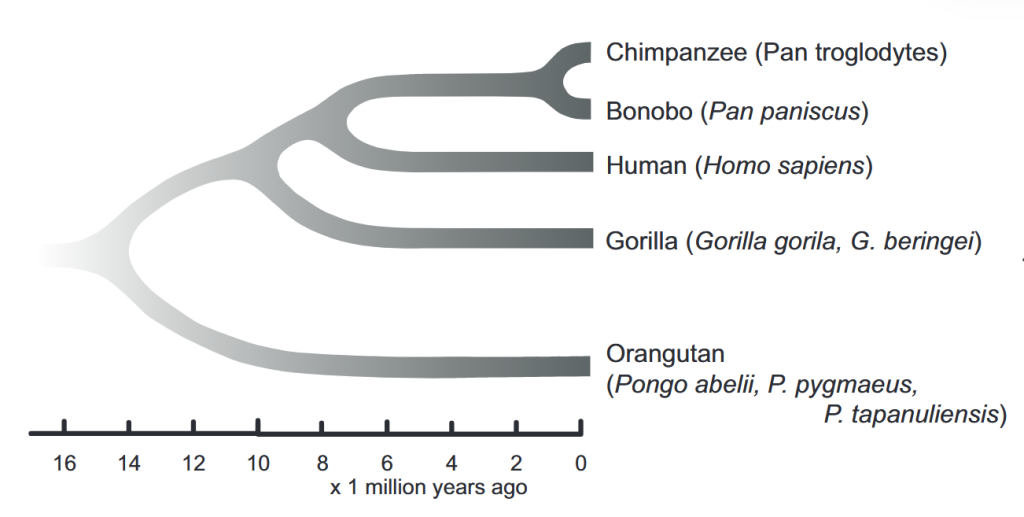
Figure 1 – A phylogeny diagram showing the genetic divergence between the chimpanzee and the bonobo approximately 1.5 million years ago (Furuichi 2019).
Hypotheses to explain why SSSB is favoured by natural selection are that it builds positive relationships and minimizes conflict (Gómez et al. 2023). Bonobo communities have a flexible hierarchy in which a female bonobo typically leads the group. Young female bonobos have been documented approaching other females and facilitating genito-genital rubbing in exchange for food (Blount 1990). Older females will also protect younger or low-ranking females from unwanted male attention or aggression. This is different from adult female chimpanzees, who rarely establish coalitions strong enough to influence group decisions. Young female bonobos who receive male aggression will follow an older bonobo female, and the two may engage in SSSB. Additionally, the older female’s son will often reproduce with the younger females who follow his mother, thus increasing the older female’s offspring. This benefits both the older female and her son, as he has the opportunity to obtain more mates, and both their social ranks will increase.
Serious violence occurs infrequently in bonobo communities and is usually defused before escalation through play, grooming, or sex, including same-sex sexual acts (Muller and Wrangham 2009). This resolves and prevents disputes from turning more hostile.
Furthermore, young bonobos will observe older group members to learn important life skills. When a young bonobo sees the older bonobos engaging in SSSB to diffuse hostility, they will mimic that behaviour when encountering a similar situation (Rumbaugh et al., 2008). This learning process is known as operant conditioning, specifically negative reinforcement, as the likelihood of SSSB occurring in one individual will increase in order to decrease the unwanted stimulus of tension.
Therefore, the ability of bonobos to use sex not just for reproduction but as a social tool highlights that SSSB is an important aspect of their lives for alliances and conflict resolution.
References
Blount, Ben G. 1990. “Issues in Bonobo (Pan Paniscus) Sexual Behavior.” American Anthropologist 92 (3): 702–14. https://doi.org/10.1525/aa.1990.92.3.02a00100.
Furuichi, Takeshi. 2019. Bonobo and Chimpanzee: The Lessons of Social Coexistence. First edition. Primatology Monographs. Springer Singapore. https://doi.org/10.1007/978-981-13-8059-4.
Gómez, José M., A. Gónzalez-Megías, and M. Verdú. 2023. “The Evolution of Same-Sex Sexual Behaviour in Mammals.” Nature Communications 14 (1): 5719. https://doi.org/10.1038/s41467-023-41290-x.
Mailund, Thomas, Anders E. Halager, Michael Westergaard, et al. 2012. “A New Isolation with Migration Model along Complete Genomes Infers Very Different Divergence Processes among Closely Related Great Ape Species.” PLoS Genetics 8 (12). https://doi.org/10.1371/journal.pgen.1003125.
Muller, Martin N., and Richard W. Wrangham, eds. 2009. Sexual Coercion in Primates and Humans: An Evolutionary Perspective on Male Aggression Against Females. Harvard University Press.
Rumbaugh, Duane M., and David A. Washburn. 2008. Intelligence of Apes and Other Rational Beings. First edition. Yale University Press. https://doi.org/10.12987/9780300129359.
Comments
15 Responses to “Exploring the Evolution of Same-Sex Sexual Behaviour (SSSB) in Bonobos”
Hi Sophia,
This is an amazing post! I thoroughly enjoyed reading, and was immediately intrigued by the title. Additionally, this was a great example of allopatric speciation and different sexual strategies. I just have a few suggestions:
1. Your figure caption should be formatted to be smaller- there is a caption heading option when you’re editing.
2. There is a comma missing in your fourth reference (it should be Shinya, Yamamoto).
I look forward to reading the finished version!
Lily
Hi Lily,
Thank you for your suggestions and I have implemented both of them.
Sophia
Hi Sophia!
I had to read this after reading the title. The discussion of homosexuality from an evolutionary standpoint is really cool!
If your word count allows for it, I believe it would be interesting to discuss the role of human bias when interpreting this behavior. For example, there is an assumption that animals have sex purely for reproduction. Our human bias results in the belief that non-evolutionary advantageous behavior (i.e. homosexual sex) to be odd and curious. In fact, even labeling something “non-evolutionary advantageous behavior” is biased.
Overall, I strongly agree with your point about sex being more than a means of reproduction.
Amazing blog post!
Skylar
Hi Skylar,
Thank you very much for your suggestions and I have added some information about human bias.
Sophia
Hey Sophia!
I was partially concerned by the title but in the first half but I was pleasantly surprised by how interesting it was. The social relationships that the bonobos build with other members of the community is really fascinating
Regarding my advice for the blog, there are a couple things that I’ve noticed within the post. First, you might want to add a citation on the first figure that you used about the phylogeny of the great apes. Secondly, the final sources in paragraph 1 and 2 can be put into Chicago style by using the “et al” prefix. Lastly, and this is just personal preference but maybe put another figure describing the societal or cultural relationships between the bonobos, kind of like a hierarchy.
Good luck and happy editing!
Aaron Ling
Hi Aaron,
Thank you for your suggestions, and I have implemented them. However, I didn’t add another figure because the hierarchy is flexible and can change between bonobo societies depending on what they need at that time.
Thank you for your time,
Sophia
Hi isci,
Thank you so much for reading my first blog post. As one of our closest living relatives in the animal kingdom, bonobos have always fascinated me, so I decided to do more research on their social interactions. I connected this to the life science component of evolution and psychology through learning methods and conditioning.
I hope you enjoy reading my blog post, and I look forward to all your suggestions 🙂
Sophia
Hi Sophia!
This is going to be a really memorable blog post and I really enjoyed the mix of biological and phycological aspects!
Quick few suggestions, I would look at all your citations and ensure they are all in the correct formatting (as an example, some are missing their comma between Author and date). Secondly, I would also add a citation for figure 1 below and remember to add a link to it. Lastly, you mentioned 15 000 other documented cases of same-sex behavior. If you have the world count, you should think about adding other examples of non-primates to add depth to your point.
Other then that, great blog and keep up the good work!
– Kai Fusch
Hi Kai,
Thank you for taking the time to read my blog post. I have corrected the citations and included your suggestions.
Sophia
Sophia,
Thanks for the blog post! Like some others, I was very curious about the title! I had expected ‘queerness’ and not ‘gayness’ and was a little nervous about where things might go. But I really liked your exploration of sexual behaviour as a social tool – and it was nice to read an article that wasn’t loaded with political rhetoric.
Here are a few comments:
* I wonder if the ‘not just’ statement in the conclusion might better highlight the important ways in which homosexuality improves bonobo social bonds and lives.
* In P2 you reference the common ancestor of humans and bonobos – it would be nice to have the name explicitly given.
* Your Figure does not have a reference given.
* At the end of P2 you use the word ‘tolerant’ as the opposite of ‘aggressive’. Is there a better choice? Maybe ‘peaceful’? ‘positive’?
This was a really great post and easy to follow your line of inquiry. Thanks!!
Good luck and happy editing!
Kayo
Hi Kayo,
Thank you very much for taking the time to read my blog post. I have implemented your comments. However, the common ancestor is unidentified, so I have not added the name of the species.
Thank you,
Sophia
Hi Sophia! This is a really interesting blog post! I just have a few points of feedback:
– make sure to capitalize the words in your title!
– consider defining the term “egalitarian society” because it is not common knowledge (at least I have not heard it before)
– consider centering your figure caption for formatting purposes
Overall great blog and I cant wait to see the finished product!
Hi Sophie,
Thank you so much for reading my blog post. I have implemented your suggestions.
Sophia
Hi Sophia!!
This is a really really cool blog post! The topic is interesting, the title is a great hook, and it’s overall very informative- especially considering the word limit.
The only suggestion for improvement I can think of to give is maybe elaborating a little on the meaning of negative reinforcement. You said SSSB was an example of negative reinforcement but didn’t define it.
Overall though, awesome post!
Ella
Thank you Ella for reading my blog post. I have added more information about negative reinforcement.
Sophia