The traditional narrative suggests that heterosexuality is the natural way of life in the animal kingdom, yet same-sex sexual behaviour (SSSB) has been documented in over 1500 different species (Gómez et al., 2023). One of these species is the bonobo (Pan paniscus), where SSSB frequently occurs (Waal et al., 1998). How and why then did the bonobos evolve and maintain this homosexual behaviour despite the lack of direct reproductive benefits?
Bonobos, chimpanzees (Pan troglodytes), and humans had the same ancestor who lived approximately six million years ago, yet chimpanzees are rarely found engaging in SSSB. Due to the widening of the Congo River, Bonobos and chimpanzees diverged around 1.5 million years ago (Figure 1). The river became a barrier to gene flow, resulting in allopatric speciation and allowing the two primates to evolve independently (Mailund et al. 2012). Chimpanzees shared the northern side of the river with gorillas, however, bonobos resided on the south side, where there was no competition from gorillas and an abundant food supply. The reduced competition is thought to explain the differences in social interactions between chimpanzees and bonobos by emphasizing coalition-building and allowing for more peaceful interactions (Muller and Wrangham 2009).
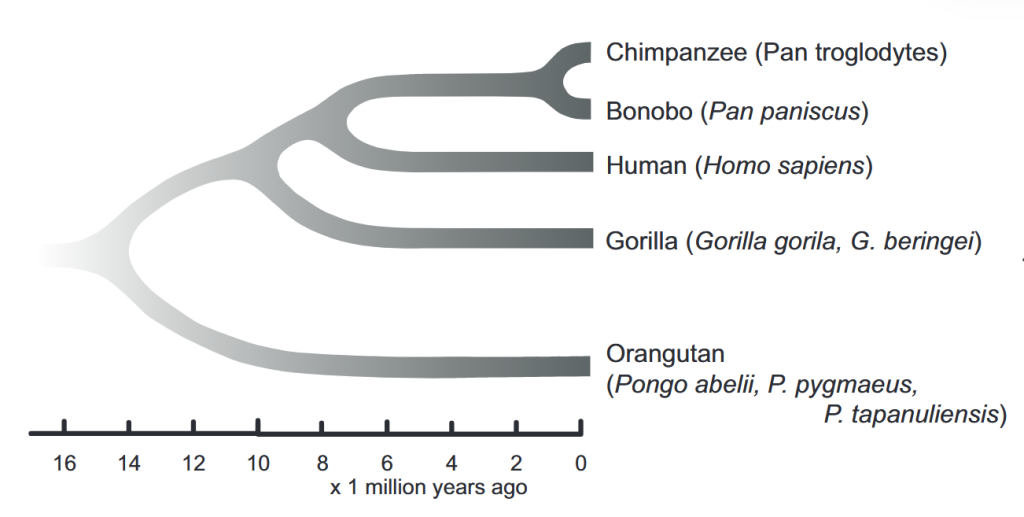
Figure 1 – A phylogeny diagram showing the genetic divergence between the chimpanzee and the bonobo approximately 2 million years ago (Furuichi 2019).
There are many hypotheses to explain why SSSB occurs. One is that it builds positive social bonds, and the other is that it minimizes conflict (Gómez et al. 2023). Bonobo communities have a flexible hierarchy in which a female bonobo typically leads the group. Young female bonobos have been documented approaching other females and facilitating genito-genital contact and rubbing in exchange for food (Blount 1990). Older females will also protect younger or low-ranking females from unwanted male attention or aggression. This is different from adult female chimpanzees, who rarely establish coalitions strong enough to influence group decisions. Young female bonobos who receive male aggression will follow an older bonobo female, and the two may engage in genito-genital rubbing. Additionally, the older female’s son will often reproduce with the younger females who follow his mother, thus increasing the older female’s offspring. This benefits both the older female and her son, as he has the opportunity to obtain more mates, and both their social ranks will increase. (Furuichi 2019).
Serious violence occurs infrequently in bonobo communities and is usually defused before escalation through play, grooming, or sex, including same-sex sexual acts. This resolves agonistic conduct and prevents conflicts from turning more hostile (Furuichi 2019).
Furthermore, young bonobos will observe older group members to learn important life skills. When a young bonobo sees the older bonobos engaging in SSSB to diffuse a conflict, they will mimic that behaviour when encountering a similar situation. Thus, SSSB is negatively reinforced when they successfully remove the unpleasant stimulus of tension and conflict. This learning process is known as operant conditioning, specifically negative reinforcement, where homosexual acts increase in likelihood of behaviour occurring in order to decrease the unwanted stimulus of tension (Rumbaugh et al., 2017).
The bonobo’s ability to use sex not just for reproduction but as a social tool highlights that homosexuality is not just an evolutionary puzzle but also an important aspect of their lives.
References
Anderson, Karyn A., Julie A. Teichroeb, Malcolm S. Ramsay, Iulia Bădescu, Sergi López-Torres, and James K. Gibb. 2024. “Same-Sex Sexual Behaviour Among Mammals Is Widely Observed, yet Seldomly Reported: Evidence from an Online Expert Survey.” PLOS ONE 19 (6). https://doi.org/10.1371/journal.pone.0304885.
Blount, Ben G. 1990. “Issues in Bonobo (Pan Paniscus) Sexual Behavior.” American Anthropologist 92 (3): 702–14. https://doi.org/10.1525/aa.1990.92.3.02a00100.
Furuichi, Takeshi. 2019. Bonobo and Chimpanzee: The Lessons of Social Coexistence. First edition. Primatology Monographs. Springer Singapore. https://doi.org/10.1007/978-981-13-8059-4.
Gómez, José M., A. Gónzalez-Megías, and M. Verdú. 2023. “The Evolution of Same-Sex Sexual Behaviour in Mammals.” Nature Communications 14 (1): 5719. https://doi.org/10.1038/s41467-023-41290-x.
Hare, Brian, Shinya Yamamoto, and Cahn Claude, eds. 2015. Bonobo Cognition and Behaviour. Brill.
Mailund, Thomas, Anders E. Halager, Michael Westergaard, et al. 2012. “A New Isolation with Migration Model along Complete Genomes Infers Very Different Divergence Processes among Closely Related Great Ape Species.” PLoS Genetics 8 (12). https://doi.org/10.1371/journal.pgen.1003125.
Muller, Martin N., and Richard W. Wrangham, eds. 2009. Sexual Coercion in Primates and Humans: An Evolutionary Perspective on Male Aggression Against Females. Harvard University Press.
Rumbaugh, Duane M., and David A. Washburn. 2003. Intelligence of Apes and Other Rational Beings. First edition. Yale University Press. https://doi.org/10.12987/9780300129359.
Waal, Frans B. M. de. 1998. Bonobo: The Forgotten Ape. First edition. University of California Press. https://doi.org/10.2307/jj.8501033.


Leave a Reply
You must be logged in to post a comment.