Within the population of USA, Alzheimer’s Disease (AD) disproportionately affects women a lot more, with 2/3 of the overall cases being women (Association 2016). In fact, through numerous studies, it was found that sex, after age, was the most determining factor in Alzheimer’s risk (Subramaniapillai et al. 2021). This is because women are more impacted negatively by factors that increase their risk of Alzheimer’s Disease, including certain hormones, proteins, and neural processing, for reasons that are currently being explored by science but are inconclusive, as most studies focused on male bodies and extrapolated to female bodies, rather than differentiating data by sex.
A prevalent risk factor in both women and men for AD is the effects of the apolipoprotein E ε4 allele, which plays a significant role in the redistribution of cholesterol and the myelination of neurons in the central nervous system. An increase in the concentration of this protein is linked with normal aging, as well as chronic and inflammatory diseases in the CNS (Torreilles and Touchon 2002). However, the effect of the allele varies between genders. Women in their 60’s who have two alleles of the +APOE-ε4 gene have a higher risk of AD than their male counterparts (Henderson and Authors and Affiliations 1999), for reasons that are currently still being explored through newer studies.
Another risk factor that is linked with higher rates of Alzheimer’s Disease in women is if a woman’s body has lower levels of hormones that are produced by the ovaries, such as estrogen and progesterone (Fox et al. 2013). Estrogen is especially important as through various studies, it has been shown to inhibit amyloid-plaque β, which is the main driving force behind Alzheimer’s Disease as it interrupts neural pathways in the cerebral cortex and hippocampus regions of our brains (Figure 1). In addition, estrogen helps to drive the removal of this plaque, inhibits neural apoptosis (i.e. cell death), and reduces brain inflammation. However, as women age, lower levels of progesterone and estrogen can be caused by various scenarios, such as if a woman had to have their ovaries surgically removed or if they experience menopause early, which causes the concentration of these hormones to drop significantly and therefore affect how well the brain is able to mitigate AD risk without the help of these ovarian hormones.
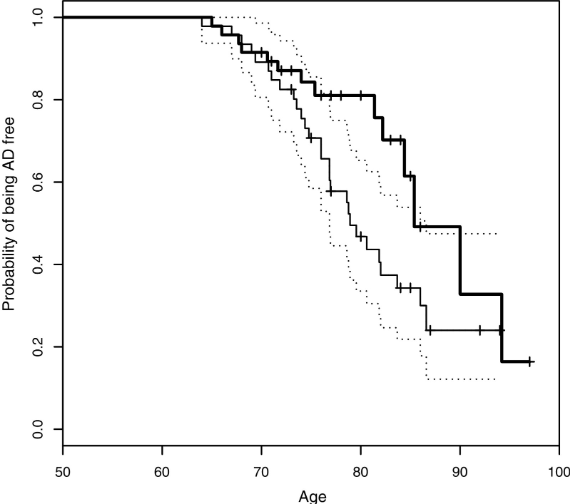
Figure 1: Graph showing the correlation between age and probability of being AD-free. The bolded upper curve shows that women with more months of estrogen exposure have higher chances than the median population of being AD-free as they age.
These factors are some of the main physiological differences between the female and male bodies which can help to explain why many more cases of Alzheimer’s Disease exist in women than in men. Aside from this, the bias that was present throughout history in scientific study had previously made finding information about Alzheimer’s Disease in women difficult for both patients themselves and caregivers (Association 2016). However, as science becomes more comprehensive, there are numerous opportunities for Alzheimer’s Disease symptoms to improve for all those affected.
References
Association, Alzheimer s. 2016. “Women and Alzheimer’s | Alzheimer’s Association.” Alzheimer’s Association. https://www.alz.org/alzheimers-dementia/how-alzheimers-impacts-different-groups/women#womenatrisk.
Fox, Molly, Carlo Berzuini, and Leslie A. Knapp. 2013. “Cumulative Estrogen Exposure, Number of Menstrual Cycles, and Alzheimer’s Risk in a Cohort of British Women.” Psychoneuroendocrinology 38 (12): 2973–82. https://doi.org/10.1016/j.psyneuen.2013.08.005.
Henderson, P. M. Bretsky J. G. Buckwalter T. E. Seeman C. A. Miller J. Poirier G. D. Schellenberg C. E. Finch V. W., and Authors and Affiliations. 1999. “Evidence for an Interaction Between… : Alzheimer Disease & Associated Disorders.” Ovid. https://www.ovid.com/jnls/alzheimerjournal/pdf/00002093-199910000-00007~evidence-for-an-interaction-between-apolipoprotein-e.
Subramaniapillai, Sivaniya, Anne Almey, M. Natasha Rajah, and Gillian Einstein. 2021. “Sex and Gender Differences in Cognitive and Brain Reserve: Implications for Alzheimer’s Disease in Women.” Frontiers in Neuroendocrinology 60 (100879): 100879. https://doi.org/10.1016/j.yfrne.2020.100879.
Torreilles, François, and Jacques Touchon. 2002. “Pathogenic Theories and Intrathecal Analysis of the Sporadic Form of Alzheimer’s Disease.” Progress in Neurobiology 66 (3): 191–203. https://doi.org/10.1016/S0301-0082(01)00030-2.


Leave a Reply
You must be logged in to post a comment.