What’s your favorite board game? When was the last time you picked one up? Board games are one of the greatest inventions ever created by humans. Not only do they span across cultures from The Royal Game of Ur in what is now Iraq (Raposo and Lamont 2023) to the tafl games of north-western Europe (Duggan 2021) to Go in China (Durrant et al. 2016) but they are also amazing vehicles to convey immersive narratives, mediate social interaction and engage the mind in hyper specific ways. They aren’t just fun and exciting ways to pass the time, but they also have potential to help in several disorders. Two of these examples are aiding in reducing some ADHD symptoms and slow the cognitive decline that comes with aging.
Though there are many board games out there that exist within an enormous range of both depth of strategy and component complexity, not all of these board games can be introduced to every audience and cannot always be easily accessible. This has lead chess and Go to be appealing choices for studies as they have minimal component complexity and enormously deep strategies. They have been used as potential therapeutic solutions for ADHD in addition to more traditional methods due to their lack of down sides and inconsequential price (Agarwal 2023). A 2014 study by Kim et al. found that after 16 weeks of learning Go a group of 42 children with ADHD had their overall ADHD rating scale (ARS) decrease significantly (Kim et al. 2014). This change came solely from the children’s inattentive sub score while the hyperactive score declined but did not change significantly (Figure 1).
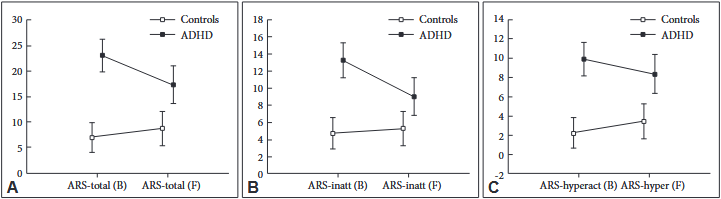
Similarly, chess has been observed to aid in the reduction of ADHD symptoms in children diagnosed with ADHD from ages 6 all the way to 17 (Fereshteh et al. 2021; Blasco-Fontecilla et al. 2016). Though these studies do all point to the same trend they are only indicative of a potential trend as their data pools are small, to establish a clear trend a much larger data pool and many more experiments would have to be performed. In addition, they all utilize different scales when analyzing ADHD symptoms which may lead to related but disparate results. All this means is that it is a blooming new area of research that needs to be explored.
On the complete other end of the spectrum, modern board and card games are also being investigated to aid in the healthy aging process of elderly people. This feels quite intuitive, with both the social aspect to playing board games as well as the mental exercise it provides it seems like it would be a great solution to maintaining healthy brain function. Excitingly, this seems to be exactly what we see. A 2013 study found that of the elderly people who participated in the 20 year long study, the ones who played board games were at a lower risk of developing dementia by about 15% (Figure 2)(Dartigues et al. 2013)!
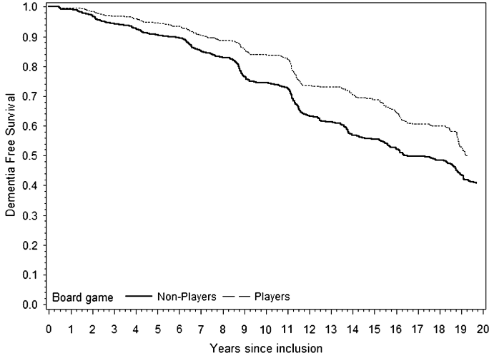
This is not only a huge decrease but it could provide some insight into combatting dementia. The participants who did not play board games before the experiment also reported to experience more depressive symptoms and had lower baseline cognition when the experiment started. This could suggest that playing board games regularly before the age of 65 (the start of the elderly category in this study) could contribute significantly to the long-term health of individuals. Whether that has to do with the social and relationship building aspect of games or the actual mental load that needs to be processed remains a fascinating area of science to explore. Other studies have also suggested similar trends with more specific neurological abilities but have also raised the possibility that because of this targeting of specific areas of brain activity a wide variety of activities, both board games and non-board game related, might be able to significantly aid in the healthy aging process (Estrada-Plana et al. 2021). With aging being such a huge part of life both in the minds of younger people and the bodies of the elder, we all want to keep experiencing life to the fullest of our abilities with people who bring us joy and board games might just be an amazing way to do that.
In conclusion, board games are so heavily overlooked when it comes to forms of media, they are a fantastic way to experience narrative fiction that directly involves you and people you care about. It has the potential to allow you to better regulate yourself as well as meaningfully connect with others. It still requires a ton more research to be able to say definitively if it meaningfully affects the physical structure of the brain or simply the mental health of the person engaging with them or neither. But for the extremely low cost and amazing potential benefits, why not get some friends together and play a game of scrabble?
References
Agarwal, Neilay Krishna. 2023. “Evaluating the Effectiveness of Chess as a Therapeutic Tool in the Comprehensive Management of ADHD.” Journal of Mind and Medical Sciences 10 (2): 191–95. https://doi.org/10.22543/2392-7674.1405.
Blasco-Fontecilla, Hilario, Marisa Gonzalez-Perez, Raquel Garcia-Lopez, et al. 2016. “Efficacy of Chess Training for the Treatment of ADHD: A Prospective, Open Label Study.” Revista De Psiquiatria Y Salud Mental 9 (1): 13–21. https://doi.org/10.1016/j.rpsm.2015.02.003.
Dartigues, Jean François, Alexandra Foubert-Samier, Mélanie Le Goff, et al. 2013. “Playing Board Games, Cognitive Decline and Dementia: A French Population-Based Cohort Study.” Epidemiology. BMJ Open 3 (8): e002998. https://doi.org/10.1136/bmjopen-2013-002998.
Duggan, Eddie. 2021. “A Game on the Edge: An Attempt to Unravel the Gordian Knot of Tafl Games.” Board Game Studies Journal 15 (1): 99–132. https://doi.org/10.2478/bgs-2021-0005.
Durrant, Stephen, Wai-yee Li, and David Schaberg, trans. 2016. Zuo Tradition Zuozhuan 左傳. University of Washington Press.
Estrada-Plana, Verónica, Roger Montanera, Ana Ibarz-Estruga, et al. 2021. “Cognitive Training with Modern Board and Card Games in Healthy Older Adults: Two Randomized Controlled Trials.” International Journal of Geriatric Psychiatry 36 (6): 839–50. https://doi.org/10.1002/gps.5484.
Fereshteh, Amouzadeh, Honarmand Peyman, Moghadam Zadeh Ali, and Rostami Reza. 2021. “The Impact of Commercial and Educational Computer Games on the ADHD Symptoms in Students with ADHD.” Alborz University Medical Journal 10 (3): 285–96.
Kim, Se Hee, Doug Hyun Han, Young Sik Lee, Bung-Nyun Kim, Jae Hoon Cheong, and Sang Ho Han. 2014. “Baduk (the Game of Go) Improved Cognitive Function and Brain Activity in Children with Attention Deficit Hyperactivity Disorder.” Psychiatry Investigation 11 (2): 143–51. https://doi.org/10.4306/pi.2014.11.2.143. Raposo, Diego J., and Padraig X. Lamont. 2023. “Mathematical Analysis of the Royal Game of Ur.” Board Game Studies Journal 17 (1): 1–46. https://doi.org/10.2478/bgs-2023-0001.


Leave a Reply
You must be logged in to post a comment.