Why have you been so sad eating dining hall food every day? It’s not just the lack of seasoning; the diversity in your gut bacteria might be as slim as your dinner options. The gut-brain axis is a two-way communication pathway facilitated by the vagus nerves which allow for the brain and gastrointestinal system to exchange physiological and psychological activity occurring in the body (Wang et al. 2025). It is widely understood that a nutritional diet aids an individual’s physical health, but it is not often correlated with mental health benefits directly. However, building a diverse gut microbiome through a rich variety of foods improves mental health by physically impacting the bacteria in the intestines. Eating a wide range of nutritional foods increases the number of beneficial bacteria and represses harmful ones (Dinan 2023).
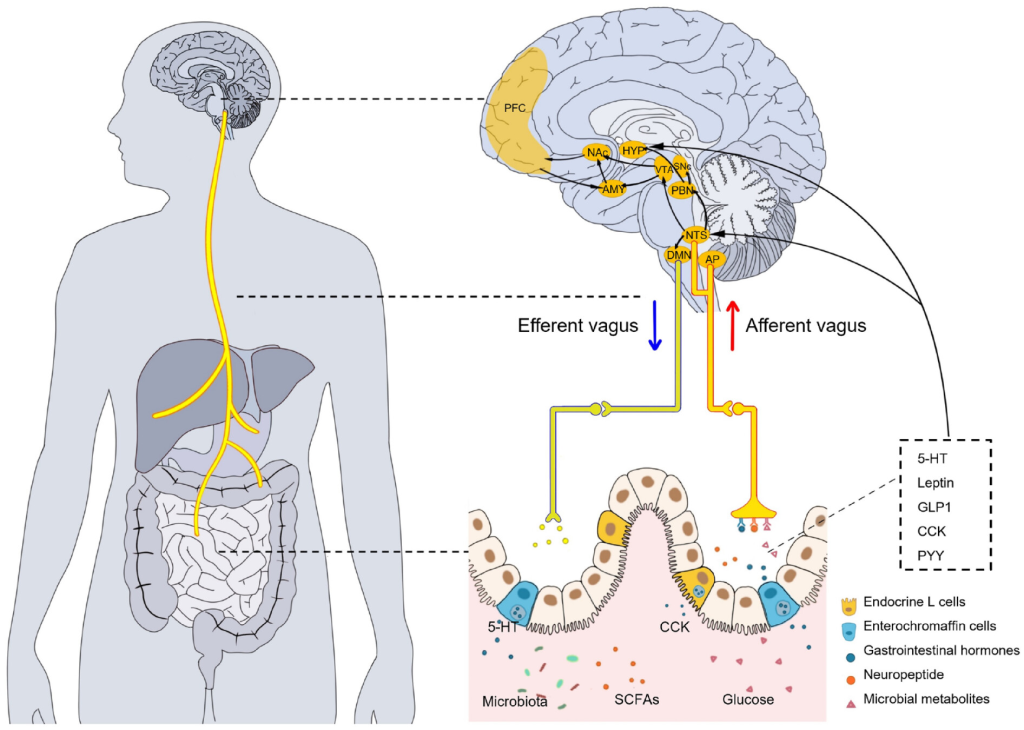
The vagus nerves facilitate communication between the gut and brain. The afferent vagus nerves sense stimuli from the gastrointestinal tract including nutrients and hormones. These signals are then sent to the brain through the vagus nerve and the signal is formed in the hypothalamus. The efferent vagus nerve transmits a response signal from the brain back to the gut (Wang et al. 2025).
Beneficial bacteria refer to specific species of organisms in the microbiome capable of synthesizing tryptophan: an essential amino acid in the process of serotonin synthesis in the brain. Tryptophan produced by gut bacteria such as Escherichia coli travels to the brain through the gut-brain axis, allowing for the synthesis of serotonin (Martinez-Gomez et al. 2012). Tryptophan is one of the nine amino acids humans cannot independently synthesize, and with the assistance of gut bacteria the synthesis of serotonin occurs in greater abundance.
Similarly, harmful bacteria are microorganisms in the intestines hypothesized to have a direct correlation to clinical depression. A 2024 study comparing the stool samples of individuals with diagnosed depression and healthy individuals found that the Firmicutes phylum of bacteria was found in every individual of the depressed group, and in none of the control group (Arbabi et al. 2024). This does not suggest that the bacteria are solely responsible for the depression diagnosis but instead draws a correlation between mental health and the species of bacteria living in the gut microbiome.
The gut microbiome is an ecosystem that thrives on a high level of diversity. By eating a variety of probiotics, prebiotics, and dietary fibre, humans can aid their gut microbiome by creating favourable conditions for beneficial bacteria growth. If the gut microbiome is a diverse and stable system, it can persist through infection of a harmful bacterial species or a few bad meals (Ebel et al. 2026). However, frequent consumption of artificial sweeteners and preservatives can suppress the growth of good bacteria significantly, making balance in a diet crucial (Xiong et al. 2023).
Overall, a nutritional diet full of natural, whole foods significantly impacts one’s mental health by physically nourishing the gut microbiome which works in our favour when it eats sufficiently. By feeding good bacteria and helping it multiply, we reap the benefits of a greater increase in serotonin, and potential natural treatments for mental disorders.
References
Arbabi, Fatemeh, Reza Shapoury, Fakhri Haghi, Habib Zeighami, and Reza Pirzeh. 2024. “Investigating the Bacterial Profiles of Lactobacillus, Bifidobacterium, Actinobacteria, Fusobacterium, Firmicutes, and Bacteroides in Stool Samples from Patients with Severe Depression and Healthy Individuals.” Psychoneuroendocrinology 170 (December): 107090. https://doi.org/10.1016/j.psyneuen.2024.107090.
Dinan, Timothy G. 2026. “Key Role of Nutrition in Mental Health.” Irish Journal of Psychological Medicine, February 2, 1–2. https://doi.org/10.1017/ipm.2026.10180.
Ebel, Emily R., Abhijit Sanjiv Kulkarni, Dattatray S. Mongad, et al. 2026. “Gut Microbiomes of Tribal Communities in India Vary with Dairy and Grain Consumption.” Gut Microbes 18 (1): 2694242. https://doi.org/10.1080/19490976.2026.2694242.
Martínez-Gómez, Karla, Noemí Flores, Héctor M. Castañeda, et al. 2012. “New Insights into Escherichia Coli Metabolism: Carbon Scavenging, Acetate Metabolism and Carbon Recycling Responses during Growth on Glycerol.” Microbial Cell Factories 11 (1): 46. https://doi.org/10.1186/1475-2859-11-46.
Wang, Yiyang, Chenxi Duan, Xinyi Du, et al. 2025. “Vagus Nerve and Gut-Brain Communication.” The Neuroscientist 31 (3): 262–78. https://doi.org/10.1177/10738584241259702.
Xiong, Ruo-Gu, Jiahui Li, Jin Cheng, et al. 2023. “The Role of Gut Microbiota in Anxiety, Depression, and Other Mental Disorders as Well as the Protective Effects of Dietary Components.” Nutrients 15 (14): 3258. https://doi.org/10.3390/nu15143258.
Comments
7 Responses to “A Gut Feeling: The Relationship Between Your Microbiome and Mental State”
Hi Joud,
This is a really interesting blog post! I have a few suggestions to help you in your editing process:
– I encourage you to add a figure to your post; it can help explain some of your content visually.
– P3S1, you have an extra space at the beginning of the sentence.
– Don’t forget to add a comment below your post to mention why you chose this topic!
Good luck!
– Harshita
Hello Harshita,
Thank you for reading my blog! I agree with your tips and have made the suggested changes.
Best,
Joud
Hi Joud,
This was a very fascinating blog post. Here are a few suggestions:
P1, S4: This sentence mentions that a nutritional diet is not often correlated with mental health benefits. However, the second sentence immediately goes into building a diverse gut microbe. I’m wondering if you can add a sentence in between these to improve the transition.
P2, last sentence: perhaps you can say “occurs in greater abundance” rather than “is in greater abundance” to improve flow. Also, consider adding a figure after this paragraph to illustrate how the gut bacteria synthesize tryptophan and how that connects to serotonin synthesis.
Also, don’t forget to make a comment about how your post connects to something in iSci or what sparked your idea for this blog!
Happy editing,
Ria
Hi Ria,
Thank you for commenting! I have made the suggested changes, and have added a figure to a different part instead, which I felt better aligned with the overall topic of the blog. I appreciate the suggestions.
Best,
Joud
Hi iSci,
I decided to write this blog after our recent lecture on extremophiles in 1A24. The idea of organisms thriving in unusual environments intrigued me, and the psychological connection of the gut to the brain ties into our lessons in psych about neuronal communication. Thank you for reading!
Joud 🙂
Hi Joud!
I found this a really interesting read! I knew of the gut-brain connection, but I didn’t really know about it. It sounds a lot more interesting than I originally thought. Plus, I loved your connection to the dining hall food; I thought it made your piece quite engaging for your audience. Here are some of my suggestions:
P3: I liked your comparison study, but when I originally read it, I didn’t quite grasp that the Firmicutes phylum was actually a “bad” bacterium, as you said when you explained it to me in person. Maybe that paragraph would benefit from having a sentence that expresses that a little clearer!
P4S3: If your word count permits, I think it would be interesting to maybe explicitly state why artificial sweeteners and preservatives suppress bacterial growth, plus it could be a good interdisciplinary link to chemistry!
I also think adding a picture could help with the engagement and comprehension of your blog too!
Overall, I really enjoyed reading your post! Thanks for sharing 🙂
Claire
Hi Claire,
Thanks for reading my blog. I’ve edited P3 to hopefully make it clearer and have added a figure. I agree with the benefit of expanding on the danger of artificial sweeteners, but I unfortunately think it would stray away from the topic too much for my word count to allow it. I appreciate your feedback!
Best,
Joud