Unfortunately, cow feces aren’t very tasty or appealing in our world, and typically when thinking of waste, all that is seen is useless byproducts or even pollutants with no immediate use. However, just as humans have found a practical use for manure, it seems the rare ecosystems of extremophiles have beat humans to the punch. Many rare bacteria and archaea have evolved to survive extreme and specific conditions, thanks to their versatility and speedy evolutionary properties, which is why we see so many unique kinds of metabolisms different from the more familiar glucose pathways.
In 2025, researchers at the University of British Columbia discovered a new species of bacterium called Syntrophacetatiphaga salishiae (STPS) (Timmers et al. 2018), which roughly translates to ‘syntrophic organism that eats acetate from another organism.’ Acetate is a commonly seen salt, and is even the main component in vinegar as its conjugate base, so it seems very different from glucose which we use in our metabolic processes. However, through syntrophic acetate oxidation a bacteria can “oxidize acetate and produce H2 and CO2, or formate… [where they] can serve as interspecies electron carriers” by their partner species, according to the study Metabolism and Occurrence of Methanogenic and Sulfate-Reducing Syntrophic Acetate Oxidizing Communities in Haloalkaline Environments.
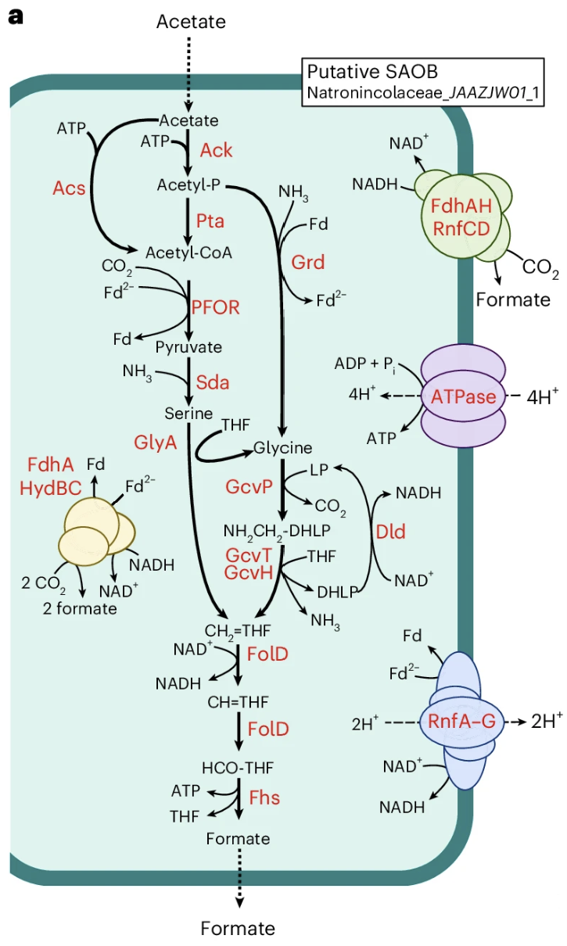
In this kind of metabolism, where the starting source is carbon based, acetate is oxidized into acetyl coenzyme A, then into pyruvate which is similar to pyruvate oxidation in more commonly known carbohydrate metabolism, except in this system the reactions operates in the reverse direction. Cellular electron carriers accept electrons from the redox reactions in the process and carry them to the further down reactions, and finally forms formate, which is the final product of its metabolism, which can be seen in Figure 1. Interestingly though, the formate STPS ‘poops’ out is then used as the electron carrier for another organism in its ecosystem.
STPS is not an organism to underestimate, it is essential to its ecosystem. The study that discovered it also noted how crucial of a role it plays in its delicate ecosystem: “[STPS] accounted for a majority of acetate flux, suggesting that the oxidative glycine pathway is an important route for anaerobic carbon transformation and is probably central to community metabolism in natural and engineered ecosystems” (Friedline et al. 2025). All of this contributes to a fragile syntrophic system; fermenting bacterium break down food waste into smaller substances like fatty acids or amino acids (including acetate), then STPS, an anoxic bacteria, consumes the acetate to make formate, which other anoxic bacterium will use that formate to make methane which is either released for the ecosystem, or can potentially be harvested as a natural gas resource.
In conclusion, STPS’s as a microorganism cooperating with other species in its metabolic processes are incredibly unique and a huge essential in its unique environment for ensuring the health and survival of its ecosystem. Microbial life is persistently adaptable, and humans are still discovering more and more about extreme environments, unique microbe metabolism, and the wonders of syntrophic systems.
References
Friedline, S., McDaniel, E.A., Scarborough, M. et al. Activity-targeted metaproteomics uncovers rare syntrophic bacteria central to anaerobic community metabolism. Nat Microbiol 10, 2749–2767 (2025). https://doi.org.libaccess.lib.mcmaster.ca/10.1038/s41564-025-02146-w
Timmers, Peer H. A., Charlotte D. Vavourakis, Robbert Kleerebezem, et al. “Metabolism and Occurrence of Methanogenic and Sulfate-Reducing Syntrophic Acetate Oxidizing Communities in Haloalkaline Environments.” Frontiers, October 27, 2026. https://doi.org/10.3389/fmicb.2018.03039.
Comments
9 Responses to “One Man’s Poop is Another Man’s Treasure: The Metabolic Systems of Rare Syntrophic Organisms”
Hi iSci,
Thanks for reading my second blog post ever, I was largely inspired by a life science lecture about extremophile organisms and syntrophic relationships, as well as our lecture on thermochemistry and its applications in metabolic processes.
Any feedback would be greatly appreciated!
– Judy H.
Hi Judy,
First of all, very interesting blog post! The title totally hooked me and got me to click, and the introductory sentences really pulled me in as my mind got curious about STPS. I had no idea that such an organism existed so it really peaked my interest.
As a few pieces of small advice:
– I would change P1S1 to “Unfortunately, cow feces aren’t very tasty or appealing in our world, and typically when thinking of waste, all that is seen is useless byproducts or even pollutants with no immediate use.” It helps the sentence flow better and easier to read.
-In P2 you cite (Timmers et al. 2018) towards the end of the paragraph but use information from it in the early sentences. As per Chicago, you should cite after the first sentence that uses resources from (Timmers et al. 2018).
-You don’t have to say “This process is shown in the figure below.” in P3. Rather, it’s better practice to say your paragraph relating to the diagram and put (Figure 1) at the end of the sentence. Usually figures go before the sentence that uses it.
-For your figure caption, change “Figure 1:” to “Figure 1.”
-For the figure I think it would help if you briefly mentioned what the proteins (transporters) are doing in the diagram.
Great job overall.
Happy editing,
Berk 🙂
Thanks for all the insightful advice! I would love to go further into detai; about the metabolic process and its proteins but I’m unfortunately constrained by the word count, so I hope the baseline information is alright, otherwise I definitely made sure to make the changes you recommended!
Hey Judy, I really liked this post. I had never heard of a bacterium that lives off acetate like this, and I thought the way the two organisms depend on each other was the most interesting part. The formate is not wasted here since the partner species uses it, so the process only works when both are there.
I did get a bit lost in the middle part. The steps from acetate to formate come in a few long sentences and I had to slow down. Going through the steps one at a time, like your figure does, might make it easier to follow.
Two small things that might help. Vinegar is mostly acetic acid and not acetate, so that line could be fixed. There are also a few small grammar mistakes near the end. One more read through would clean those up.
Overall I enjoyed reading it and I learned something new.
Thanks Ilyas! I hope my edits made it a bit more readable, and thanks for the advice about the acetate; I made sure to specify its exact role in acetic acid as its conjugate base. I tried my best to simplify and improve the readability of the metabolic process, thank you so much for the feedback!
Hi Judy,
I really enjoyed reading your blog post! I found the concept of microorganisms cooperating to break down waste products into useful resources really interesting. Here are three points of feedback:
1.Consider briefly explaining why STPS is considered a rare organism and what makes its metabolism different from that of more commonly studied bacteria. This would help readers better understand the significance of the discovery.
2.The explanation of acetate metabolism contains several complex steps in a long paragraph. Breaking the process into shorter sentences and explaining how acetate is converted into formate would make the metabolic pathway easier to follow for readers without a strong background in biochemistry.
3.Consider expanding on the potential real-world applications of STPS, particularly in wastewater treatment, anaerobic digestion, or biogas production. Discussing how understanding this organism could improve waste management would help connect the scientific discovery to its broader environmental significance.
Overall, great work exploring a fascinating example of microbial cooperation and the interconnectedness of metabolic systems!
-Tvara
Tvara, thank you so much for your insightful questions! I was really inspired by your prompts to add more information on the study I highlighted from just last year, but since I was confined to a word limit I decided to stick with the information that was relevant to my current course content. Thank you so much for pointing out the run on sentences (bad habit of mine), and I hope my edits made it more readable! Thank you
Hi Judy,
I loved your blog post and especially the title, as it quickly grabbed my attention. I also thoroughly enjoyed learning about the metabolic process of STPS. I just have one suggestion because “Syntrophacetatiphaga Salishiae” should be italicized, as it is the species name, and “Salishiae” should start with a lowercase.
Again, this was a great blog post about an interesting topic, and I look forward to your final draft.
Sophia
Thanks for pointing that out, Sophia, I really appreciate it!