
Imagine falling asleep, becoming aware that you’re dreaming, and being able to answer questions and solve problems. As impossible as it sounds, researchers have shown that lucid dreamers can answer questions during REM sleep and even perform complex tasks within dream environments. But how does lucid dreaming work, why can some people consciously control their dreams, and did this unusual ability serve a greater evolutionary purpose?
A study done by Karen Konkoly PH.D and her team, found that individuals who are asleep and in the midst of a lucid dream (which can be described by the individual as being aware of the fact that they are currently dreaming) can perceive questions from an experimenter and provide answers using electrophysiological signals. Through a process analyzing rapid eye movement (REM), ranging from individuals who often had lucid dreams to those who did not at all, they found that they were able to showcase abilities ranging from analysis of new information, keeping information within their memory, to even computing simple replies to stimulus as seen in Figure 1. Across 6 of the individuals tested (who were in confirmed signal-verified lucid dreamers during REM sleep) were able to correctly answer questions on 29 occasions, much greater than the number of incorrect answers of 5. These replies consisted of distinctive eye movements and facial muscle contractions (Konkoly et al. 2021).
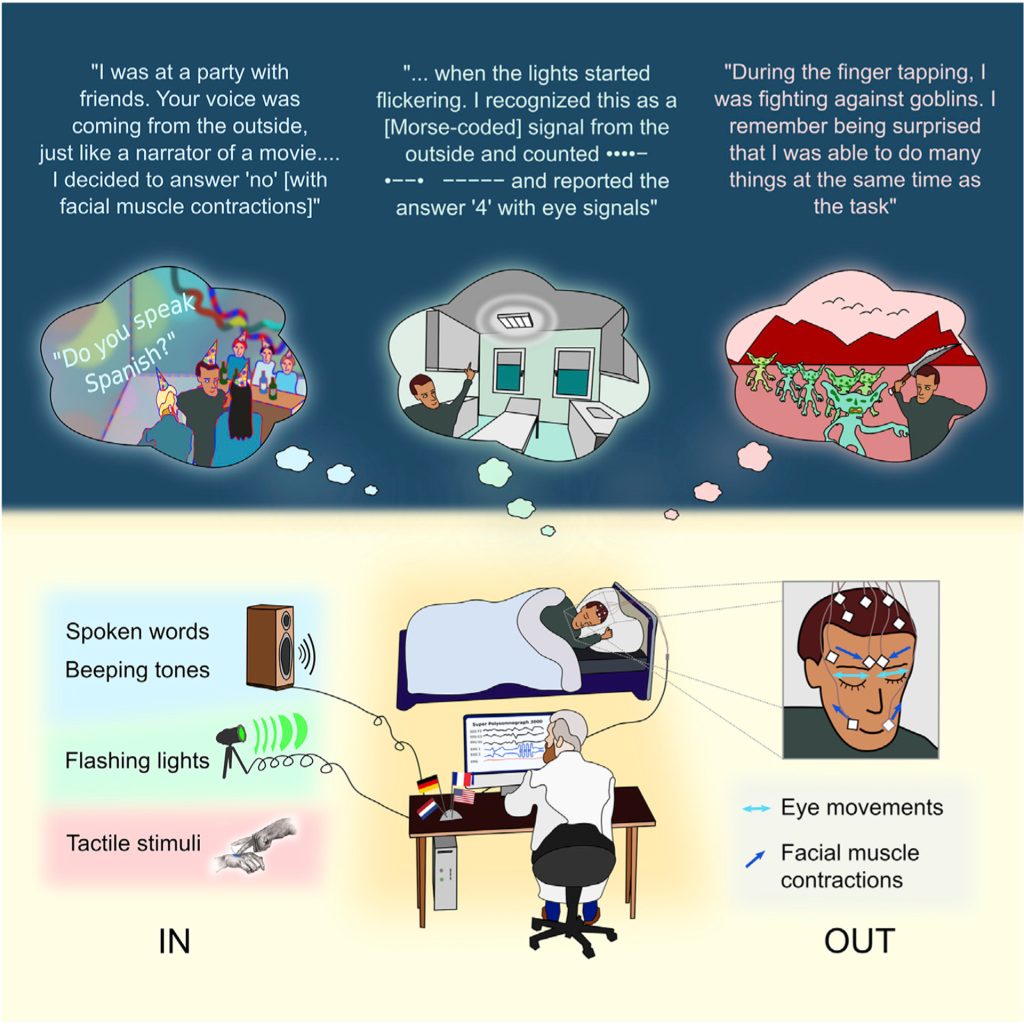
Figure 1: Overview of the experimental setting to test responses (Konkoly et al. 2021)
Some even wonder if we can do tasks while in REM sleep, a thought that researchers at REMspace decided to test. Using participants who were well-versed in lucid dreaming, they used electromyographical (EMG) sensors which detected leg and arm muscle movements and diodes on their eyes to indicate obstacles. This technology was used to convert EMG impulses into controlling a virtual car. Many participants were even able to drive said virtual car, successfully avoiding digital obstacles placed in the simulation (Raduga and Shashkov 2024) as seen in Video 1.
Video 1: Two-way control of a virtual object from a lucid dream (REMspace 2024 )
This leads to another question: how exactly is this able to happen scientifically? The neurobiology of lucid dreaming is still not completely known. A good hypothesis is that in certain areas of the brain, such as the amygdala, medial prefrontal cortex and anterior cingulate cortex, the blood flow increases more than when we are awake or in deep sleep as seen in Figure 2. This higher blood flow matches the highly visual dreams we typically experience during REM sleep. So this sudden shift from dream mode to awake mode may cause a partial activation of our brains, allowing for awareness that the experience is a dream, decision-making inside the dream, responses to external cues or experimenters, or even memory of goals formed while awake (Baird et al. 2020).
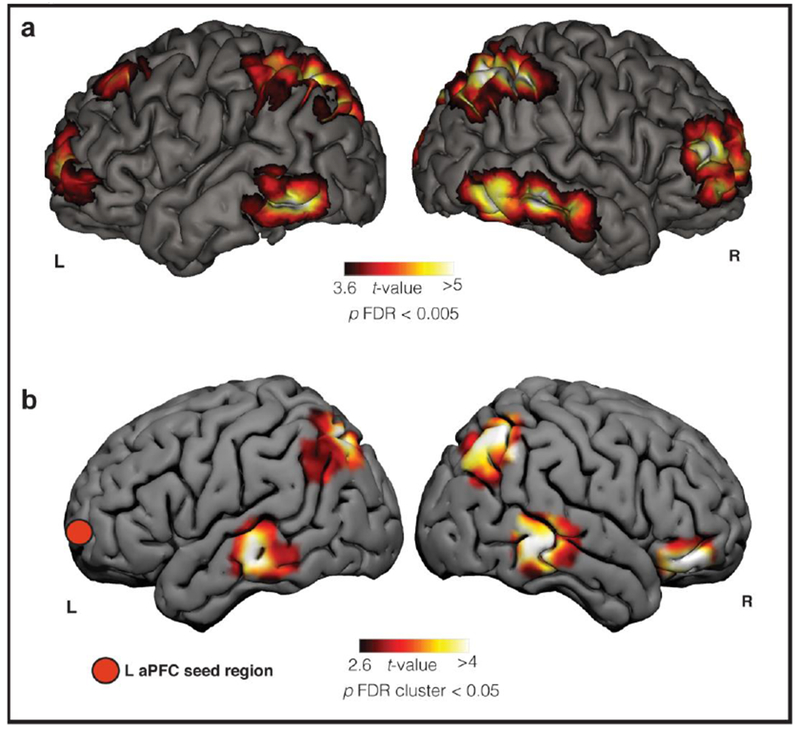
Figure 2: Increased brain activity (in anterior prefrontal cortex) and stronger functional connectivity in regions linked to self-awareness and higher-order cognition during lucid dreaming (Baird et al. 2020)
From an evolutionary standpoint for this phenomenon, we also do not have a certain confirmed answer as to why humans are able to do this. Some theories have arisen to better understand human beings and the vast secrets of our minds. Researcher A. Revonsuo proposed a hypothesis suggesting dreaming evolved as an ancient biological defence mechanism. Within one’s dreams, we are able to construct a complex model of the world, often recreating certain types of waking experiences. He proposed that by simulating dangerous or life-threatening scenarios in a safe environment, the brain allowed ancestral humans to rehearse threat perception, avoidance, and fight-or-flight responses without real-world consequences. We may see examples of this from children’s dreams, recurrent dreams, nightmares, post-traumatic dreams, and the dreams of hunter-gatherer groups (Revonsuo 2000).
Lucid dreaming acts as a bridge from this simulated world to conscious awareness. This is a byproduct of the highly evolved self-reflective consciousness that characterizes humans. Rather than evolving as a trait with a specific adaptive purpose, lucid dreaming may result from metacognition, self-awareness, and executive control becoming active during sleep, allowing individuals to recognize that they are dreaming and, in some cases, influence the dream experience. This suggests that lucid dreaming may reflect the unique capacity of the human brain to monitor and reflect upon its own mental states, even while asleep (Mota-Rolim et al. 2021). While many questions remain unanswered, lucid dreaming demonstrates that the boundary between wakefulness and sleep is far more complex than once imagined.
References
Baird, Benjamin, et al. “The cognitive neuroscience of lucid dreaming.” National Library of Medicine, National Library of Medicine, 1 May 2020, https://pmc.ncbi.nlm.nih.gov/articles/PMC6451677/. Accessed 23 October 2026. https://doi.org/10.1016/j.neubiorev.2019.03.008
Konkoly, Karen R., et al. “Real-time dialogue between experimenters and dreamers during REM sleep.” PMC, 28 May 2021, https://pmc.ncbi.nlm.nih.gov/articles/PMC8162929/. Accessed 28 October 2026. https://doi.org/10.1016/j.cub.2021.01.026
Mota-Rolim, Sergio A., et al. ““Is this a Dream?” – Evolutionary, Neurobiological and Psychopathological Perspectives on Lucid Dreaming.” Frontiers, Frontiers in Psychology, 8 February 2021, https://www.frontiersin.org/journals/psychology/articles/10.3389/fpsyg.2021.635183/full. Accessed 23 October 2026. https://doi.org/10.3389/fpsyg.2021.635183
Raduga, Michael, and Andrey Shashkov. “Two-way control of a virtual avatar from lucid dreams.” OSF, 20 June 2024, https://osf.io/preprints/psyarxiv/xzmwh_v1. Accessed 28 October 2026. https://doi.org/10.31234/osf.io/xzmwh
REMspace. “Two-way control of a virtual avatar from lucid dreams Post author.” REMspace, REMspace, 2024, https://remspace.net/blog/two-way-control-of-a-virtual-avatar-from-lucid-dreams/.
Revonsuo, A. “The reinterpretation of dreams: an evolutionary hypothesis of the function of dreaming.” National Library of Medicine, National Library of Medicine, 23 December 2000, https://pubmed.ncbi.nlm.nih.gov/11515147/. Accessed 23 October 2026. https://doi.org/10.1017/s0140525x00004015
Comments
9 Responses to “Dreaming? Yes. Conscious? Also Yes.”
Hey everyone!
Through our psychology lecture on the different parts of the brain and the life science lectures we had on evolution, I wanted to use these lenses to uncover how it, is possible for some individuals to become consciously aware while they are asleep. Lucid dreaming stood out to me because it combines many research driven displines to help explain a fascinating phenomenon that I have experienced myself! I was especially interested in learning not only how the brain can allow people to interact with the outside world while dreaming, but also whether this unusual ability could reveal something about why dreams evolved in the first place. Hope you guys enjoy reading it!
– Aanya
Hey Aanya, I really enjoyed this post. I thought the two way communication study was the most interesting part. The idea that someone can be fully asleep and still answer questions with eye movements is hard to wrap my head around, and the virtual car study after it made it even wilder.
One thing I wanted to know more about was the numbers in that first study. You said there were 29 correct answers across 6 people, but not how many people or tries there were in total. Adding that would help the reader tell how strong the result really is.
The virtual car part also got a bit confusing near the end. I was not sure what the diodes on their eyes were doing, and the last sentence ends with “or both” without saying what both means. A short line explaining that part would help.
Overall it was a fun read and the evolution section tied it together well.
Thanks for the feedback!
Hey Aanya,
Fantastic blog. I just had a few nit picky points of feedback:
+ I’d remove the extra bolding on your Video 1 caption
+ Change Works Cited –> References or Bibliography
+ Make sure your in-text citations has the year included –> “(Smith et al. 2020)”
+ Your reference list seem a bit oddly formatted, make sure everything is in the isci format (Chicago Manual of Style (Author-date) 18th Edition). I normally use MyBib or Zotero:))
Amazing job overall!
Happy editing,
– Amy
Thank you so much for the feedback!
Hi Aanya
Great blog post1 I found it incredibly interesting learning about REM sleep
In P1, I think you could get rid of “while your fast asleep” cause you already state that with “imagine falling asleep”
Maybe instead of saying “a study” in P2, state what that study is. For example “ a study conducted by…”
Besides that, this was an amazing blog post,
Happy editing
Brianna
Thank you for the feedback!
Hi Aanya,
I found your blog post really interesting and well-written. For such a mind-boggling topic, I think you did a great job executing it. I was particularly intrigued by the video and sections about how people can control and drive cars in lucid dreams! Just a few comments:
I think a little more explanation is needed for your graph in figure 1, as there is a lot of text on it. A quick description of what the graph shows, conditions, and results could really help readers.
In P4 S2, “A key idea that is a good hypothesis” sounds a bit redundant. I think it would be better to simplify it to just one part. For example, either “A key hypothesis” or “A key idea.”
For Figure 2, I think it would also help to explain which specific parts of the brain show increased activity in each panel (A, B, C, and D). This would make the figure easier to understand.
Overall, top 3 blog posts I’ve read. Good job and happy editing
Thanks for the feedback!