There are many different theories that describe the placebo effect, but in general, the placebo phenomenon uses a subject’s past associations with certain stimuluses like smell, touch and sound to mislead their beliefs on the effects of an administered treatment (Vase and Wartolowska 2019). Placebos have been most often used as a control group for clinical studies, however there is interesting potential in using this psychological tactic to treat certain conditions in a non-invasive manner (Vase et al. 2002). The efficacy of the tactic varies based on the subject’s previous experiences and the presentation of the treatment. This efficacy measure is known as the placebo response, and it is records the change in pain of a patient before and after receiving the placebo treatment (Vase and Wartolowska 2019). Within the sphere of placebo response, the placebo effect refers to the psychobiological factors affecting the patients response (Benedetti and Shaibani 2025).
It has been found that response is highly affected by the verbal explanation that accompanies the placebo administration and prior experience with the treatment the patients are being deceived about. As described by Vase and Wartolowska (2019), patients told that they may be receiving a placebo or a real treatment had a lower placebo response to those told that they are receiving an actual treatment.
This observation relates to the three main methods of placebo deliverance. Natural history, where the subjects are told nothing about the treatment they are receiving. Double blind administration, where the participants are told they could be receiving a placebo or an actual treatment, and finally deceptive administration where the patient is fully mislead on the contents of their treatment (Pollo et al. 2001).
From a biological point of view, brain imaging shows that the anticipation of a placebo, namely the double-blind administration, activates the lateral prefrontal cortex, which is associated with task selection and decision-making processes. Conversely, pain relief after deceptive placebo administration shows decreased activity in pain processing areas of the brain (Vase and Wartolowska 2019).
This imaging has been substantiated through many clinical trials, including a study by Pollo et al. (2001). Their study recorded doses of pain medication requested by patients under the placebo of actually being a saline basal injection instead of buprenorphine- a pain treatment opioid. The trial had three groups separating into the three deliverance methods mentioned above. All three groups originally received the pain killer and were then switched to an alternation of placebo and buprenorphine without their knowledge after three days.
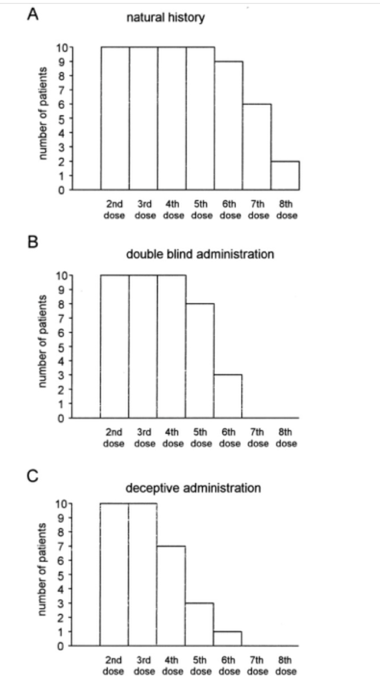
Figure 1: Received doses of Buprenorphine by patients after requesting additional pain medication. In the natural history method, patients were told they were originally receiving a rehydrating solution and requested the most doses of buprenorphine throughout the testing period. The double-blind group was told they may be receiving a pain killer or placebo, and averaged fewer doses than the natural history group. Lastly, the deceptive administration group was told that they were receiving a strong pain killer and requested the fewest number of does during the trial period (Pollo et al. 2001).
From these results, it can be concluded that deceptive verbal accompaniment to placebo administration is often the most successful in terms of placebo response. This knowledge is helpful when looking at clinical applications of the placebo phenomenon. Currently, the main clinical applications are highly centred around analgesic responses, however there is also evidence that applying using the placebo effect through mock surgical procedures can yield high placebo response (Vase et al. 2002). This presents innovative gateways into research on potential non-invasive treatments in lieu of some current clinical treatments.
References
Benedetti, Fabrizio, and Aziz Shaibani. 2025. ‘Chapter 1 – A Brief History of Placebo’. In Placebo Effects in Neurology, edited by Fabrizio Benedetti and Aziz Shaibani, vol. 213. Handbook of Clinical Neurology. Elsevier. https://doi.org/10.1016/B978-0-443-29884-4.00009-1.
Pollo, Antonella, Martina Amanzio, Anna Arslanian, Caterina Casadio, Giuliano Maggi, and Fabrizio Benedetti. 2001. ‘Response Expectancies in Placebo Analgesia and Their Clinical Relevance’. Pain 93 (1): 77–84. https://doi.org/10.1016/S0304-3959(01)00296-2.
Vase, Lene, Joseph L. Riley, and Donald D. Price. 2002. ‘A Comparison of Placebo Effects in Clinical Analgesic Trials versus Studies of Placebo Analgesia’. Pain 99 (3): 443–52. https://doi.org/10.1016/S0304-3959(02)00205-1.
Vase, Lene, and Karolina Wartolowska. 2019. ‘Pain, Placebo, and Test of Treatment Efficacy: A Narrative Review’. British Journal of Anaesthesia 123 (2): e254–62. https://doi.org/10.1016/j.bja.2019.01.040.

Leave a Reply
You must be logged in to post a comment.