Rice is NOT Nice: How Ancient Rice Domestication Led to “Asian Flush”

For many, a night out might mean unwinding with friends, laughing, and getting a little tipsy. But for me, and many other East Asians, that picture quickly shifts to turning bright red after just a few sips. Commonly known as “Asian flush”, this reaction often causes symptoms including a vividly flushed red face, increased heartbeat, and sometimes a sudden wave of nausea (Wall and Ehlers 1995). While it may feel like a frustrating physiological quirk, this alcohol-induced flushing is actually a biological artifact of human evolution, representing a deeply rooted link between ancient agricultural practices and genetics.

The biological mechanism of the flush is due to how the body metabolizes alcohol in the liver. When alcohol is consumed, the enzyme alcohol dehydrogenase (ADH) converts it into a toxic byproduct called acetaldehyde. A second enzyme, aldehyde dehydrogenase 2 (ALDH2), then breaks down the acetaldehyde into acetate, which is non-toxic and released from the liver. However, molecular analyses reveal that roughly half of the Chinese, Japanese, and Korean populations possess a specific genetic variant of the ALDH2 gene. This variant encodes a defective enzyme subunit, slowing the breakdown of acetaldehyde and causing it to accumulate in the body (Wall and Ehlers 1995).

People inheriting two copies of the defective ALDH2 gene experience such severe symptoms that they consume almost no alcohol, while those with one copy still experience flushing (Figure 1). Concurrently, another genetic variant common in East Asia, ADH1B, performs the initial conversion of ethanol to acetaldehyde up to 100 times faster than the ancestral gene (Peng et al. 2010). The combination of rapid acetaldehyde production and delayed breakdown causes a toxic buildup in the blood, triggering intense flushing and discomfort.
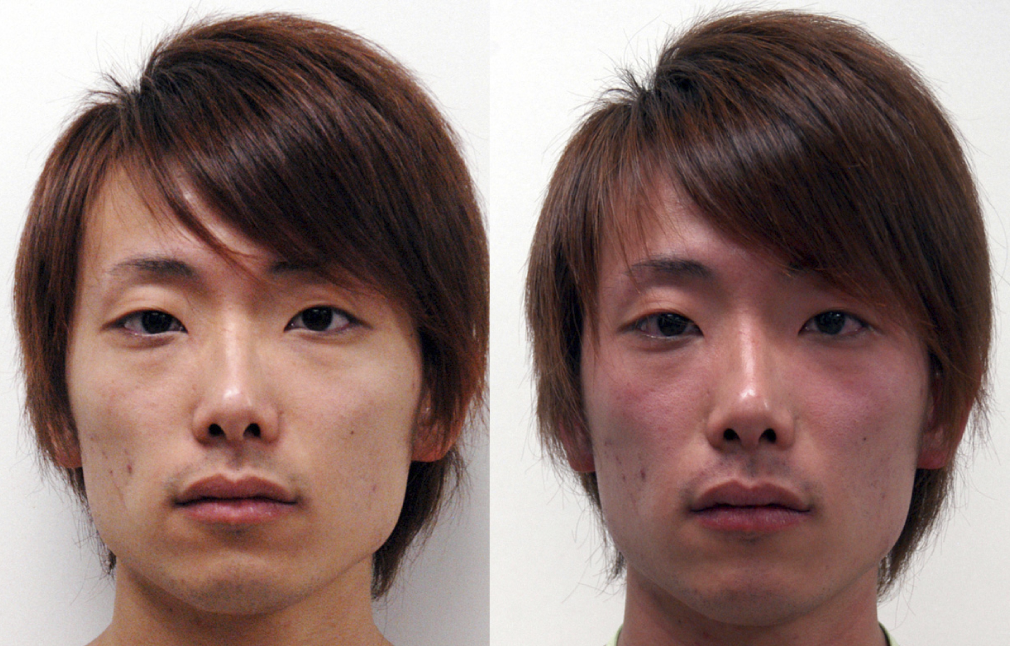
Figure 1: Facial flushing in someone with ALDH2 heterozygote before (left) and after (right) alcohol consumption (Brooks et al. 2009).

To understand why these specific genetic traits flourished in East Asia, we must look to the region’s agricultural history. Around 10,000 years ago, early human populations along the Yangtze River in southern China began domesticating paddy rice (Peng et al. 2010). Because rice yielded three to five times more output per acre than crops like wheat, this massive agricultural surplus naturally led to the practice of fermentation to prevent grain spoilage (Zhu et al. 2021). By fermenting their excess harvests, these early societies brewed rice wines. While originally adopted to preserve food and enhance its nutritional value, this brewing process also produced ethanol. Initially, this offered distinct survival and social advantages, functioning as a disinfectant, a mild analgesic, and a profound mind-altering agent (Peng et al. 2010; Zhu et al. 2021).

However, this dietary shift introduced a new environmental pressure. Rice-farming communities had unprecedented, prolonged access to alcohol compared to earlier hunter-gatherer populations (Zhu et al. 2021). This access came with steep societal and health risks associated with overconsumption, including addiction, innate immune system modulation, and tumour development (Peng et al. 2010). Rather than causing these mutations directly, the transition to rice agriculture created strong selective pressure that actually favored pre-existing ALDH2 and ADH1B variants, accelerating their spread across East Asian populations (Peng et al. 2010). The severe physical discomfort caused by the ALDH2 and ADH1B mutations served as a natural deterrent to alcohol, biochemically mimicking symptoms that modern anti-alcoholism drugs provide, like disulfiram (Peng et al. 2010). Individuals carrying these genes were naturally discouraged from excessive drinking, drastically lowering their risk for alcoholism and protecting them from the effects of overconsumption.

So, the next time you see someone with “Asian flush”, remember that it is not a random quirk. It is simply an example of gene-culture coevolution left by ancient farmers whose agricultural inventions left a protective mark on their DNA.

References

Brooks, Philip J., Mary-Anne Enoch, David Goldman, Ting-Kai Li, and Akira Yokoyama. 2009. “The Alcohol Flushing Response: An Unrecognized Risk Factor for Esophageal Cancer from Alcohol Consumption.” PLoS Medicine 6 (3): e1000050. https://doi.org/10.1371/journal.pmed.1000050.

Peng, Yi, Hong Shi, Xue-bin Qi, et al. 2010. “The ADH1B Arg47His Polymorphism in East Asian Populations and Expansion of Rice Domestication in History.” BMC Evolutionary Biology 10 (January): 15. https://doi.org/10.1186/1471-2148-10-15.

Wall, Tamara L., and Cindy L. Ehlers. 1995. “Genetic Influences Affecting Alcohol Use Among Asians.” Alcohol Health and Research World 19 (3): 184–89.

Zhu, Chen, Thomas Talhelm, Yingxiang Li, Gang Chen, Jiong Zhu, and Jun Wang. n.d. “Relationship between Rice Farming and Polygenic Scores Potentially Linked to Agriculture in China.” Royal Society Open Science 8 (8): 210382. https://doi.org/10.1098/rsos.210382.

Comments

11 Responses to “Rice is NOT Nice: How Ancient Rice Domestication Led to “Asian Flush””

  1. Via Kim Avatar
    Via Kim

    Hi iSci!
    For my blog post, I took inspiration from WineSci, where we have been discussing alcohol metabolism and topics surrounding agriculture which I have been exploring in climate change to write about how ancient rice cultivation practices led to the development of “Asian flush”. I hope you enjoy reading about this topic, and I would love to hear any feedback or suggestions you may have 🙂

    -Via

  2. Emma Ramos Avatar
    Emma Ramos

    Hi Via,

    This article caught my eye since as I’m asian as well and have been told multiple times that I get “Asian Flush” too!! This was such an interesting read, thank you for writing about it! Here’s a couple suggestions to help you edit:

    – In P2S4, you say “…and Korean populations possess a specific genetic variant of the ALDH gene, encodes a…”, consider making it say “which encodes” or “that encodes” so the sentence flows better.
    – In P3S1, you use both “severe and extreme”, I would consider keeping one and using a different word, maybe something that illustrates how the build up can actually be dangerous to their health.
    – For the last sentence in P4 you’re missing a period, so just make sure to add it in after the citation!

    – This last one is a bit more word/topic dependent, but consider adding a sentence or two expanding on how dangerous the build up of Acetaldehyde is for humans!! It leads to a significantly higher risk of esophageal squamous cell carcinoma and is known to be human carcinogen. This could further emphasize why it is supposed to deter people from drinking, but subsequently how this can pose major health risks for those with these genetic variations.

    I truly enjoyed this article!! I hope these suggestions help you edit it!

    -Emma

    1. Via Kim Avatar
      Via Kim

      Hi Emma, thank you so much for reading my blog and commenting! I have applied all of your suggestions to my post! For your last suggestion, I think that would be a really interesting topic to discuss, but unfortunately, adding that would exceed my word count 🙁 But thank you again!
      -Via

  3. Nathaniel Wang Avatar
    Nathaniel Wang

    Hello Via!

    This is a very fun blog post that is very relevant to me haha. Here are a few small suggestions:

    -in P3 the phrase “accelerates the initial conversion of ethanol to acetaldehyde up to 100 times faster than the ancestral gene” is slightly redundant. Maybe consider changing it to “…accelerates the initial conversion of ethanol to acetaldehyde by up to 100-fold compared to the ancestral allele (or enzyme)”
    -The last sentence of P4 is missing a closing period after “(Peng et al. 2010; Zhu et al. 2021)”
    -Following standard genetics convention, italicizing the gene names (ALDH2, ADH1B) helps visually distinguish them from the enzymes (ALDH2, ADH) they produce.

    Overall this was a very fun blog post to read, I look forward to seeing your final blog!

    Nathaniel Wang

    1. Via Kim Avatar
      Via Kim

      Hi Nathaniel, thank you so much for reading my blog post and for giving me suggestions! – I have applied all of them to my post. Thanks again!
      -Via

  4. Ellie Jeong Avatar
    Ellie Jeong

    Hi Via,

    This article caught my attention because, as an East Asian myself, I’ve witnessed “Asian Flush” happen many times! I found it really interesting to learn about its possible connection to ancient rice domestication and human evolution. This is a few suggestions that might help strengthen your article:

    – In P4, you said, “In this environment, the genetic mutations causing the “Asian flush” provided a distinct evolutionary advantage”. I think it would be helpful to clarify that rice domestication may have contributed to the spread of these genetic variants, rather than directly causing the mutations themselves.

    This article was very interesting to read, and I was able to learn more about how ancient rice domestication may have influenced the evolution of genetic variants associated with “Asian Flush” and how these variants affect the body’s ability to break down alcohol! I hope this suggestion was helpful. Happy editing.

    -Yuna Jeong

    1. Via Kim Avatar
      Via Kim

      Hi Yuna, thank you so much for reading my post and for giving me a suggestion! I think clarifying that point really helped clear up my writing. Thanks again!
      -Via

  5. Zara Sarfraz Avatar
    Zara Sarfraz

    Hi Via,

    I loved your blog post! Genetic mutations caused by evolution is something I’m also very passionate about, so this topic was super engaging for me.

    I have only a few quick suggestions for you:

    – This tip is subjective, but consider making your figure caption a little bit bigger so that it is easier to read. Not as big as your text of course, but if there is a good in-between size, I think that would really help out us readers with glasses a bit!

    – Unhighlight your “References” header, as bolding is more than effective in bringing attention to it.

    – It’s a little hard to tell, but I believe you have added an extra space in between your second-last and last reference. Double-check this!

    Besides those, great job! I think your figure choices and writing style really helped me follow along with the topic easily.

    Happy editing!

    Zara

    1. Via Kim Avatar
      Via Kim

      Hi Zara, thank you so much for your comment and suggestions! – They helped me refine my blog post a lot 🙂
      -Via

  6. Ananya Meleen Sheth Avatar
    Ananya Meleen Sheth

    Hi Via,
    I really enjoyed how you explained all the info here, it was engaging while still explaining all the concepts clearly. I had a few suggestions that I’ve listed below:

    – In this quote “Because rice yielded three to five times more output per acre than crops like wheat (Zhu et al. 2021), this massive agricultural surplus naturally led to the practice of fermentation to prevent grain spoilage.” I would consider moving the citation to the end of the sentence.

    – This sentence is a bit long and introduces a lot of information. “However, molecular analyses reveal that roughly half of the Chinese, Japanese, and Korean populations possess a specific genetic variant of the ALDH gene, which encodes a defective enzyme subunit that slows the breakdown and leads to the accumulation of acetaldehyde.” You could restructure it like this “However, molecular analyses reveal that roughly half of the Chinese, Japanese, and Korean populations possess a specific genetic variant of the ALDH2 gene. This variant encodes a defective enzyme subunit, slowing the breakdown of acetaldehyde and causing it to accumulate in the body.”

    Overall, this was a really good blog post and I look forward to the final draft!
    Ananya

    1. Via Kim Avatar
      Via Kim

      Hi Ananya, thank you so much for reading my blog post and for your suggestions! – I have applied all of them to my post. Thanks again! -Via

Leave a Reply