Earth’s magnetic field sets it apart from many other planets, including Venus and Mars. It makes Earth habitable through protecting life from radiation solar winds, water loss, and atmospheric erosion (Pan and Li 2023). The geomagnetic field may have also had a role in the origins of life through stabilizing the temperature, so that water was in a liquid state, as well as oxidizing the atmosphere (Erdmann et al. 2021). In addition to contributing to conditions that support life, the magnetic field also plays a major role in the orientation and navigation of many organisms, ranging from bacteria to vertebrates (Pan and Li 2023).
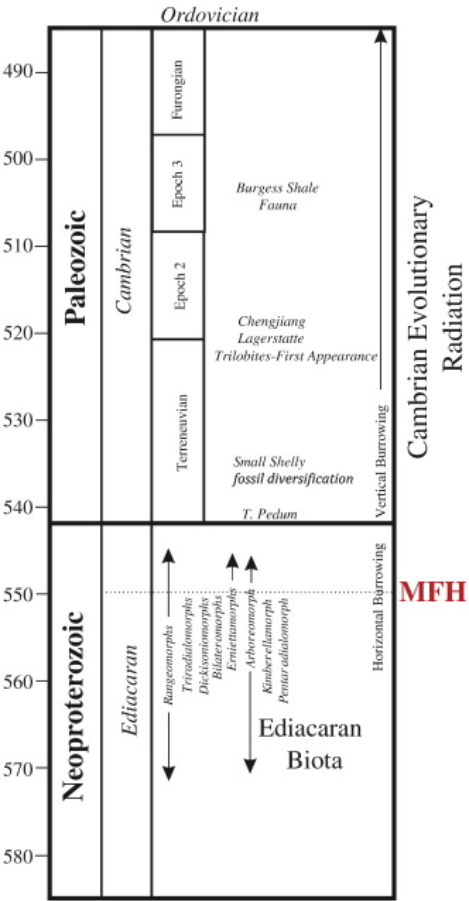
Based on the geomagnetic field record that is found in rocks which lithified at that time, and fossil records, a link between fluctuations in the geomagnetic field and the evolution of mammals was found (Channell and Vigliotti 2019). Additionally, approximately 580 mya, during the Early Cambrian period, there was a major evolutionary expansion for life. This was thought to be the result of the unusually high field polarity reversal frequencies, which resulted in oxygenation of the oceans (Channell and Vigliotti 2019). This trend is also seen during the Ediacaran period, approximately 550 mya. During the Ediacaran, a major extinction of large, soft bodied organisms, which coincided with the development of vertical burrowing in shallow to deep marine environments, due to the increased ultraviolet (UV) radiation (Meert et al. 2016). Increased UVB radiation also contributed to evolutionary adaptations in other ways, including through means of genetic repair from UV damage and masking behaviour in animals (Meert et al. 2016). This supports frequent magnetic field reversals, and field weakening, being key drivers in evolutionary changes, through acting as biological pressures. This also highlights their role in contributing to mass extinction events (Meert et al. 2016).
Human evolution is also speculated to have geomagnetic field activity influence. One reason why this is speculated is due to the proposal that low magnetic field strength played a role in Neanderthal extinction, which coincides with a major period of decreased geomagnetic field strength (Channell and Vigliotti 2019). Notably, episodes of low magnetic field strength appear to have also corresponded with other significant evolutionary events in human and other large mammals (Channell and Vigliotti 2019). Phylogenetics demonstrates that adaptations have occurred from regional migration as a result of a difference in radiation exposure, which is linked to the magnetic field (Channell and Vigliotti 2019). This is specifically related to phenotypical divergence due to increased pigment protecting against skin cancer, however reducing vitamin D3 synthesis, thus resulting in pigmentation differences from the presence different environmental pressures (Channell and Vigliotti 2019).
Overall, these findings support that Earth’s geomagnetic field activity has played a key role in the evolution of life, through their impacts on the environment, and creating biological pressures necessary for evolution to occur.
References
Channell, J. E. T., and L. Vigliotti. 2019. “The Role of Geomagnetic Field Intensity in Late Quaternary Evolution of Humans and Large Mammals.” Reviews of Geophysics 57 (3): 709–38. https://doi.org/10.1029/2018RG000629.
Erdmann, Weronika, Hanna Kmita, Jakub Z. Kosicki, and Łukasz Kaczmarek. 2021. “How the Geomagnetic Field Influences Life on Earth – An Integrated Approach to Geomagnetobiology.” Origins of Life and Evolution of Biospheres 51 (3): 231–57. https://doi.org/10.1007/s11084-021-09612-5.
Meert, Joseph G., Natalia M. Levashova, Mikhail L. Bazhenov, and Ed Landing. 2016. “Rapid Changes of Magnetic Field Polarity in the Late Ediacaran: Linking the Cambrian Evolutionary Radiation and Increased UV-B Radiation.” Gondwana Research 34: 149–57. https://doi.org/10.1016/j.gr.2016.01.001.
Pan, Yongxin, and Jinhua Li. 2023. “On the Biospheric Effects of Geomagnetic Reversals.” National Science Review 10, no. 6: nwad070. https://doi.org/10.1093/nsr/nwad070.


Leave a Reply
You must be logged in to post a comment.