Crisp and light bodied with hints of apples, citrus, and… smoke? Probably not what you want to taste when you are sipping on your favourite wine. Unfortunately, smoke and ash could become much more common in the fruity flavour profiles of many wine varieties, due to what is known as ‘smoke taint’ from wildfires (Madhusoodanan 2021).
‘Smoke taint’ is becoming an increasingly common issue for vineyards, as wildfires increase in severity and occurrence due to climate change (Madhusoodanan 2021). This can create unwanted smoky or ashy flavours in wines. When wood and vegetation burns, volatile phenol compounds are released into the air, and can be subsequently transported kilometers away from their source (Mirabelli-Montan et al. 2021). These particles are then absorbed by grapes, and bind to sugar molecules, turning into non-volatile phenolic glycosides. In this form, they are undetectable in terms of flavour. These compounds remain bound to sugars within the fruit until fermentation, where the yeast hydrolyzes the phenolic glycosides back into volatile phenols (Mirabelli-Montan et al. 2021). This rerelease of the volatile phenols is what results in the unpleasant flavours in finished wines.
As established, when the grapes are first harvested the smoke exposure causes no noticeable flavour, odor, or physical change in the fruit (Piao et al. 2025). This makes it extremely difficult for vineyards to determine the extent of smoke taint damage on their crops until they have already fermented their wines. Researchers are investigating techniques involving fining and purification of wines post-fermentation, in order to mitigate the economic loss that vineyards face when they create batches of wine badly affected by smoke taint (Mirabelli-Montan et al. 2021).
There is no set solution, however one method that has proved to be effective for mildly smoke-tainted wines is adding activated carbon, as it has shown the ability to absorb volatile phenols from wine (Mirabelli-Montan et al. 2021). However, with this method the carbon is non-selective for the compounds it absorbs and also removes desirable flavours, aromas, and colour. To combat this, researchers developed molecularly imprinter polymers (MIPs), which are synthesized material that are made to selectively bind to only the unwanted volatile phenol compounds (Figure 1) (Huo et al. 2024). The synthetic polymers are created by arranging monomers around a template target molecule, in order to align specific functional group bonding between the MIPs and target compound (Haupt et al. 2011). The monomers go through polymerization to keep their shape permanent, then the template molecule is removed and the MIPs can bind to the unwanted smoke taint compounds (Haupt et al. 2011).
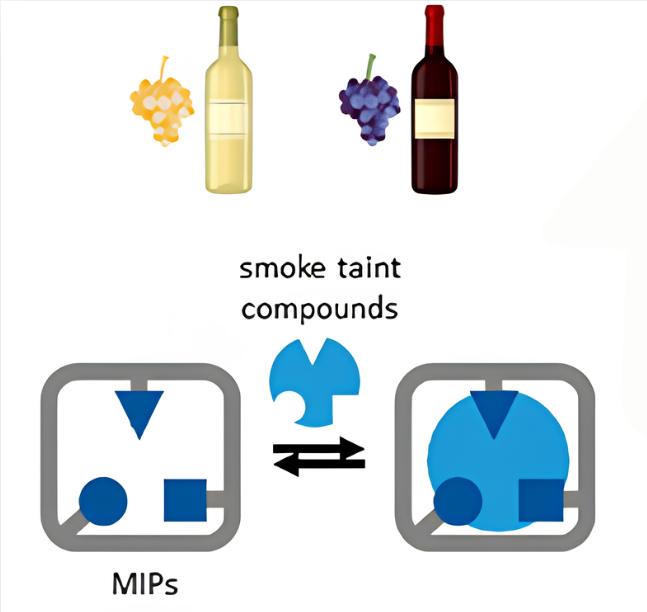
Figure 1. Graphical abstract of how molecularly imprinted polymers (MIPs) selectively bind to specific volatile phenol compounds in white and red wines (Huo et al. 2024).
Huo et al. 2024 found that the MIPs were able to remove 35-57% of the unwanted volatile phenols from Pinot Noir wine. This can bring smoke taint levels below detectable thresholds in low to moderately impacted wines. The MIPs also performed best when they were added after the yeast was inoculated during fermentation, so the timing matters when adding removal agents to the wine. Unfortunately, there are still some drawback of this fining agent; specifically red wine colour was still impacted, and severely smoke tainted wine still had detectable flavour drawbacks (Huo et al. 2024). This initial experiment is promising, but more research and technological development is needed to improve the technology. In theory the use of MIPs would help reduce the negative impacts that fining agents such as activated carbon have on desirable wine quality.
Until a foolproof plan to prevent or remove smoke taint from grapes is developed, vineyards will have to live with the effects of wildfire smoke on their crop, and keep experimenting with possible solutions. So next time you see a wildfire on the news, know you could be in for some ashy flavoured wine within the next year!
Bibliography
Haupt, Karsten, Ana V. Linares, Marc Bompart, and Bernadette Tse Sum Bui. 2011. “Molecularly Imprinted Polymers.” Topics in Current Chemistry, 1–28. https://doi.org/10.1007/128_2011_307.
Huo, Yiming, Renata Ristic, Carolyn Puglisi, et al. 2024. “Amelioration of Smoke Taint in Wine via Addition of Molecularly Imprinted Polymers During or After Fermentation.” J. Agric. Food Chem. 72 (32): 18121–31. https://doi.org/10.1021/acs.jafc.4c03912.
Madhusoodanan, Jyoti. 2021. “Science and Culture: Wildfires Pose a Burning Problem for Wines and Winemakers.” Proceedings of the National Academy of Sciences 118 (34). https://doi.org/10.1073/pnas.2113327118.
Mirabelli-Montan, Ysadora A., Matteo Marangon, Antonio Graça, Christine M. Mayr Marangon, and Kerry L. Wilkinson. 2021. “Techniques for Mitigating the Effects of Smoke Taint While Maintaining Quality in Wine Production: A Review.” Molecules 26 (6): 1672. https://doi.org/10.3390/molecules26061672.
Piao, Hailan, Thomas S Collins, and Thomas Henick-Kling. 2025. “Investigation of Smoke-Taint Precursor Modification by Glycosidase Activity in Diverse Wine Yeast and Bacterial Strains.” Frontiers in Microbiology (Switzerland) 16 (October): 1679638. PubMed Central. https://doi.org/10.3389/fmicb.2025.1679638.


Leave a Reply
You must be logged in to post a comment.