Have you ever found yourself in an unfamiliar environment, feeling uncomfortable or as though you don’t quite belong? Think about the transition from being a senior in high school, surrounded by familiar faces and routines, to becoming a first-year university student, where everything suddenly feels new. In moments like these, it’s easy to find yourself reminiscing about the past, remembering a time when everything seemed easy, familiar, and comfortable. Feelings of loneliness and negative emotions can trigger nostalgia, bringing back memories that strengthen our sense of social connection (Wildschut et al. 2006). But what if nostalgia does more than just provide emotional comfort? What if revisiting these memories could actually make us feel physically warmer?
Nostalgia is often associated with emotional warmth, a comforting feeling that comes from revisiting meaningful moments in our past. However, nostalgia is much more complex than simply remembering a happy memory. It is often a bittersweet experience, combining happiness from what we once had with sadness from knowing those moments have passed. What makes nostalgia particularly fascinating is the possibility that this emotional warmth may extend beyond our psychological experiences. Our bodies constantly respond to changes in temperature in our environment through a process known as thermoregulation, which involves temperature signals from our skin and mechanisms that help maintain our internal body temperature (Romanovsky 2014). However, physically regulating body temperature and consciously feeling warm are not necessarily the same thing. Research suggests that recalling nostalgic memories can influence how warm we perceive our surroundings to be, even when the surrounding temperature remains unchanged (Zhou et al. 2012). Perhaps the warmth we associate with nostalgia is not entirely metaphorical after all.
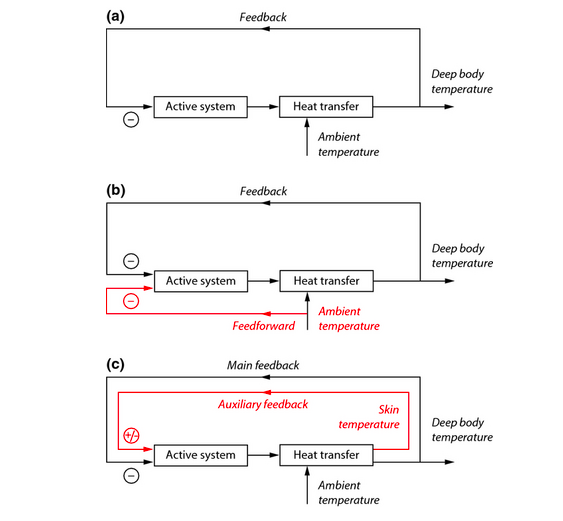
Romanovsky (2014, fig. 1).
To explore the relationship between nostalgia and physical warmth, researchers conducted five studies examining how nostalgic memories influence our experiences with temperature. In one experiment, participants who recalled nostalgic memories perceived their surroundings as warmer than those who recalled ordinary experiences. As described in the study, “Nostalgia, in turn, modulates the interoceptive feeling of temperature” (Zhou et al. 2012). Another experiment found that participants who reflected on nostalgic memories could tolerate painful cold for longer periods. These findings suggest that nostalgia may influence how we experience physical discomfort, rather than simply providing emotional comfort.
So, can memories really keep us warm? The answer may be more complicated than we think. Nostalgia has been associated with “the maintenance of physiological comfort” (Zhou et al. 2012). Suggesting that its effects may extend beyond emotional reassurance. However, this does not necessarily mean that our actual body temperature increases. Instead it signifies how closely our emotional experiences, connections and physical sensations may be connected. What I find particularly fascinating is how something as simple as remembering the past could change how we experience the present. Thinking back to the transition from high school to university, nostalgia may provide a sense of familiarity when everything around us feels unfamiliar. Although memories cannot physically bring us back to the past, perhaps they can still offer us a little warmth in the present.
References
Wildschut, Tim, Constantine Sedikides, Jamie Arndt, and Clay Routledge. “Nostalgia: Content, Triggers, Functions.” Journal of Personality and Social Psychology (Washington, DC) 91, no. 5 (2006): 975–93. https://doi.org/10.1037/0022-3514.91.5.975.
Romanovsky, A. A. “Skin Temperature: Its Role in Thermoregulation.” Acta Physiologica (England) 210, no. 3 (2014): 498–507. https://doi.org/10.1111/apha.12231.
Zhou, Xinyue, Tim Wildschut, Constantine Sedikides, Xiaoxi Chen, and Ad J. J. M. Vingerhoets. 2012. “Heartwarming Memories: Nostalgia Maintains Physiological Comfort.” Emotion 12 (4) (08): 678-684. doi:https://doi.org/10.1037/a0027236. http://libaccess.mcmaster.ca/login?url=https://www.proquest.com/scholarly-journals/heartwarming-memories-nostalgia-maintains/docview/926641500/se-2.


Leave a Reply
You must be logged in to post a comment.