Bees and the Invisible Electric Field 

You see a bee landing on a flower, the interaction seems quite simple, however something beyond our vision is occurring right under our nose, that being electromagnetic fields produced by bees. Research shows that bees become electrically charged when interacting with pollen-producing plants and use this charge to communicate with other bees. Additionally, interactions occur between bees and naturally transpiring fields providing environmental information (Warnke, 2007). This phenomenon has opened new areas of research, including but not limited to electric ecology (Clarke et al. 2017).

As bees fly through their environment, their bodies create and accumulate an electric charge. The triboelectric effect is a mechanism where electric charge can be produced, where friction and overcontact from plants and materials the bees come into contact with could cause electron transfer. From this friction, bees get a positive electric charge of approximately +30 to 50pC (Clarke et al. 2017). Due to bees having a relatively low capacitance, they have a considerable voltage associated with the charge they carry, based on the equation V=Q/C, where capacitance and voltage are inversely related. That being said, we can understand that this electric field is not only affecting bees but also the environment around them.  

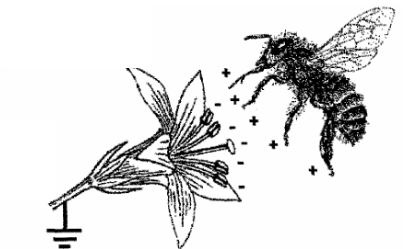
This electric field from bees allows for complex interaction with flowers, as they too have an electric field. Flowers, as well as other plants, distort Earth’s natural vertical field as they are grounded (Clarke et al. 2017). Thus, when a bee with a positive electric charge gets in close proximity to a flower, there are electrostatic interactions that get stronger as the distance is shorter, particularly strong at 2-3 cm with 5kV/m (Clarke et al. 2017). These electrostatic forces can contribute to pollination as they influence pollen transfer from flower to flower as they help pollen stick to the bee as they move between different flowers as seen in Figure 1. This proves that pollination is not just a physical mechanism but a physical force beyond that, that plays a role (Vaknin et al. 2000).
​


Figure 1. Positively charged bee inducing an opposite charge on the flower, thereby creating temporary forces (Vaknin et al. 2000).

Bees not only interact with these electric fields, but they can also detect them from other bees. An example of this is seen through bumblebees, in which they can detect electric fields through small hairs on their bodies. Whereas honey bees use a slightly different mechanism to detect these electromagnetic waves by using their antennae. These mechanisms are extremely important for communication such as the waggle dance, which allows honey bees to communicate about foraging information (Greggers et al. 2013).

This information helps us understand the whole relationship of pollination and all the factors involved beyond what can be seen through our eyes. However, these interactions are not fully understood by researchers regarding the information that bees get from electrical fields or how the environment can influence the signals they receive. So next time you see a bee approach a flower, think about interactions beyond what you can just see and appreciate how complex and efficient nature around us is!

References 

Clarke, Dominic, Erica Morley, and Daniel Robert. 2017. “The Bee, the Flower, and the Electric Field: Electric Ecology and Aerial Electroreception.” Journal of Comparative Physiology A 203 (9): 737–48. https://doi.org/10.1007/s00359-017-1176-6.

Greggers, Uwe, Gesche Koch, Viola Schmidt, et al. 2013. “Reception and Learning of Electric Fields in Bees.” Proceedings of the Royal Society B: Biological Sciences 280 (1759): 20130528. https://doi.org/10.1098/rspb.2013.0528.

Vaknin, Y., S. Gan-Mor, A. Bechar, B. Ronen, and D. Eisikowitch. 2000. “The Role of Electrostatic Forces in Pollination.” Plant Systematics and Evolution 222 (1–4): 133–42. https://doi.org/10.1007/bf00984099.

Warnke Ulrich, Dr. 2008. BEES, BIRDS and MANKIND.

Comments

5 Responses to “Bees and the Invisible Electric Field ”

  1. Maya Kumar Avatar
    Maya Kumar

    Hi iSci! I chose to write on bees and their invisible electric field that plays a huge role in pollination. This topic was mentioned in Will Roman’s ISS presentation and prompted me to want to dive deeper into this interaction and its importance. I hope you enjoy reading and feel free to leave any feedback you may have!
    – Maya Kumar

  2. Saniyah Farzeen Avatar
    Saniyah Farzeen

    Hi Maya!

    I really enjoyed reading this! I had no idea that electric fields played such a big role in pollination, and I thought the way you explained something we normally can’t see was super interesting 🙂

    I just had a few small suggestions while I was reading:

    – In your introduction, you mention that bees become electrically charged when interacting with plants, but later you explain that they can also gain charge through flight and contact with their surroundings. I think it could be helpful to make those two ideas connect a little more clearly so the reader understands where the charge is coming from.

    – In the third paragraph, when you mention the 5 kV/m value, I think it might be worth clarifying that this is the electric field strength rather than the force itself. I also found the sentence about pollination being “not just a physical mechanism but a physical force beyond that” a little hard to follow, so maybe you could simplify it and say more directly that electrostatic forces can help with pollen transfer alongside physical contact.

    – In the paragraph about bee communication, I would maybe use “electric fields” instead of “electromagnetic waves” just to keep the terminology consistent with the rest of the post.

    Overall though, I thought this was such a cool topic and really easy to follow. The connection between physics and pollination was especially interesting!

    Happy editing!
    Saniyah

  3. Claire Chisholm Avatar
    Claire Chisholm

    Hey Maya!

    Really great blog post! I thought it was really interesting how bees produce electric fields and how these play a role in pollination. Some suggestions I have are:

    – P1S1: The first sentence is a little long and could be broken into two sentences. I would suggest putting a period after “flower” and starting the next sentence with “The interaction seems quite simple.”

    – P2S2: I noticed that “where” is repeated twice. I would suggest rewording this sentence to improve the flow.

    – P3S4: The sentence beginning “These electrostatic forces can contribute to pollination” repeats “as they” a few times. I would suggest breaking it into two sentences to make it easier to follow.

    Overall, really great blog post! I enjoyed learning about how electric fields influence pollination.

    – Claire

  4. Hafsa Ghouri Avatar
    Hafsa Ghouri

    Hi Maya K!

    Great work!! I really enjoyed reading your blog post. I found it very interesting and informative, so good job! I have a few minor suggestings that I think could help you:

    P2S2: Consider altering this sentence slightly to aid clarity. Something like this perhaps: “The triboelectric effect is a mechanism producing electric charge, where friction and overcontact from plants and materials the bees come into contact with could cause electron transfer.”

    P3S4: Consider slightly splitting this sentence into two sentences so that it flows better, such as “ These electrostatic forces can contribute to pollination by influencing pollen transfer from flower to flower. They can also help pollen stick to the bee as it moves between different flowers, as shown in Figure 1.”

    P4S2: Consider tweaking this sentence so it sounds better. Something like this: “An example of this is seen in bumblebees, which can detect electric fields through small hairs on their bodies.”

    Overall, great job! I really like this.

    Hafsa 🙂

  5. Riyal Monga Avatar
    Riyal Monga

    Hi Maya! I’ve seen bees land on flowers so many times, but I’d never thought to ask what happens to the pollen just *before* the bee lands. That part of your post caught my attention. I had a few suggestions as I was reading.

    1. P1S1 – I’d turn the opening scene into a question and save the explanation for the next sentence. Something like “When you watch a bee land on a flower, can you tell when the interaction actually begins?” would tie in nicely with your point later about the electric field acting while the bee is still approaching.

    2. P2S2 – I wasn’t sure what “overcontact” meant. You could explain the triboelectric effect more simply with “When a bee comes into contact with another material and then separates from it, electrons can transfer between the two.” That would also help explain where the charge in the next sentence comes from.

    3. P3S3 – I’d clarify what “5 kV/m” measures. Since the sentence mentions distance, it took me a second to realize that 2-3 cm is the gap between the bee and the flower, while 5 kV/m describes the electric field strength. I’d also double-check whether the source gives that value at that specific distance before pairing the numbers.

    4. P4S2-3 – The comparison between bumblebee hairs and honey bee antennae was one of my favourite details. You could bring it out by combining those sentences into one. I’d also stick with “electric fields” throughout, since switching to “electromagnetic waves” made me wonder whether you were introducing a different signal.

    One quick reference detail I noticed was that Warnke is listed as 2007 in the opening paragraph and 2008 in the references. Overall, I liked how your ending brought me back to the bee from the first line. I’ll definitely be paying more attention to its approach next time! Happy editing 🙂

    Regards,
    Riyal

Leave a Reply