Scientists have found plastic lodged inside human arteries (Marfella et al. 2024). Could part of the solution be sitting in your fridge, in a jar of kimchi? A recent study from the World Institute of Kimchi in South Korea found that a bacterium associated with kimchi fermentation can bind nanoplastics and increase their excretion in mice (Lee et al. 2026). So could the microbes that ferment our food also help protect us from pollutants?
Microplastics are plastic particles smaller than 5 mm, while nanoplastics are generally smaller than 1 µm. Their small size is concerning because some can cross biological barriers and potentially accumulate in tissues (Teng et al. 2025). In a study of patients who had plaque surgically removed from their carotid (neck) arteries, those with plastic in their plaque had a higher risk of heart attack, stroke, or death over about three years (Marfella et al. 2024). Although this doesn’t establish causation, it addresses concerns about the potential health effects of plastic exposure.
Kimchi fermentation depends on lactic acid bacteria naturally present in ingredients such as cabbage and garlic. One of these, Leuconostoc mesenteroides, is particularly active during early fermentation (Jung et al. 2011). Through heterolactic fermentation, these bacteria metabolize sugars into lactic acid, carbon dioxide, and other compounds (Jung et al. 2011). Lactic acid lowers the pH, while fermentation products contribute to kimchi’s sour flavour and fizz. This is similar to wine fermentation, where microorganisms also metabolize sugars and produce compounds that influence flavour (Swiegers et al. 2005). However, while yeast primarily produces ethanol during alcoholic fermentation, lactic acid bacteria in kimchi mainly contribute to acid production. L. mesenteroides also happens to be the same species tested for binding nanoplastics.
Lee et al. (2026) compared two kimchi-derived bacterial strains and found that one particular strain, L. mesenteroides CBA3656, maintained approximately 57% nanoplastic adsorption under simulated intestinal conditions. This occurs through biosorption, where plastic particles attach to bacterial cell surfaces rather than being chemically degraded (Figure 1). By binding to bacteria, the particles may be more likely to pass through the digestive tract and be excreted.
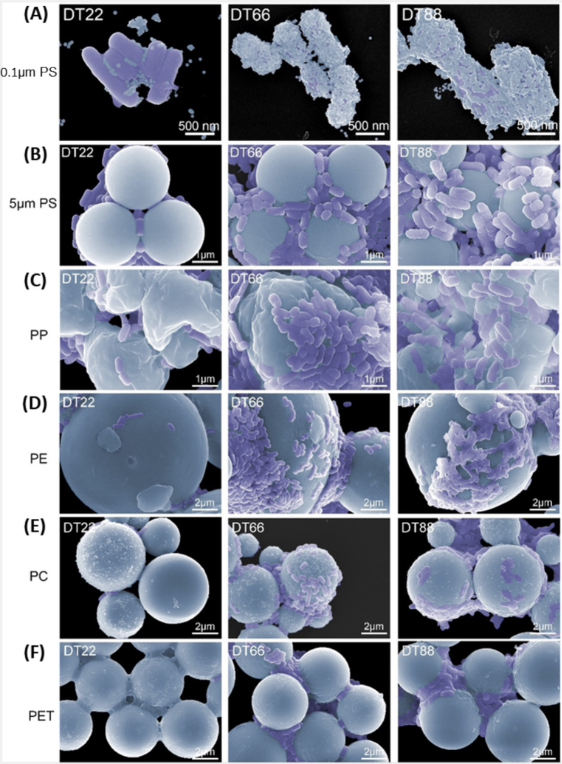
Figure 1. Scanning electron microscopy images showing lactic acid bacteria (purple) binding to microplastic particles (cyan). High-binding strains accumulate more particles on their surfaces. This illustrates the type of biosorption investigated in kimchi-derived bacteria. Figure 2 from Teng et al. (2025).
In germ-free mice, treatment with the kimchi bacterium more than doubled nanoplastic excretion (Lee et al. 2026). Similar results were observed by Teng et al. (2025), who screened 784 bacterial strains and identified probiotics capable of increasing microplastic excretion.
Does this mean eating kimchi removes nanoplastics? Not quite. The kimchi study used germ-free mice, which lack the complex gut microbiome found in humans. Researchers also tested specific bacterial strains against laboratory polystyrene particles, rather than the mixture of plastics encountered in everyday life. Additionally, eating kimchi doesn’t guarantee exposure to the same bacterial strain or concentration used experimentally. The study was also funded by the World Institute of Kimchi itself. These findings link fermentation biochemistry and environmental toxicology in a promising way, but human studies are still needed. For now, kimchi remains a fermented food worth enjoying for its flavour, rather than a proven solution to plastic exposure.
References
Jung, Ji Young, Se Hee Lee, Jeong Myeong Kim, Moon Su Park, Jin-Woo Bae, Yoonsoo Hahn, Eugene L. Madsen, and Che Ok Jeon. 2011. “Metagenomic Analysis of Kimchi, a Traditional Korean Fermented Food.” Applied and Environmental Microbiology 77 (7): 2264-74. https://doi.org/10.1128/AEM.02157-10.
Lee, Jisu, Min Ji Lee, Mi-Ja Jung, Yeon Bee Kim, Yujin Kim, Jeong Ui Yun, Sohee Nam, Young Joon Oh, Tae Woong Whon, and Se Hee Lee. 2026. “Efficient Biosorption of Nanoplastics by Food-Derived Lactic Acid Bacterium.” Bioresource Technology 447: 134234. https://doi.org/10.1016/j.biortech.2026.134234.
Marfella, Raffaele, Francesco Prattichizzo, Celestino Sardu, Gianluca Fulgenzi, Laura Graciotti, Tatiana Spadoni, et al. 2024. “Microplastics and Nanoplastics in Atheromas and Cardiovascular Events.” New England Journal of Medicine 390 (10): 900-910. https://doi.org/10.1056/NEJMoa2309822.
Swiegers, Jan H., Eveline J. Bartowsky, Paul A. Henschke, and Isak S. Pretorius. 2005. “Yeast and Bacterial Modulation of Wine Aroma and Flavour.” Australian Journal of Grape and Wine Research 11 (2): 139-73. https://doi.org/10.1111/j.1755-0238.2005.tb00285.x.
Teng, Xin, Tengxun Zhang, and Chitong Rao. 2025. “Novel Probiotics Adsorbing and Excreting Microplastics In Vivo Show Potential Gut Health Benefits.” Frontiers in Microbiology 15: 1522794. https://doi.org/10.3389/fmicb.2024.1522794.


Leave a Reply
You must be logged in to post a comment.