Historically and culturally, menstrual blood (MB) has been treated as waste that women should be ashamed of. However, recent research has found that it could completely transform healthcare for millions of people.
Prior to the National Institutes of Health (NIH) Revitalization Act in 1993, women were not required to be included in NIH-funded clinical research in the US (Armstrong 2018). However, there were no details on how many subjects needed to be women. Seven years later, in 1997, Health Canada published guidelines recommending women to be included in clinical trials. This absence of female inclusion in research leads to dangerous complications and side effects for women.
Biases in the medical world have led to women’s self-reports of pain being doubted until objective evidence is found for the cause, resulting in prolonged anguish. In 2026, a study with 6607 participants found that 43.3% of females with autoimmune diseases reported misdiagnoses with a mental health condition as opposed to 32.7% of men (Sloan et al. 2026). The subjective nature of early autoimmune symptoms such as chronic pain, brain fog, and severe fatigue often results in doctors defaulting to historical biases that dismiss women as emotional. Furthermore, US studies found that pregnant Black women had a lower average of iron, so a lower cut-off point for anemia diagnoses was set. However, it was changed in 2021 because it was found that these women were 65% more likely to give birth with anemia, which is a factor in maternal mortality. This highlights the systemic issue in research, where the medical concerns of Black women are frequently dismissed.
Nonetheless, recent research found that menstrual blood, which has long been overlooked, is a promising resource for stem cell research (Feng and He 2025). Early clinical research found that menstrual blood mesenchymal stromal/stem cell research, which looks at cells derived from menstrual blood that can differentiate into other cells. Despite the notable possibilities for innovation, this research is only 0.25% of all mesenchymal cell research, and the majority of first authors are women (Manica et al. 2022) (Figure 1).
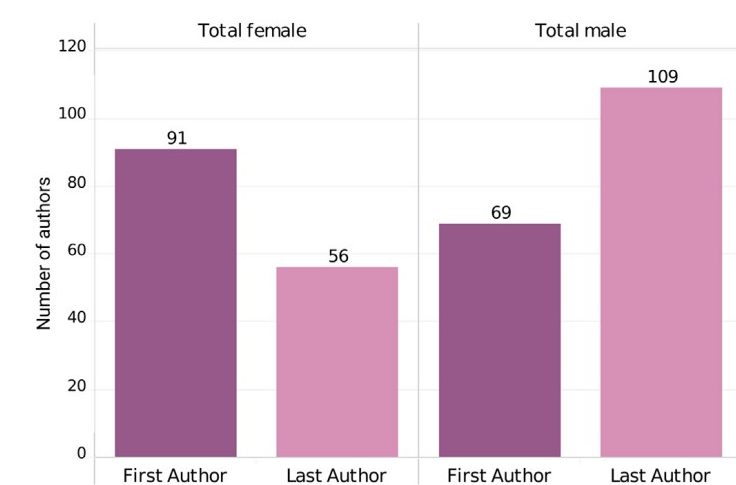
Figure 1: A graph showing the difference between the number of male and female authors in menstrual blood stem cell research. In total, 91 females were credited as first authors compared to 69 males.
Furthermore, menstrual blood has been found to have the potential to become a non-invasive diagnostic tool for women’s health. MB is a complex biofluid that contains many unique biomarkers and proteins that can be used to identify different conditions like endometriosis, cervical cancer, and infections of the vaginal tract (Feng and He 2025). A menstrual pad with a microfluidic monitoring platform is currently being developed to detect biomarkers in the menstrual fluid. The test trip in the pad will change colour when detecting proteins like the C-reactive protein, which can identify autoimmune disorders or infections, and the carcinoembryonic antigen, which is associated with cancers (Dosnon et al. 2025).
The shift of menstrual blood being a stigmatized waste product to a vital clinical tool demonstrates the importance of confronting systemic biases in research.
References
Armstrong, Elisabeth. 2018. “The Gender Gap in Pharmaceutical Research.” Voices in Bioethics 4 (September). https://doi.org/10.7916/vib.v4i.6008.
Dosnon, Lucas, Thomas Rduch, Charlotte Meyer, and Inge K. Herrmann. 2025a. “A Wearable In‐Pad Diagnostic for the Detection of Disease Biomarkers in Menstruation Blood.” Advanced Science 12 (32): e05170. https://doi.org/10.1002/advs.202505170.
Feng, Yige, and Yujie He. 2025. “The Secrets of Menstrual Blood: Emerging Frontiers from Diagnostic Tools to Stem Cell Therapies.” Frontiers in Cell and Developmental Biology 13 (August): 1623959. https://doi.org/10.3389/fcell.2025.1623959.
King, Sally. 2025. “Menstrual Myth Busting.” https://books-scholarsportal-info.libaccess.lib.mcmaster.ca/en/read?id=/ebooks/ebooks9/degruyter9/2025-02-14/1/9781447371656#page=10.
Manica, Daniela Tonelli, Karina Dutra Asensi, Gaia Mazzarelli, Bernardo Tura, Germana Barata, and Regina Coeli Santos Goldenberg. 2022. “Gender Bias and Menstrual Blood in Stem Cell Research: A Review of Pubmed Articles (2008–2020).” Frontiers in Genetics 13 (December): 957164. https://doi.org/10.3389/fgene.2022.957164.
Merkatz, Ruth B., Robert Temple, Solomon Sobel, Karyn Feiden, David A. Kessler, and null null. 1993. “Women in Clinical Trials of New Drugs – A Change in Food and Drug Administration Policy.” New England Journal of Medicine 329 (4): 292–96. https://doi.org/10.1056/NEJM199307223290429.
Shafiq, Shafia Muhammad, Kainat Younis, Maryam Mirza, Sidra Abdullah, and Raghabendra Kumar Mahato. 2025. “Beyond Waste: Menstrual Blood as a Powerful Diagnostic Tool for Women’s Health.” Annals of Medicine and Surgery 88 (2): 2122–23. https://doi.org/10.1097/MS9.0000000000004583.
Sloan, Melanie, Sydnae Taylor, Benjamin Cox, et al. 2026. “Sex and Disease Differences in Patients’ Diagnostic Experiences in Autoimmune Diseases: An International Cross-Sectional Study.” eClinicalMedicine 0 (0). https://doi.org/10.1016/j.eclinm.2026.104259.


Leave a Reply
You must be logged in to post a comment.