Is it Cold Enough?

Somewhere at the back of the fridge is a container that was supposed to be tomorrow’s lunch. The meal has been postponed, perhaps more than once. Keeping it cold buys time, but it does not put everything inside it on hold. Listeria monocytogenes, a bacterium that can cause foodborne illness, can continue growing at refrigeration temperatures (Edgcomb et al. 2000). It can take up unsaturated fatty acids from its surroundings and incorporate them into its cell membrane, helping maintain fluidity in the cold. Fatty acids available in food could therefore help the bacterium tolerate the cold environment inside of a fridge (Touche et al. 2023).

To understand that possibility, consider what cooling does to the membrane. Proteins embedded in the membrane help move substances into and out of the cell. Their functions depend partly on membrane fluidity, how freely its molecular components move. Membrane lipids contain fatty-acid tails that pack alongside one another. Cooling reduces their movement, making the membrane more rigid. Branched tails disrupt tight packing and help preserve fluidity. In Listeria, the branched fatty acid anteiso-C15:0 plays this role (Julotok et al. 2010). A cold-sensitive mutant, a genetically altered strain deficient in branched-chain fatty acids, had less fluid membranes than other strains. Supplying 2-methylbutyric acid, a molecule used to make these fatty acids, restored fluidity towards that of the other strains (Edgcomb et al. 2000). Taking up a compound used in fatty-acid production could therefore help restore membrane fluidity.

The next question is whether supplying these compounds also affects growth. Adding isoleucine, an amino acid used to produce anteiso-branched fatty acids, increased the proportion of anteiso-C15:0 and slightly stimulated growth at 10°C (Figure 1; Julotok et al. 2010). A later experiment supplied fatty acids themselves, which Listeria incorporated into its membrane. Unsaturated fatty acids, containing carbon-carbon double bonds, helped maintain fluidity and promoted growth at 5°C. The saturated fatty acids tested, which lack those double bonds, reduced fluidity and prevented growth at that temperature (Touche et al. 2023). The type of fatty acid available mattered. Unsaturated fatty acids offered no corresponding growth benefit at 37°C, supporting a role in compensating for cold stress rather than simply providing extra nutrients (Touche et al. 2023).
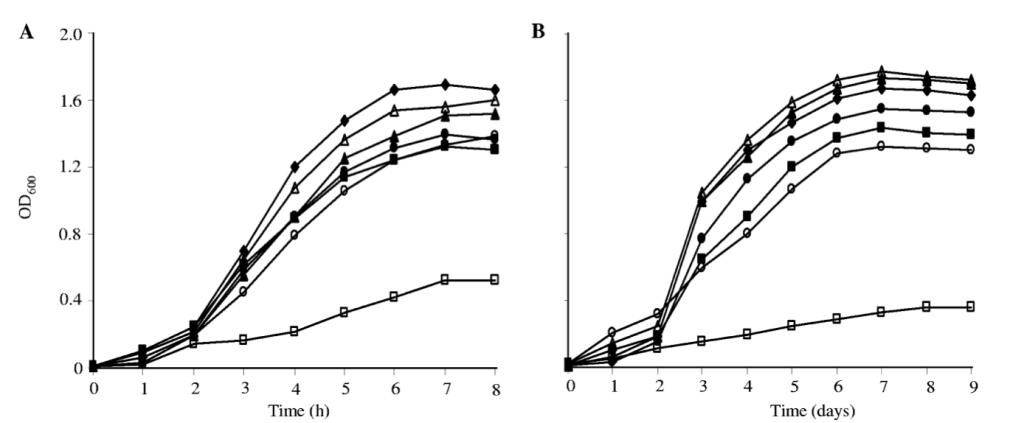

Figure 1. Growth of Listeria monocytogenes with different fatty-acid precursors at 37°C (A) and 10°C (B). Optical density at 600 nm measures culture turbidity as an indicator of growth. Reproduced from Julotok et al. (2010), figure 2.

These findings suggest that food composition could influence refrigerated bacterial growth through its effects on membrane chemistry. They do not establish which foods would have that effect. The experiments used laboratory media, where supplied fatty acids may be more accessible than those within food, and responses varied between bacterial strains (Touche et al. 2023). Testing actual foods would help determine whether the same mechanism matters during storage. If it does, the food being preserved could also help bacteria withstand the cold meant to preserve it. Tomorrow’s lunch might be helping more than one organism get through the night.

References

Edgcomb, Michelle R., Samanthi Sirimanne, Brian J. Wilkinson, Drouin Pascal, and Morse, Reef (Philip D.II. 2000. “Electron Paramagnetic Resonance Studies of the Membrane Fluidity of the Foodborne Pathogenic Psychrotroph Listeria Monocytogenes.” Biochimica et Biophysica Acta (BBA) – Biomembranes 1463 (1): 31–42. https://doi.org/10.1016/S0005-2736(99)00179-0.

Julotok, Mudcharee, Atul K. Singh, Craig Gatto, and Brian J. Wilkinson. 2010. “Influence of Fatty Acid Precursors, Including Food Preservatives, on the Growth and Fatty Acid Composition of Listeria Monocytogenes at 37 and 10°C.” Applied and Environmental Microbiology 76 (5): 1423–32. https://doi.org/10.1128/aem.01592-09.

Touche, Cécile, Sarah Hamchaoui, Aurore Quilleré, Maud Darsonval, and Florence Dubois-Brissonnet. 2023. “Growth of Listeria Monocytogenes Is Promoted at Low Temperature When Exogenous Unsaturated Fatty Acids Are Incorporated in Its Membrane.” Food Microbiology 110 (April): 104170. https://doi.org/10.1016/j.fm.2022.104170.

Comments

8 Responses to “Is it Cold Enough?”

  1. Yasmin Anouar Avatar
    Yasmin Anouar

    Hello Gelila!

    This was an incredibly interesting read on how bacteria can still persist in the fridge and that your food is not necessarily frozen in time when placed in a cooler environment. I have a few comments for you to consider.

    – Remember to add a comment that explains how your blog post connects to iSci content!
    – In Chicago style, the “Works Cited” is titled “References”

    Happy editing!

    Yasmin

    1. Gelila Mekre Avatar
      Gelila Mekre

      Hi Yasmin!

      Thank you for reading my post! I’m glad you found it interesting. I’ve added a comment explaining the connections to class content. Thank you for the reminder! I’ll also change “Works Cited” to “References,” Thanks for catching that too!

      – Gelila

  2. Gelila Mekre Avatar
    Gelila Mekre

    Hey iSci!

    My interest in this topic started during our Life Sciences lecture on extremophiles, which got me thinking about how organisms function in challenging environments. For RP1, my research focused on the possibility of cell like membranes forming in Titan’s methane lakes. This made me curious about how membrane composition affects the conditions a cell can tolerate. I decided to explore this in a more familiar setting by looking into bacteria that can grow in the fridge. This connected Life Sciences with Chemistry through how the structure of fatty acids affects their packing within a membrane. I found it interesting that these molecular differences could help explain why refrigeration slows bacterial growth without always stopping it.

    I’m excited to hear your feedback!

    – Gelila Mekre

  3. Hassan Rasheed Avatar
    Hassan Rasheed

    Hi Gelila,
    Great post! I liked how you started with a forgotten lunch in the fridge and ended by bringing it back. I just have a few suggestions:

    Figure suggestion: P2 explains how straight, branched and unsaturated fatty-acid tails pack in the membrane. A simple diagram comparing the three, with tight packing versus loose packing, could help readers picture why some tails keep the membrane more fluid.

    P1S4: You use “unsaturated fatty acids” here but don’t define it until P3S4. Moving the short definition up to its first use would help readers follow the idea from the start.

    References: The author names in the Edgcomb et al. (2000) entry look jumbled (“Drouin Pascal, and Morse, Reef (Philip D.II.”). It should probably read “Pascal Drouin, and Philip D. Morse II.”

    Excited to see the final version. Good luck!
    Hassan

  4. Maybel Wang Avatar
    Maybel Wang

    Hi Gelila,

    This was a very interesting blog post! Here are some minor suggestions I have:

    – P3S2: very small thing, but just (Figure 1) is enough, no need for the citation after it.
    – Try using more than 3 sources to expand the scope of your research
    – Make sure you fully explain the figure in the figure caption. For example, how the x-axis is different between the panels, what the increase in optical density means, and what are the different curves representing within each panel?

    Overall this was a great topic! Happy editing!

    Maybel

  5. Joshua Yoon Avatar
    Joshua Yoon

    Hi Gelila,
    Great post! This was very fun to read. I especially liked the ending, it made me audibly laugh. A few suggestions:

    P2S7-8, the transition feels a little weird. It took me a few re-readings to identify what you were talking about when I read “A cold-sensitive mutant…”.

    In P3, it might be helpful to provide a frame of references for fridges/cold cellars. Maybe have the average temperature there somewhere?

    Overall amazing post, very fun to read. Happy editing!
    Josh

  6. Kimi Wong Avatar
    Kimi Wong

    Hi Gelila!

    This was an interesting read! Potential suggestions you might want to consider:

    – P2S2: Very very nitpicky thing but into and out of can probably just be shortened to in and out of
    – P2S3: Also very nitpicky but I would say that cell membranes simply depend on fluidity, not just partly

    It was a great read regardless! Happy editing!
    Kimi Wong

  7. Daniel Cao Avatar
    Daniel Cao

    Hi Gelila!

    Very interesting blog post, it was enjoyable to learn a biological explanation of how food still spoils even when kept cold. I do have some suggestions though:
    – The title is a little vague – its a very good hook, but perhaps some suggestion of the topic of the post would be great as well.
    – In sentence 1 of paragraph 3, there is no need to put the citation in the (Figure 1) – just cite it in the caption and it will be all good!
    – The second last sentence of paragraph 3 “The type of fatty acid available mattered.” is a little awkward in my opinion – the 2 sentences before it do a pretty good job already at establishing that the type of fatty acid (between sat. and unsat.) mattered, so it feels a bit redundant to say.

    Overall, a great read. Happy editing!
    Daniel

Leave a Reply