Paper or Plastic? The Greener Choice Isn’t What You Think

Imagine yourself at any grocery store, presented with the age-old dilemma: “Paper or plastic?” Most shoppers instinctively grab paper, assuming it is the cleaner, greener choice to protect wildlife and reduce plastic waste. But when we look at the full picture, the eco-friendly answer is surprisingly counterintuitive. 

Scientists often rely on the Life Cycle Assessment (LCA), which is a scientific methodology used to evaluate the environmental impacts of a product, process or service. It does so by tracking its environmental impacts across every stage of the product’s life: from raw material extraction, manufacturing, transport, usage, and final disposal (Edwards and Fry 2011). Producing a traditional paper bag requires a significant amount of energy and wood pulp and its heavier shipping weights also drive up carbon footprints (Edwards and Fry 2011). 

For every type of bag, the production stage causes most of the climate impact, while the transport and disposal matter much less (Edwards and Fry 2011). Research shows that to equate the global warming impact of one standard single-use plastic bag, a paper bag would need to be reused roughly 4 times (Figure 1), and that’s assuming it won’t tear or degrade long before reaching that threshold (Edwards and Fry 2011). Furthermore, the research conducted by the Danish Environmental Protection Agency reveals that the material that yields the lowest overall environmental impact across multiple categories is a lightweight low density polyethylene plastic bag when reuse is not considered (Bisinella et al. 2018). 
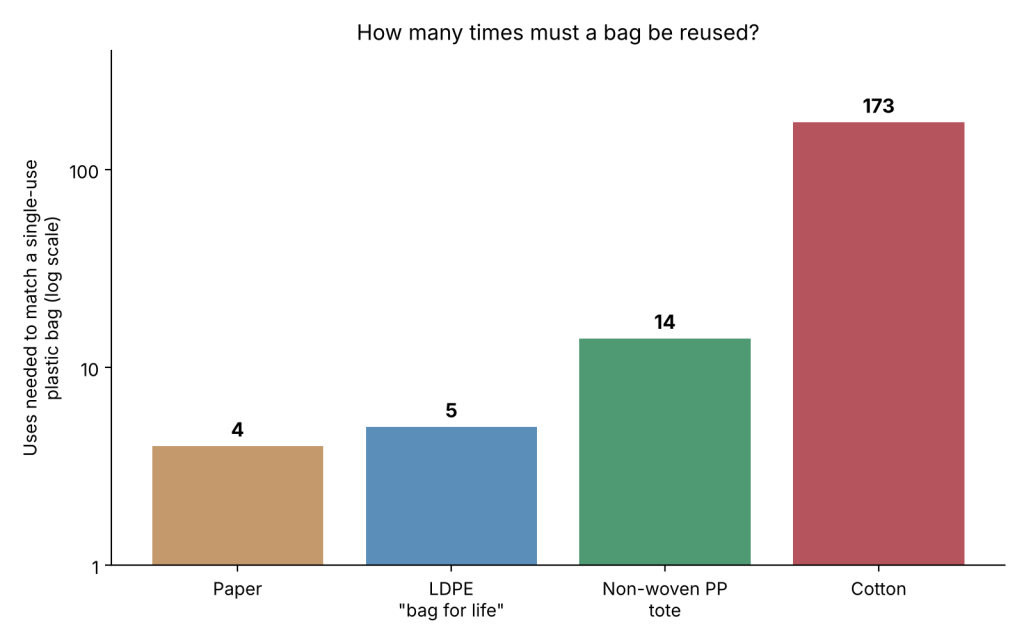
Figure 1. Number of times each bag type must be used to match the global warming potential of a conventional single-use plastic bag, assuming 40% of plastic bags are reused as bin liners. Shown on a logarithmic scale. Data from Edwards and Fry 2011.

Another twist emerges when we look beyond carbon emissions: Conventional plastic persists in oceans and soils for a very long time, fragmenting into microplastics rather than biodegrading, while paper breaks down much faster. Most standard LCAs don’t account for this building up of litter on land and in the ocean. Since most of the plastics ever produced end up accumulated in landfills or the natural environment as opposed to being recycled (Geyer, Jambeck, and Law 2017), plastic bags pose a serious threat to the wildlife that could ingest or get entangled in lingering fragments. Additionally, the original UK supermarket study did not include litter in its scope (Edwards and Fry 2011). Thus, choosing between paper and plastic represents a genuine trade-off between minimizing carbon emissions and preventing long-term physical pollution. 

Ultimately, sustainability is rarely black and white; it depends on what you measure. The single best bag is whichever one you already own and reuse as many times as possible. For scientists and consumers alike, examining these systems reminds us to question our assumptions and look at the whole picture before declaring a winner. 

References

Bisinella, Valentina, Paola Federica Albizzati, Thomas Fruergaard Astrup, and Anders Damgaard, eds. 2018. Life Cycle Assessment of Grocery Carrier Bags. Environmental Project No. 1985. Copenhagen: Danish Environmental Protection Agency. https://www2.mst.dk/Udgiv/publications/2018/02/978-87-93614-73-4.pdf.

Edwards, Chris, and Jonna Meyhoff Fry. 2011. Life Cycle Assessment of Supermarket Carrier Bags: A Review of the Bags Available in 2006. Report SC030148. Environment Agency. https://assets.publishing.service.gov.uk/media/5a7bff74ed915d01ba1ca7c7/scho0711buan-e-e.pdf.

Geyer, Roland, Jenna R. Jambeck, and Kara Lavender Law. 2017. “Production, Use, and Fate of All Plastics Ever Made.” Science Advances 3 (7): e1700782. https://doi.org/10.1126/sciadv.1700782.

Comments

6 Responses to “Paper or Plastic? The Greener Choice Isn’t What You Think”

  1. Farida Shaban Avatar
    Farida Shaban

    Hi iSci! While brushing up on our sustainability lectures from the start of the year, I wanted to find an exact number for how much more sustainable paper bags are than plastic. The answer turned out to be a lot more complicated than I expected. Enjoy!

  2. Ella Nayagar Avatar
    Ella Nayagar

    Hi Farida,
    Cool post! I knew that paper bags weren’t necessarily as eco-friendly as people think but I didn’t know it was to this extent… It’s interesting that there is no clearly “better” option between the two, when you’d think it’s so obvious.

    Some minor feedback:
    – Near the end, there’s a part of your sentence that’s a little wordy – “Since most of the plastics ever produced” – could be shortened to something like “Since most plastic” ?
    – For your Geyer/Jambeck/Law in-text citation, it should just have the first author’s name and then ‘et al.’ since there are more than 2 authors.
    – Your first few paragraphs cite Edwards and Fry after almost every sentence, which gets a bit repetitive. Maybe you could delete a few?

    But overall this was a nice read, I really enjoyed. This is good information to have when thinking about sustainable choices!
    Ella

  3. Claire Cleary Avatar
    Claire Cleary

    Hi Farida! This was a really interesting blog post. I had no doubt in my mind that paper was better than plastic, but I never actually considered the manufacturing process at all! Thanks for sharing your findings :)! A few suggestions I had;

    – P2L1 – You say “which is a scientific methodology used to evaluate the environmental impacts of a product”; this reads a little awkward. Maybe remove methodology and replace it with process?

    – You cite mainly Edwards and Fry for your first couple of paragraphs; maybe another study or citation to back up these ideas would help to make your piece even stronger!

    – P5S2 – You make the claim that using a reusable bag is the most environmentally friendly option, which I believe is fairly common knowledge; however, since your blog post is arguing against the common knowledge of what we know to be the most environmentally sound option, I think a citation here would add to your blog.

    Overall, I really enjoyed reading your writing; thanks for teaching me something new :)!

    Claire

  4. Michelle Zhang Avatar
    Michelle Zhang

    Hi Farida,

    With the push to eliminate single use plastics, it’s important to know the tradeoffs that happen within these policies and I really enjoyed reading your post!

    Here’s a couple things you can look into while editing:

    – In your second paragraph, I would see if there’s any specifics reported for how much emissions paper production produces, as “significant amount of energy” is pretty vague
    – I would define what each category in the x axis of the graph stands for (ie. LDPE = low density polyethylene) in your figure caption, and you can probably cut the title out of the graph
    – If word count allows, I would also take a sentence to explain the differences between different bags (LDPE vs plastic vs non-woven PP)
    – I agree with Ella’s comment that you reference Edwards and Fry when explaining the climate impacts of different bags, though I suggest finding more studies that also look at the same topic for a more inclusive overview. Especially since the study is from a while ago!

    Happy editing! 🛍️
    Michelle

  5. Nica Dimaandal Avatar
    Nica Dimaandal

    Hi Farida!

    This was a great way to apply our lessons from Sustainable Chemistry to a daily use most people don’t think about (plastic vs paper!) The figure was very helpful to my understanding of your post and the conclusion provided a great summary and thoughts for further reflection!

    – P3S1: I would reformat this to say that the transport and disposal matter relatively much less! (Transport and disposal still matter toward climate impact)

    – I wonder if you can add another focus on the environmental impacts of this pollution in paragraph 4. An idea could be to integrate concepts from our Earth Science groundwater lessons, since blog posts should integrate two or more disciplines!

    Overall good job and I enjoyed reading your blog!

    Happy editing,
    Nica

  6. Ava Elcsics Avatar
    Ava Elcsics

    Hi Farida,

    I really enjoyed reading your blog post.

    Some suggestions include:
    – In last sentance of paragraphy two you used the word “and” two times. I would suggest reworking this sentance to only use “and” one time for better sentance flow.
    – In P3S2, you mentioned “research shows that to equate the global warming”, I am a little confused about what “equate global warming” means. I would suggested rereadig this section and explain what this means to the reader.
    – In addition, it took me a couple of times to understand what the last sentance of paragraph 3 is saying. I would suggest rereading this.

    Happy editing,
    Ava

Leave a Reply