Chronic pain is a condition that causes considerable suffering, physical limitations, and emotional distress in people (Elkins et al. 2007). It is defined as pain that persists for longer than 6 months (Elkins et al. 2007). Traditionally, medications are used to ease chronic pain, but their effects can vary, as well as sometimes causing unwanted side effects within patients (Dowell 2022). Researchers have turned their attention to an alternative psychological treatment for chronic pain, one of them being hypnosis. Hypnosis serves as a demonstration as to how psychological processes can alter the brain’s perception of pain (Bicego et al. 2022).
Hypnosis can be defined as a state of consciousness characterized by focused attention and reduced peripheral awareness (Rousseaux et al. 2025). In this waking state, a person detaches their attention from their immediate surroundings and focuses it on inner experiences like feelings, cognition, and imagery (Williamson 2019). The brain has two cerebral hemispheres, the left and the right (as seen in Figure 1). While in our normal waking state, the left brain is our dominant side, the ‘conscious mind’, and is the more intellectual part of us. When we become relaxed or deeply involved in an activity, our right brain becomes more dominant. Researchers consider the right side of the brain our ‘unconscious mind’ because it is more emotional and communicates through symbols or images. (Williamson 2019).
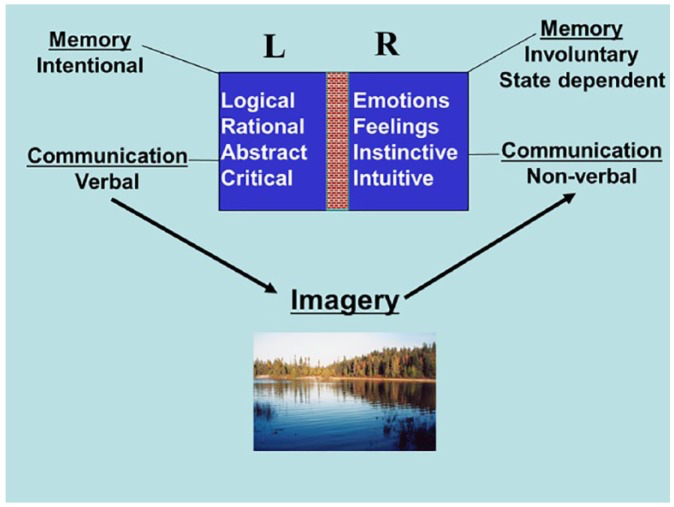
An interest in hypnosis for pain management has increased since recent evidence shows that hypnosis can reduce pain associated with medical procedures (Elkins et al. 2007). Various imaging methods, such as electroencephalography (EEG), can provide information about the brain during pain control hypnosis (Wolf et al. 2022). Highly hypnotizable individuals show distinct patterns of brain activity when experiencing hypnotic analgesia, which is pain relief through hypnosis. Electrical signals detected from EEG, like P200, which indicates the perceived intensity of a stimulus, and N100, which assists the brain in responding to incoming sensory information, are event-related potentials (ERPs) (Wolf et al. 2022;Sur and Sinha 2009). These represent changes in brain activity triggered by a response to a specific stimulus, such as a painful sensation (Sur and Sinha 2009). One study found that highly hypnotizable individuals display larger P200 waves during hypnosis analgesic (Wolf et al. 2022). The larger P200 response suggests that hypnosis can influence the brain’s attention and evaluation of pain. Another study found that highly hypnotised individuals had freed N2 amplitudes over the frontal and temporal regions of the brain, and during analgesia, they also demonstrated a larger N2 peak over temporal regions. This means that hypnosis can influence the brain’s processing of pain-related information in regions associated with attention and sensory processing (Wolf et al. 2022).
Researchers observed that highly hypnotizable individuals experienced a significant reduction in perceived pain, reduced emotional distress associated with the pain, and pain relief that continued even after the hypnosis session ended (Wolf et al. 2022). For instance, a group of people suffering from arthritis pain who underwent the hypnosis intervention experienced a significant reduction in pain intensity after four weeks of treatment, which persisted through three and six months of follow-up. In contrast, those who did not undergo treatment reported only slight changes in pain throughout the 6 months of the study (Gay et al. 2002). Hypnosis appears to influence the brain’s processing of pain, which is why researchers have seen it as a powerful intervention for those with chronic pain (Wolf et al. 2022). Hypnosis does not make the impossible possible, but it can help patients believe and experience what might be possible for them to achieve (Williamson 2019).
References
Bicego, Aminata, Floriane Rousseaux, Marie-Elisabeth Faymonville, Anne-Sophie Nyssen, and Audrey Vanhaudenhuyse. 2022. “Neurophysiology of Hypnosis in Chronic Pain: A Review of Recent Literature.” The American Journal of Clinical Hypnosis 64 (1): 62–80. https://doi.org/10.1080/00029157.2020.1869517.
Dowell, Deborah. 2022. “CDC Clinical Practice Guideline for Prescribing Opioids for Pain — United States, 2022.” MMWR. Recommendations and Reports 71. https://doi.org/10.15585/mmwr.rr7103a1.
Elkins, Gary, Mark P. Jensen, and David R. Patterson. 2007. “Hypnotherapy for the Management of Chronic Pain.” The International Journal of Clinical and Experimental Hypnosis 55 (3): 275–87. https://doi.org/10.1080/00207140701338621.
Gay, Marie-Claire, Pierre Philippot, and Olivier Luminet. 2002. “Differential Effectiveness of Psychological Interventions for Reducing Osteoarthritis Pain: A Comparison of Erickson Hypnosis and Jacobson Relaxation.” European Journal of Pain 6 (1): 1–16. https://doi.org/10.1053/eujp.2001.0263.
Rousseaux, Floriane, Émilie Giguère, Mathieu Landry, et al. 2025. “Comparison of Experimental Pain Modulation by Hypnosis, Virtual Reality and Virtual Reality Hypnosis in Healthy Individuals.” European Journal of Pain (London, England) 29 (10): e70166. https://doi.org/10.1002/ejp.70166.
Sur, Shravani, and V. K. Sinha. 2009. “Event-Related Potential: An Overview.” Industrial Psychiatry Journal 18 (1): 70–73. https://doi.org/10.4103/0972-6748.57865.
Williamson, Ann. 2019. “What Is Hypnosis and How Might It Work?” Palliative Care 12 (January): 1178224219826581. https://doi.org/10.1177/1178224219826581.
Wolf, Thomas Gerhard, Karin Anna Faerber, Christian Rummel, Ulrike Halsband, and Guglielmo Campus. 2022. “Functional Changes in Brain Activity Using Hypnosis: A Systematic Review.” Brain Sciences 12 (1): 108. https://doi.org/10.3390/brainsci12010108.


Leave a Reply
You must be logged in to post a comment.