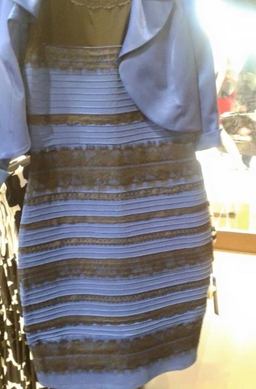
In 2015, a single photo of a dress (see Figure 1) seemed to divide the entire internet. Some people saw the dress as blue and black, while others saw white and gold. Despite staring at the same image, neither side could understand how anyone could see it differently. What seemed like a bizarre debate soon became a scientific mystery. How can two people look at the exact same image and interpret it completely differently?
Colour is not an inherent property of an object, but rather the result of how your brain interprets light. When light hits an object, certain wavelengths are absorbed while others are reflected. These reflected wavelengths enter your eyes and contribute to the colour we perceive. The molecular structure of an object determines which wavelengths it absorbs and reflects, meaning that different materials interact with light differently (Cianci 2023). The reflected light ultimately is what your brain interprets as colour.
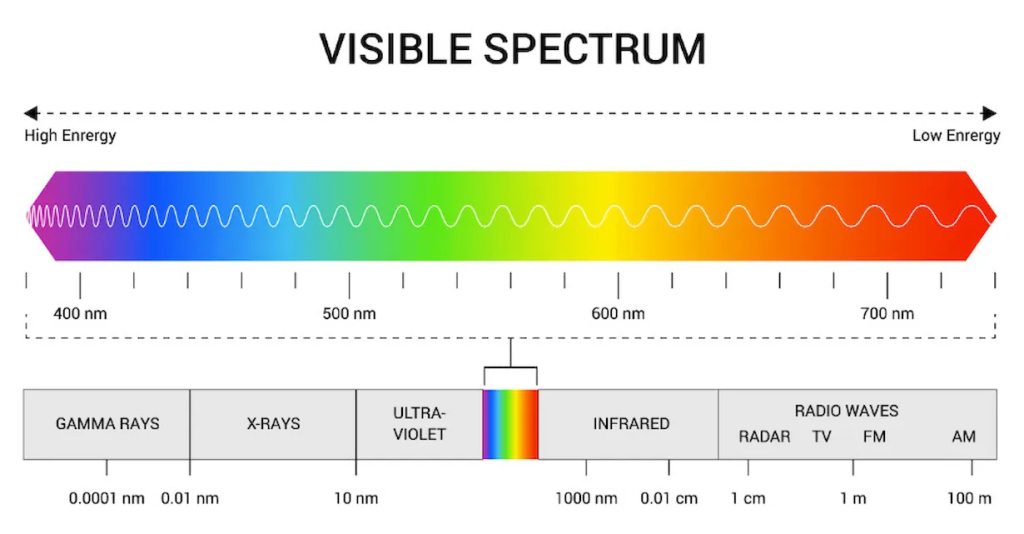
Once reflected light enters the eye, it reaches a layer at the back of the human eye called the retina. The retina is where two types of photoreceptor cells, rods and cones, are located. These cells convert incoming light into electrical signals that are sent to the brain for processing. Rods are responsible for vision in dim lighting and help you distinguish between light and dark, while cones allow you to perceive colour in lighter conditions. Humans generally have three types of cone cells, each sensitive to different ranges of light wavelengths: short, medium and long wavelengths, which ultimately correspond to blue, green and red (see Figure 2). Together these cones send combined information to the brain allowing you to identify millions of different colours. The brain then processes these signals through the central nervous system, transforming the information detected by your eyes into the colours we consciously experience (Bevil R 2021).
However, colour perception is influenced by more than just the wavelength detected by your eyes. Several factors, including surrounding colours, lighting conditions, brightness and visual context, can influence how your brain interprets incoming light (Nassau 2006). One important process involved is known as colour constancy, which allows you to recognize an object’s colour even when the lighting around it changes. For example, a white shirt would normally seem white, whether it is seen under bright sunlight or artificial lighting, despite the light reflected into your eyes being different as illumination changes. This happens because the brain tries to account for the surrounding illumination and adjust its interpretation of the incoming reflected wavelengths. When illumination conditions are unclear, the brain may make different assumptions about the environment an object is in, causing people to perceive the same image differently (Hurlbert 2007).
So whether you see black and blue or white and gold, it is simply a difference in the way your brain interprets colour based on lighting. Since the original photo is overexposed, the lighting is unclear leaving your brain to fill in the uncertainty to distinguish the colour. Some people assume the dress is in a bluish shadow and mentally subtract the blue illumination, causing the dress to appear white and gold. Others assume it is under warmer, artificial lighting leading them to perceive the dress as blue and black (Devitt 2017). This demonstrates how your brain uses colour constancy to compensate for illumination, allowing objects to appear relatively consistent in colour even with changing lighting conditions. Despite the science behind our perception, the question remains: do you see white and gold, or blue and black?
References
Bevil R, Conway. 2021. “Colors.” Current Biology 31 (16): R982–83. https://doi.org/10.1016/j.cub.2021.06.072.
Christoph, Witzel, O. Regan J. Kevin, and Sabrina Hansmann-Roth. 2017. “The Dress and Individual Differences in the Perception of Surface Properties.” Individual Differences as a Window into the Structure and Function of the Visual System 141 (December): 76–94. https://doi.org/10.1016/j.visres.2017.07.015.
Cianci, Lisa. 2023. “Why Are Things Different Colours?” Pressbooks.Pub, RMIT Open Press, February 23. https://rmit.pressbooks.pub/colourtheory1/chapter/why-are-things-different-colours/.
Datacolor. 2020. “The Science of How We See Color.” September 30. https://www.datacolor.com/business-solutions/blog/why-we-cant-agree-color-perception/.
Devitt, James. 2017. “Why Did We See ‘The Dress’ Differently? The Answer Lies in the Shadows, Neuroscience Research Finds.” Www.Nyu.Edu, April 7. https://www.nyu.edu/about/news-publications/news/2017/april/why-did-we-see-_the-dress-differently–the-answer-lies-in-the-sh.html.
Hurlbert, Anya. 2007. “Colour Constancy.” Current Biology 17 (21): R906–7. https://doi.org/10.1016/j.cub.2007.08.022.
Letstalkscience.Ca. 2019. “How Do We See Colour? – Let’s Talk Science.” July 23. https://letstalkscience.ca/educational-resources/stem-explained/how-do-we-see-colour.
Lewis, Tanya. 2015. “Science of ‘The Dress’: Why We Confuse White & Gold With Blue & Black.” Livescience.Com, Live Science, May 14. https://www.livescience.com/50842-dress-debate-color-perception.html.
Lifocolor.De. 2025. “How Colours Are Created and Why We See Them Differently.” June 2. https://www.lifocolor.de/en/news-events/why-people-perceive-colours-differently/.
Nassau, Kurt. 2006. “Color | Definition, Perception, Types, & Facts.” In Encyclopædia Britannica. June 22. https://www.britannica.com/science/color.
Sherman, Bonnie S. 2013. “Perception of Brightness and Contrast.” In Research Starters. EBSCO. https://www.ebsco.com/research-starters/religion-and-philosophy/perception-brightness-and-contrast/.
Wikipedia. 2021. “The Dress.” Wikipedia, April 15. https://en.wikipedia.org/wiki/The_dress.


Leave a Reply
You must be logged in to post a comment.