Insects have been on planet Earth for hundreds of millions of years (Livingston 2014). Therefore we can expect that insects would have information about those years to offer us. Other methods of establishing timelines of an organism’s death, such as carbon dating, are important to date historic artifacts and findings, but insects may be able to narrow the location and environment down even further.
Insects are often found in many burial sites alongside human remains (Magni et al. 2023). These remains can be more recent, but insects can still provide data about organisms that have been deceased for centuries. The type of insects and quantity at a given location can provide valuable information about the burial practices, cadaver age (time of death), and in some cases even a probable cause of death (Magni et al. 2023).
In terms of cadaver age different insects are known to inhabit the bodies of dead organisms at distinct stages of decay. There are insects classified as necrophagous, meaning that they feed off of the carrion of a deceased organism, that inhabit the body shortly after it dies (Entomologists’ soc. n.d.). Necrophagous insects begin to feed hours or even minutes after the body dies and begin to lay maggots. Most of these necrophagous insects in the early stages are common fly species (Sharif 2024). One or two days later, during the bloating phase of decomposition, necrophilous insects arrive. The necrophilous insects are often select beetle species and come to feed on the fly maggots. Omnivorous insects turn up a few days later. Omnivorous insects, such as ants and roaches, find a food source in the corpse as well as the local necrophagous and necrophilous insects. Once the dead organism itself can no longer provide sustenance for the aforementioned insects, it is the opportunist insects who extend their domain into the cadaver (Magni et al. 2023).
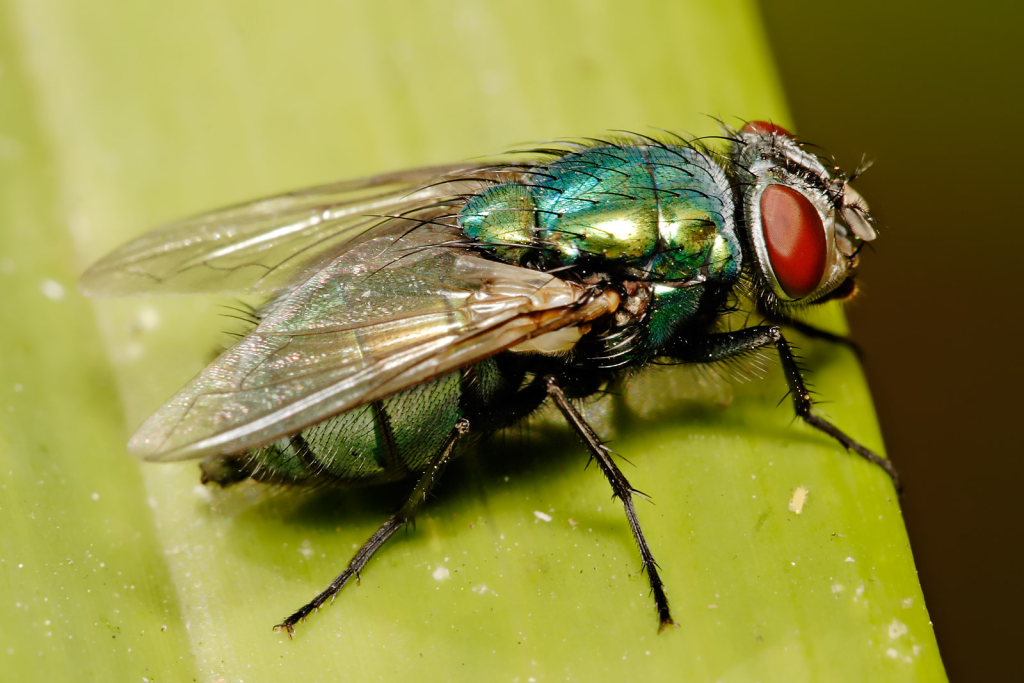
Figure 1. Image of a blow fly, one of the most common necrophagous insects found on recently deceased bodies. The blow fly has distinct lifecycle stages which forensic scientists can measure from maggot, to pupation, to the adult fly. The maggots are hatched in an abrasions on the body or any naturally occurring orifice (Manning 2020). Image from fir0002.
Archaeologists and forensic entomologists can use this data both to determine time lines for deaths in today’s world, but it can also provide valuable information about humans that have been deceased for hundreds if not thousands of years.
The chitin in an insects exoskeleton is well resistant to time and based on the quantity and wear can tell scientists how long they’ve been there, and create an estimate of how many generations of insects the dead organism has sustained since it has been deceased.
Chitinous insects are present all over the world and in the vast majority of ecosystems. The properties of chitin allow it to hold up in a variety of environments for several months to millions of years, more than long enough for scientists to discover it, making this process widely applicable.
References
“Forensic and Ecological Significance of Necrophagous Insects: Insights from Animal Carcasses, Human Cadavers, and Myiasis Patients – Sciencedirect.” Forensic and ecological significance of necrophagous insects: Insights from animal carcasses, human cadavers, and myiasis patients, November 2024. 10.1016/j.legalmed.2024.102544
Livingston, Stephanie. “Global ‘tree of Life’ Study Shows Insects Ruled Earth 400 Million Years Ago.” Global ‘tree of life’ study shows insects ruled Earth 400 million years ago, May 10, 2019. https://www.floridamuseum.ufl.edu/science/global-tree-of-life-study-shows-insects-ruled-earth-400-million-years-ago/.
Magni, Paola Annarosa, Abigail Dianne Harvey, and Edda Emanuela Guareschi. “Insects Associated with Ancient Human Remains: How Archaeoentomology Can Provide Additional Information in Archaeological Studies.” MDPI, January 3, 2023. 10.3390/heritage6010023
Manning, Paul. “Life after Death: How Insects Rise from the Dead and Transform Corpses into Skeletons.” Dalhousie News, October 29, 2020. https://doi.org/10.64628/aam.4a7dfk6rn
“Necrophagous.” Necrophagous – Entomologists’ glossary – Amateur Entomologists’ Society (AES). Accessed October 2, 2026. https://doi.org/10.1039/BK9781847558084-00338
Wikimedia Commons contributors, “File:Australian sheep blowfly.jpg,” Wikimedia Commons, https://doi.org/10.1007/springerreference_90315
Comments
5 Responses to “Archaeoentomology: Using Insects to Tell Time”
Hi iSci!
In Life Sciences we have been looking into the behaviours and attributes of different insects, as well as their relationships with their environments. The concept of organisms in relation to their environment is also a topic we’ve covered in Earth Sciences, in the form of carbon dating organisms to get a more accurate date on fossils or artifacts. I was interested to learn how insects might be useful in dating as well!
Hey Ella!
I thought your blog about how different groups of insects can be used for dating was really interesting. One thing that could make your blog a bit clearer is adding a specific example of how scientists use the presence of a certain insect to estimate the age of a body. I think this would help connect the different insects you introduced to the actual process of determining the body’s time of death. I think it would make the blog more interesting if you can also briefly explain how environment factors like temperature or location, might affect the insects as this can show why use of insect to determine timelines are limited. Overall, I really enjoyed reading your blog!
Hi Ella,
What a fascinating blog post! I never knew how an insect’s exoskeleton and the type of insect inhabiting the organism can play a role in determining the cadaver age!
Some suggestions:
-For in-text citations, remember to always cite the source in the first sentence that you reference that source: for example, in P2S1: “Insects are often found in many burial sites alongside human remains (…) and in some cases even a probable cause of death. (Magni 2023).” While you do have the citation at the end of the paragraph, it needs to go in the first sentence as well as the last to ensure the reader knows what source is being used.
-Remember to put your references in a bold blue title!
-In P5S2: “At least long enough for scientists to discover it, making this practice widely applicable.” I think this sentence starts a bit awkwardly from the last sentence. Maybe you could write it as, “Insects are present all over the world, and the properties of chitin allow it to hold up in environments long enough for scientists to discover it, making this practice widely applicable”.
Overall awesome blog post! Happy editing 🙂
Hi Ella,
I really enjoyed reading your paper and loved how it tied with the content you are learning in class! I really enjoy listening to true crime podcasts, so this was really neat seeing how they can determine the time of death using insects. I have a few suggestions:
– You only need a period after the in-text citation.
– Include the brackets (time of death) after the first time you mention cadaver age.
– In your 3rd paragraph, instead of introducing the different species like such, “_____ insects are next.” Consider including some specific times. For example, “10 days after the time of death, necrophilous insects consume the necrophagous insects.” This allows a more specific portrayal of the type of information these insects can tell us.
– For citing, if there is more than one author, make sure you include et al. So your in-text for the Magni paper should look like this (Magni et al. 2023). Also in your references, ensure you are using the DOI.
Overall, I really enjoyed reading your blog post, and I look forward to seeing the final copy. Well done!
-Ava
Hello Ella!
Amazing blog post, I really enjoyed reading it! As the second years are in the midst of our PAIx project, our ears perk up whenever we hear about insects – so I really liked this alternative view on entomology. I have a couple of suggestions to make your post even better:
(1) Add a figure! A picture is worth a thousand words and is good practice for blog-style writing.
(2) P3S1: If you have the word count, I think it would be really interesting to include what insects and when they infest the body. If you don’t have the word count, this could be a perfect place for a figure – use the figure caption to add any relevant information.
(3) P3S3: Define the terms necrophilous and necrophagous, your readers don’t know what they mean and what the difference between them is.
Once again, great job!
Happy editing,
Farwa 🙂