Sound surrounds us constantly, and hearing is regarded as one of our most valuable senses (Enoch et al. 2019). But have you ever been in a building where sound seemed to wash over you? Cathedrals are famous for this effect: their high ceilings and stone surfaces cause sound to reflect and linger, causing long reverberations and echo (Figure 1). Sound that carries these room reflections is called “wet,” while sound with the reflections removed is called “dry.” This raises the question: how does one’s auditory environment impact their emotions?
Figure 1. King’s College Choir performance of Gregorio Allegri’s Miserere mei, Deus (King’s College Choir 2014).
Algargoosh et al. (2022) explored this in a mixed-methods study, playing participants the same recordings in dry form and in wet form, the latter including the specific reverberations from worship spaces. From self-reports, positive emotions such as “inspired,” “cheerful,” and “thrilled” were more often named for wet recordings (Figure 2). Heart rate also raised more on average during wet recordings, indicating a physical and emotional response to stimuli.
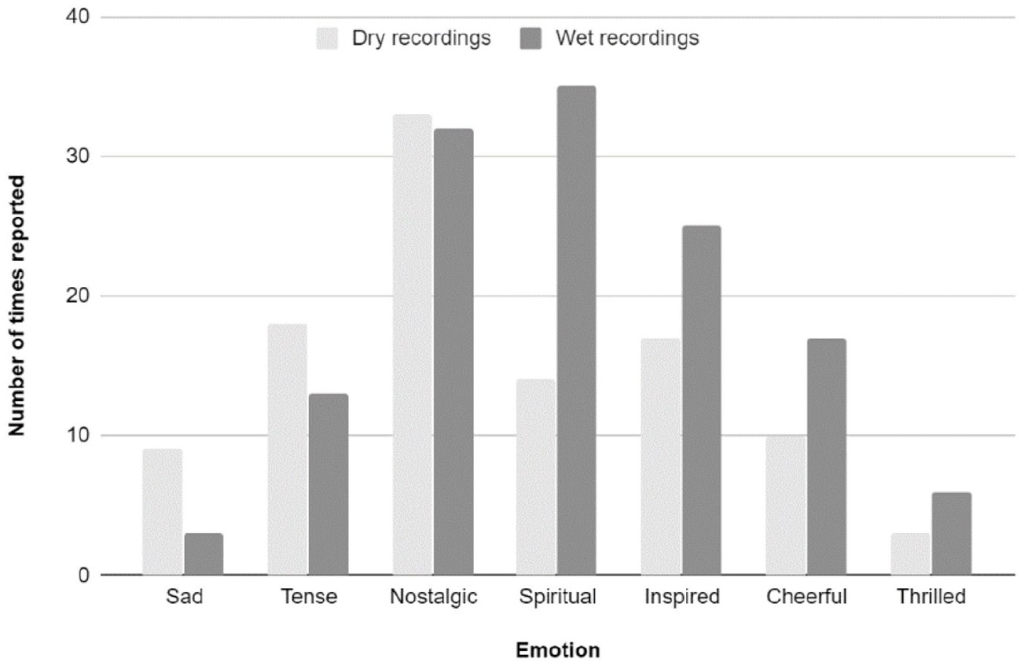
Figure 2. Bar-chart of the number of times each keyword emotion was reported by participants while listening to dry and wet recordings (Algargoosh et al. 2022).
Music’s emotional aspect is best understood through the brain’s reward system. The mesolimbic dopamine system normally reinforces certain crucial stimuli such as food, drugs, or money; correlating each with pleasure. Yet, that same system responds to music. ‘Chills’ or ‘musical frisson’ are normally used as a mark of peak emotional response to audio, representing a pattern of autonomic nervous system arousal (Blood and Zatorre 2001).
Music’s emotional aspect is best understood through the brain’s reward system. The mesolimbic dopamine system reinforces certain crucial stimuli such as food, drugs, or money; correlating each with pleasure. Yet, that same system responds to music. ‘Chills’ or ‘musical frisson’ are normally used as a mark of peak emotional response to audio, representing a pattern of autonomic nervous system arousal (Blood and Zatorre 2001). Positron emission tomography (PET), which uses a radioactive tracer to track molecules in the brain, shows dopamine release in the striatum, a reward-procession region, during pleasurable music. In these moments, heart rate (P<0.05) and respiration (P<0.001) rises significantly while temperature decreases significantly (P<0.01) (Salimpoor et al. 2011). Similarly, functional magnetic resonance imaging (fMRI), which tracks changes in blood flow, adds an understanding of timing. The caudate, involved in predicting rewards, is more active as listeners anticipate a peak, whereas the nucleus accumbens, central to experiencing pleasure, is more active during the peak itself (Figure 3). In fact, composers in music frequently exploit this phenomenon by slowing the tempo or prolonging tension before resolution. This cycle of dopamine release from anticipation and peak is prominent in sacred music composed for resonant spaces, with slow harmonic swells and long suspensions.
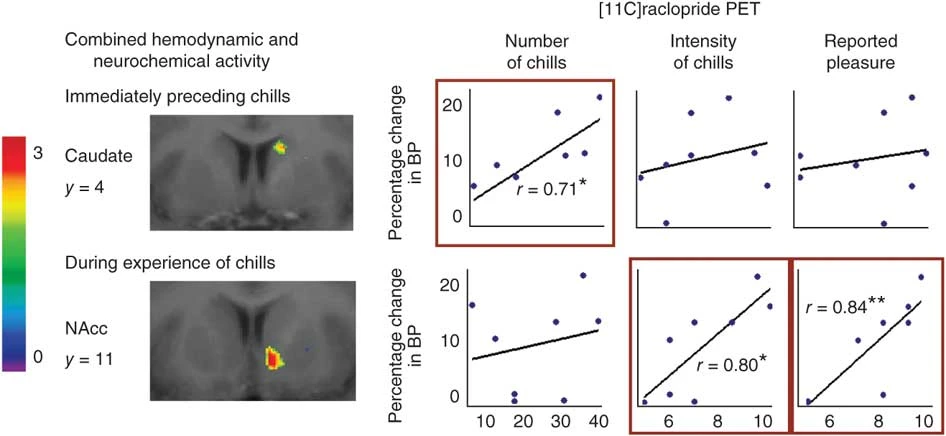
Figure 3. Coronal slices (left) that show the differences in two sections of the striatum, caudate and nucleus accumbens (NAcc), during music-induced chills. Coloured areas represent where dopamine release was detected, and warmer colours indicate stronger effects. Behavioral ratings of the number and intensity of chills and pleasure reported (right) during the PET scans plotted against a radioactive trace [11C]raclopride binding potential changes in both clusters. The number of chills reported was positively correlated with percent binding potential change in the caudate. Asterisks mark statistically significant correlations (Salimpoor et al. 2011).
Music is present in most religious services, and the social setting of ritual can intensify its emotional effect to the point of ecstasy (Penman and Becker 2009). A main link to spirituality is awe, an emotional response to perceptually vast stimulithat exceeds one’s current understanding (Keltner and Haidt 2003). Cappellen and Saroglou (2012) analyzed the effect of awe on individuals who are religious, which discovered that awe nudges people toward spiritual interpretations: participants asked to recall an awe-inspiring event gave especially spiritual responses on a later questionnaire. The pleasure of music and the awe of the space reinforce each other, though no study directly tests such a combination.
The evidence demonstrates that resonant architecture amplifies sound, music engages reward circuitry through anticipation and release, and the vastness of both can evoke awe. So do cathedrals make you believe in God? Not directly – acoustics have not been directly shown to create belief thus far, but they explain why these spaces so reliably produce pleasure and wonder that is perceived as a spiritual experience. When combined with religious settings, these effects help explain why music and architecture are powerful elements of worship and belief.
References
Algargoosh, A., B. Soleimani, S. O’Modhrain, and M. Navvab. 2022. “The Impact of the Acoustic Environment on Human Emotion and Experience: A Case Study of Worship Spaces.” Building Acoustics 29 (1): 85–106. https://doi.org/10.1177/1351010X211068850.
Blood, Anne J., and Robert J. Zatorre. 2001. “Intensely Pleasurable Responses to Music Correlate with Activity in Brain Regions Implicated in Reward and Emotion.” Proceedings of the National Academy of Sciences of the United States of America 98 (20): 11818–11823. https://doi.org/10.1073/pnas.191355898
Enoch, Jamie, Leanne McDonald, Lee Jones, Pete R. Jones, and David P. Crabb. 2019. “Evaluating Whether Sight Is the Most Valued Sense.” JAMA Ophthalmology 137 (11): 1317–20. https://doi.org/10.1001/jamaophthalmol.2019.3537.
Keltner, Dacher, and Jonathan Haidt. 2003. “Approaching Awe, a Moral, Spiritual, and Aesthetic Emotion.” Cognition and Emotion 17 (2): 297–314. https://doi.org/10.1080/02699930302297.
King’s College Choir. 2014. “King’s College Choir Announces Major Change.” YouTube video, March 31, 2014. https://youtu.be/ukDAfF0-8q8?si=vXH17TQPag7JQ0X1&t=48.
Penman, Joshua, and Judith Becker. 2009. “Religious Ecstatics, ‘Deep Listeners,’ and Musical Emotion.” Empirical Musicology Review 4 (2): 49–70. https://doi.org/10.18061/1811/37474.
Salimpoor, Valorie N., Mitchel Benovoy, Kevin Larcher, Alain Dagher, and Robert J. Zatorre. 2011. “Anatomically Distinct Dopamine Release during Anticipation and Experience of Peak Emotion to Music.” Nature Neuroscience 14 (2): 257–62. https://doi.org/10.1038/nn.2726.
Van Cappellen, Patty, and Vassilis Saroglou. 2012. “Awe Activates Religious and Spiritual Feelings and Behavioral Intentions.” Psychology of Religion and Spirituality 4 (3): 223–36. https://doi.org/10.1037/a0025986.
Comments
17 Responses to “Why Cathedrals Make You Believe in God: How Acoustics Relate to Neurological Reward Circuitry”
Hi iSci!
I hope you enjoyed reading 🙂
This first post of mine combined acoustics and sound (physics), psychology, and also biology. It also includes social sciences through the aspect of religion studies.
I got curious about the topic after discovering the LIVELab at McMaster and all of their amazing work regarding music and psychology. As a musician myself, I got curious about why ‘holy’ or ‘spiritual’ places feel that way by nature (e.g. Notre Dame Cathedral) from a scientific perspective. The most interesting part for me was connecting between architectural acoustic design to human reward systems to religious ties.
I would love any and all feedback!
*Please note that this post is neutral regarding any/all religious stances and does not promote any method of belief*
Hi Berk!
Great job on your blog post, I enjoyed reading it!
I just have a few suggestions while you edit.
-Be careful of word count, your blog looks quite long and upwards of 650 words, try to keep it within 400-500
-Question at the end of P1, remove the “for”, strengthens the flow of the paragraph.
-Can you put figure 1 after your first paragraph? It is usually good practice to reference your figure in writing before
-I think you are missing a space before your citation in the last sentence of P2
-P3, since PET is an abbreviation, the first time you use the word, say “Position emission tomography (PET),” then use “PET” any other times
-Typically, the final paragraph of your post should not include any new information that requires citations, I would suggest cutting some of the paragraph down and split the paragraph in two to write a stronger conclusion
Overall great work!
Happy editing
-Hava
Hi Hava,
Thank you for your incredibly helpful feedback! I have applied all changes that were possible. For word count though, my year’s count does not involve references or figure descriptions, so it is currently sitting below the maximum 550 limit currently 🙂
Sincerely,
Berk
Hello Berk!
Firstly, I find your topic incredibly interesting and unique! I really liked how you referenced reliable research studies and graphs to support your arguments. Some suggestions:
– I think you might need to cut down on some info, as your blog might exceed the suggested word limit
– Certain words and jargon could be simplified to communicate the scientific topic more clearly. For example, you could briefly explain what the caudate and nucleus accumbens are before elaborating on them.
Overall, you did a wonderful job!
– Swetha S
Hi Swetha,
Thank you for your wonderful feedback!
The post is currently sitting below the maximum word count of 550 (does not include figure descriptions), but I did cut down on some of it.
I have implemented all other pieces of feedback.
Thank you,
Berk
Hi Berk,
Really interesting blog topic!
I just had a suggestion: would you be able to define wet vs dry sounds more fully? Since the graph you included is directly contrasting these, a proper definition of both would help readers understand the data.
I look forward to reading your final draft!
Alice
Hi Alice,
Thank you for your advice! I have implemented your changes.
Thank you,
Berk
Hello Berk, I really enjoyed your blog post on Cathedrals, it was a fascinating topic that drew me in immediately!
Here a few suggestions:
P1S1 – you say “Sound is all around us, being our second most valuable of our 5 senses”, this sentence is a tad difficult to read, I would maybe change it too, “Sound is all around us, it being the second most valuable of our 5 senses.” or maybe “Sound is all around us, being our second most valuable of 5 senses.”
P1S3 – what makes a song be defined as wet? I would define wet and dry sounds a little more clearly in P1 or 2 because I can’t fully understand the study in P2 without that info.
P2S2 – you say participants twice, I would maybe try to reword that so you only say it once in the sentence.
P4S2 – you say “Statistically, when listening to pleasurable music, heart rate rises significantly (P<0.05), respiration rises very significantly (P<0.001), and temperature decreases significantly (P<0.01). " I don't believe something can be significant and very significant. Something is significant or it's not, so I would remove the very.
Overall, amazing job Berk!! – Ava Petteplace
Hi Ava,
Thank you for the advice! I have implemented your changes and changed P1S1 completely.
Thank you,
Berk
Hello Berk,
Amazing blog post, it was an interesting read. I have a couple suggestions that will make it even better:
(1) P1S1: Awkward phrasing and the fact that it is our “second most important sense” seems out of place and irrelevant.
(2) P2S2: In the sentence, you use the word “self-report” and then later use the verb “reported”. Change the latter to avoid repetition.
(3) P4S1: From my knowledge, PET stands for POSITRON emission tomography, not POSITION emission tomography.
Once again, good job!
Happy Editing,
Farwa 🙂
Hi Farwa,
Thank you so much for the advice! All changes have been applied 🙂
Hi Berk!
I really enjoyed your post, especially the connection you made between the physical properties of a space and the neurological response to music. I agree with Alice and Ava that defining “wet” and “dry” sounds more clearly would help readers understand the comparison in Figure 2.
One additional suggestion is to clarify the transition between the discussion of dopamine and the connection to religious experiences. You explain the reward response to music really well, but the final step connecting this response to feelings of spirituality could be made more explicit. For example, briefly explaining how the experience of awe might interact with the pleasurable response to music would make the overall argument easier to follow. I also think this would help distinguish what the studies directly demonstrated from the broader connection you are proposing.
Overall, I thought your blog post was very interesting and I’m excited to see the final edit!
Happy editing!
Samara 🙂
Hi Samara,
Thank you for your advice! I have implemented your changes word count permitting.
Sincerely,
Berk 🙂
Hello Berk,
Great blog post! A couple suggestions I have:
– Within paragraph 4, I suggest your place your citation for the first couple sentences, be placed closer as you mention many p-values, that as of right now seem like they came out of nowhere.
– Especially because you do not reference it later on, you do not need to define large terms with their acronym name (e.g autonomic nervous system (ANS)). But with the term fMRI, you use the acronym without defining the term first.
– Your figure 3 should be more accessible to the blog reader through your caption. You should describe aspects of the figure such as the asterisks on the scatterplots, what is NAcc and how does that differ from the caudate, and what does the colour scale on the left represent.
Happy editing!
Hanna
Hi Hanna,
Thank you for all of your very helpful advice! I have implemented all of your suggested changes.
Sincerely,
Berk 🙂
Hello, Berk
I really enjoyed this post! I thought the connection between acoustics, music, the brain, and religion was really interesting, and something I have never thought of before. Here are a few things I think could overall help clean up your blog:
– I think including a more clear defintion of wet vs. dry may help readers understand your arguement fully.
– I found Figure 3 to be complicated. I think it could use a bit more explaining in simple terms. It would help to tell the reader what the different parts of the figure are showing and what they should take away from it.
– The conclusion is good, but I think it could connect back the original question more directly. Since the title asks why cathedrals make people believe in God, the ending could clarify that the research explains why these spaces can creating feelings of pleasure and spirituality, rather than proving that they directly cause religious belief.
Overall, I loved reading your blog!!
Audrey
Hi Audrey,
Thank you for your comments! I have implemented your changes word count permitting.
Sincerely,
Berk Coskun