The American psychologist William James famously said, “the same space of time seems shorter as we grow older” (James 1890, 625). But a day is still 24 hours, so why does time seem to speed up as we grow older? Time is something that is measured by a clock, remains constant, and is used universally. The days that felt like forever when we were children now seem to pass in the blink of an eye. This has to do with how our brain functions. Although time itself does not actually move faster as we age, the passing of time may feel faster. One of the theory is the routine and memory theory, which is that time spent in routine activities may be remembered as passing more quickly than time spent in new or unfamiliar experiences (Avni-Babad & Ritov 2003).
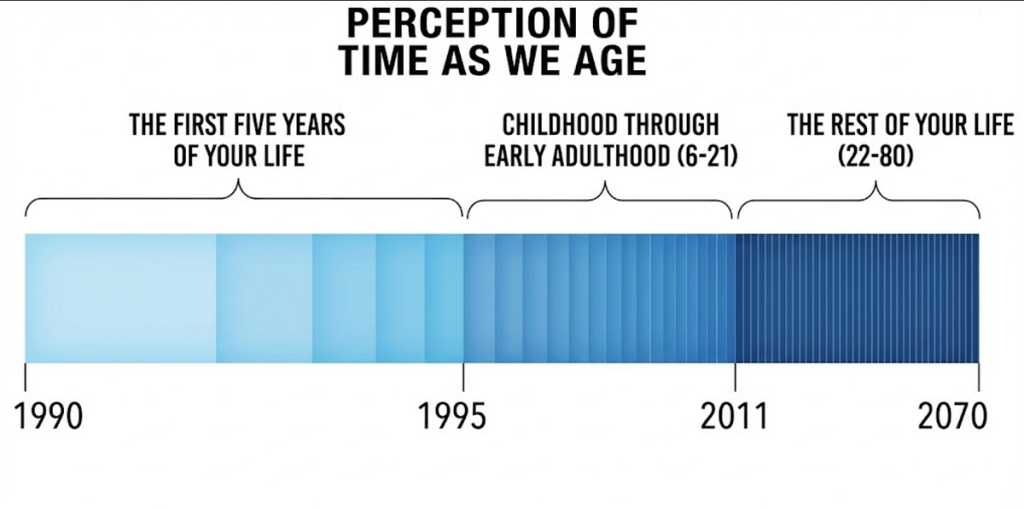
The way we live repetitive lives may influence the speed at which we feel time passes. Research has been conducted with four experiments and two field studies examining how routine affects people’s perception of time. The research was to compare how people remembered time spent in routine versus non-routine situations. In the experiments, routine was created by repeating the same patterns, tasks, or blocks, while the field studies examined people on vacation. Through this experiment participants generally remembered routine periods as shorter than equally long non-routine periods. As a result, research suggested that the brain stores new experiences much more richly than it does of routine experiences. This is because the brain is already aware of is familiar with events happening in the routine, so they do not use much of their energy to storing them. This is why our memory of childhood are so vivid and memorable, while years filled with repetitive routines seem to pass quickly when looking back (Avni-Babad & Ritov 2003).
This becomes even more noticeable with age as childhood tends to contain many first and novel experiences. Over time, this turns into a routine and can occupy a larger part of everyday life. For example, people have hard time remembering what they had for lunch as eating is constantly repeated. However, there may be a way to make time feel slower by getting out of repetitive routines and trying new experiences. David R. Hamilton, a scientist, author, and speaker, explains that novel experiences are encoded more richly than familiar experiences, which can make these experiences stand out more in memory. Therefore, breaking out of routines may make a period of time feel longer when looking back. (Hamilton 2022).
In short, time itself does not speed up as we grow older. Instead, repetitive routine affects how our brain stores the experience. By increasing the routine as we get older by repeating going to school or work, people get familiar with their lives and the brain saves energy in storing them, resulting in fewer distinctive memories. Maybe time does not become faster as we grow older; instead, our lives become too familiar, leaving us with only fewer moments to remember.
References:
David R. Hamilton, “Why Time Speeds Up as You Age,” David R Hamilton PhD, March 17, 2022, https://drdavidhamilton.com/why-time-speeds-up-as-you-age/
Dinah Avni-Babad and Ilana Ritov, “Routine and the Perception of Time,” Journal of Experimental Psychology: General 132, no. 4 (2003): 543–550, https://doi.org/10.1037/0096-3445.132.4.543
MKWritesHere. “Why Time Speeds Up As You Age — And How to Slow It Down.” Medium, February 24, 2026. https://medium.com/@muthu10star/why-time-speeds-up-as-you-age-and-how-to-slow-it-down-41dd250a9d37
Comments
9 Responses to “Where Did the Time Go?”
Hey iSci!
I chose this topic because I was genuinely curious why time feels so much longer in childhood than it does as we get older. Especially since starting university, I’ve felt like time has been passing by so quickly. While researching this topic, I became especially fascinated by how routine and memory can change the way we experience time. This connects to psychology and neuroscience that we will be learning about later in iSci because memory is not simply about remembering information, but also about how the brain stores and retrieves our experiences. The Psychology & Neuroscience textbook discusses how memory works and how different areas of the brain, such as the hippocampus and prefrontal cortex, contribute to different types of memory. Although we have not covered this material in iSci yet, I am looking forward to learning about it, as learning about the neuroscience behind memory will help me better understand why familiar routines can make the times feel like they pass by so quickly. I am especially interested in learning more about how the brain turns our everyday experience into memories and how those memories shape our awareness of time. I hope you enjoy my blog, and I am excited to see your feedback! 😊
Hi Ellie,
Good job on your blog post! This was a really interesting read.
Here are some suggestions to consider while editing:
– P1. S4: I would reword this sentence for better flow to something like “The days that felt like forever when we were children now seem to pass in the blink of an eye.”
– P1. S6: Maybe add a citation here to support that routine and memory theory is the most well-known explanation for this
– P2. S8: Small wording fix: change “our memory of a childhood” to “our memories of childhood are…”.
– Adding a figure could help make the post more visually engaging
Overall, great work and I’m looking forward to seeing your final post!
– Nour
Hi Nour,
Thank you for the feedback! I agree that rewording P1S4 makes the sentence flow more naturally, so I made a change. I also added a citation to support the discussion of routine and memory theory and corrected the wording. As well, I added a figure to make the blog more visually engaging and to help explain the idea.
Thanks again for your help! I really appreciate your feedback.
Ellie
Hi Elie,
I enjoyed reading your blog post. I think this concept is really interesting to look into.
I just have a couple of suggestions for you:
– Be careful with your citation placement. If you are citing a source only at the end of a paragraph but using it throughout, I would suggest using the sandwich method (citing both the first and last sentences of the paragraph).
– In the section where you wrote, “However, there may be a way to make time feel slower. By getting out of repetitive routines and trying new experiences. David R.”, I would combine the first two sentences: “However, there may be a way to make time feel slower by getting out of repetitive routines and trying new experiences.”
– I’m not sure why “David R.” is at the end of that same sentence. I would double-check that reference and consider removing it.
Overall, great job on your first of many iSci blog posts!
Happy editing,
Abbie
Hi Abbie,
Thank you for your feedback!
I combined the two sentences about making time feel slower!
Thank you again for your suggestion. I really appreciate it.
Ellie
Hi Ellie,
Great work on your blog post! It was a really interesting topic to read about.
Here are a few minor suggestions:
– I would recommend adding a figure for a visual explanation of the research studies that you explained in P2.
– I would also recommend formatting the references title as a heading better to distinguish it from the rest of the text.
– Your in-text citations are not properly formatted according to Chicago Author-Date style. In general, Chicago does not use a comma between the author and date, and I recommend fixing that throughout your post, except for the P1 citation.
Overall, great blog post and happy editing!
Saanvi
Hi Saanvi,
Thank you for your helpful feedback! I agree that adding a figure would help readers with the understanding, so I added a figure to visually explain. I also formatted the “References” as bolded. Lastly, I corrected my in-text citations to follow Chicago style by removing the commas between the author and date.
I really appreciate your suggestion.
Ellie
Hi Elie,
Amazing blog post, it was such an interesting read! Here are a couple of suggestions that might make your blog post even better:
(1) Add a figure! This might have been said above, but I think it’s important to re-emphasize! A picture is worth a thousand words.
(2) P3S6: Who is David R. Hamilton? Maybe introduce him so we know why you’re mentioning his opinion.
(3) P1S5: When you state a theory you need to cite it, as it is not common knowledge.
Once again, great blog post – I can’t wait to read the final iteration!
Happy editing,
Farwa 🙂
Hi Farwa,
Thank you so much for your feedback! I agree that adding a figure helps make the content easier to understand; I added a figure to explain how our perception of time changes with age. I also introduced David R. Hamilton as a scientist, author, and speaker to provide more context. As well, I added a citation to the routine and memory theory.
Thank you again for your helpful feedback! I really appreciate it.
Ellie