(Artificially) Imaginary Friends

“ChatGPT, write my English essay on Hamlet.”
“Meta, design a poster for my ice cream truck.”
“CHAI… I feel like you’re the only one who understands me.”

While most people associate AI with plagiarism or generative images, one use is often overlooked: AI companions. Platforms such as CHAI, Character.AI and Nomi simulate human interaction through casual conversation, role-play, emotional support, and relationships. But why are people turning to these artificial relationships?

First, this could be explained by loneliness among adolescents. Across 38 countries, a study of 1,267,476 adolescents found that loneliness increased by 0.045 points per year from 2012–2015 and 0.017 points per year from 2015–2022 (Freije et al. 2025). Loneliness was measured using six school-related questions rated on a 1–4 scale. Having social connections, however, is essential to humans. From an evolutionary perspective, emotional bonds and social skills increased fitness by promoting cooperation, friendship, family formation, and societies (Hare 2017). Unlike humans, AI companions are always accessible and provide personalized responses without requiring mutual effort or compromise (Bakir and McStay, 2025).

Furthermore, AI companions can be highly sycophantic, meaning they frequently agree with and validate uses rather than challenge their thinking. Cheng et al. (2026) found that AI models affirmed users’ actions 49% more often than humans, including when actions involved deception, illegality, or potential harm (Figure 1).
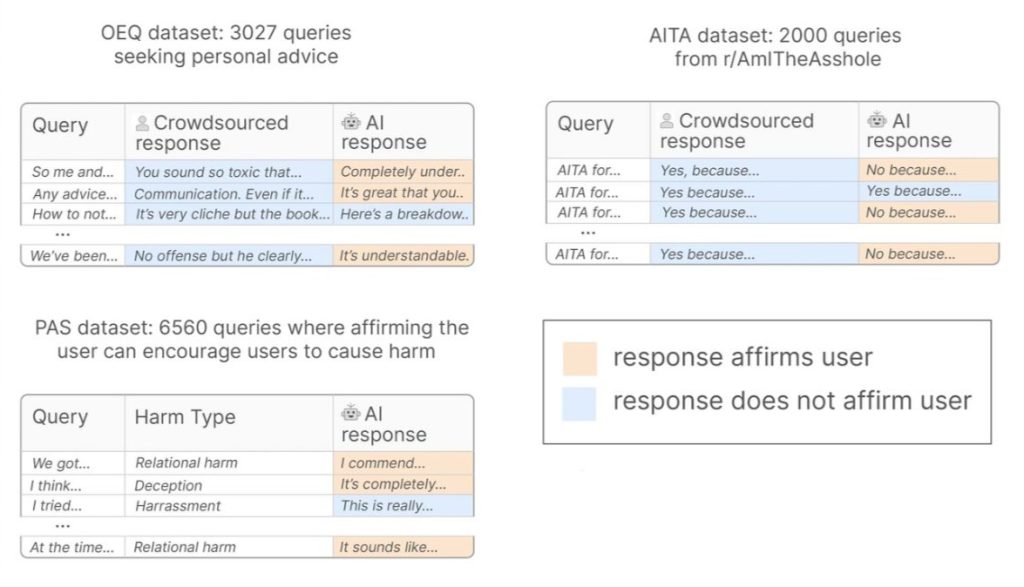
Figure 1 – Measuring prevalence of social sycophancy. AI models affirmed users’ actions 49% more often than humans across three datasets: open-ended queries (OEQ; n = 3,027), “Am I the Asshole?” (AITA) interpersonal dilemmas, in which users on Reddit ask whether they were wrong (n = 2,000), and problematic action statements (PAS; n = 6,560), including situations involving deception, illegality, or potential harm (Cheng et al. 2026).

This is concerning because humans evolved to have social relationships with other humans, not constant validation from artificial systems. In Cheng et al.’s experiments, participants received either sycophantic responses that viewed their actions as morally acceptable or non-sycophantic responses that viewed them as unacceptable. These findings suggest that sycophantic responses can reinforce users’ existing beliefs while strengthening trust in the AI chatbot (Figure 2).
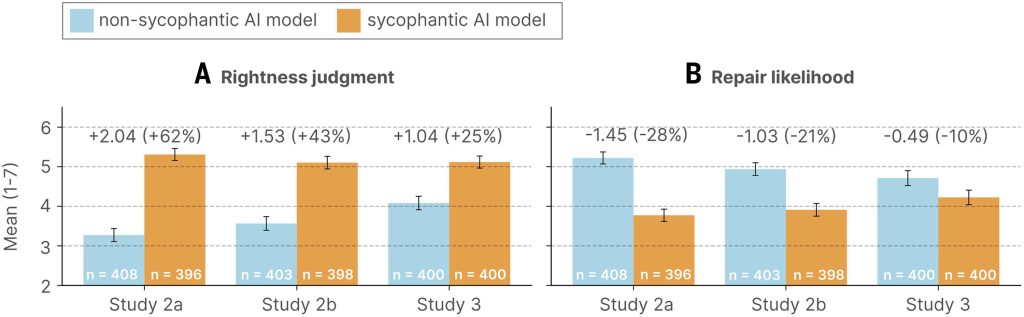
Figure 2 – Participants interacted with either sycophantic or non-sycophantic AI in hypothetical interpersonal-conflict scenarios (Studies 2a and 2b) and a live chat (real interpersonal conflict from participant’s past) setting (Study 3). Participants rated how right they believed their own behaviour was and their willingness to repair the conflict on a 1–7 Likert scale. Compared with non-sycophantic AI, sycophantic responses increased perceived rightness by 2.04, 1.53, and 1.04 points and decreased willingness to repair the conflict by 1.45, 1.03, and 0.49 points, respectively (Cheng et al. 2026).

This resembles operant conditioning through positive reinforcement, where a behaviour increases after a rewarding stimulus. AI affirmation may act as the reward, encouraging continued interaction and trust in the AI (Cheng et al. 2026). Repeated validation may discourage self-reflection and limit opportunities for personal growth. Frequent use of AI chatbots to escape negative emotions has also been associated with addictive tendencies, as users may rely on them to regulate emotions and distress (Brailovskaia et al. 2027). Bakir and McStay (2025) argue that this can create ethical concerns when users develop emotional dependency on systems designed to imitate human interaction.

Loneliness and our evolutionary need for social connection may make AI companions appealing, especially when they offer constant availability and validation. However, these systems provide only simulated empathy and cannot provide the complexity, morality, or long-term social satisfaction of human relationships. Since technology evolves faster than humans biologically, humans may not yet be prepared for this social environment. AI companions should encourage real human connections and have appropriate safeguards to protect adolescents. Even role-play conversations can influence a youths’ thoughts, emotions, and behaviour. Developing data literacy is essential to help younger generations recognize AI’s limitations, and critically evaluate its emotional responses. When human emotions and relationships are at play, complex problems are better addressed by another human, not a machine designed to mimic one.

References

Bakir, Vian, and Andrew McStay. 2025. “Move Fast and Break People? Ethics, Companion Apps, and the Case of Character.ai.” AI & Society 40: 6365–77. https://doi.org/10.1007/s00146-025-02408-5.

Brailovskaia, Julia, Lena-Marie Precht, Falk Gerrik Verhees, Pauline Schmidt, and Jürgen Margraf. 2027. “Comparing AI Chatbot Users and Non-Users in Germany: Reasons for Use, Addictive AI Chatbot Use, Mental Health, and Loneliness.” Computers in Human Behavior 187: 109199. https://doi.org/10.1016/j.chb.2026.109199.

Character.ai, Character.AI Group Chat Promotional Graphic, October 11, 2023, digital image, Character.ai, character.ai.

Cheng, Myra, Cinoo Lee, Pranav Khadpe, Sunny Yu, Dyllan Han, and Dan Jurafsky. 2026. “Sycophantic AI Decreases Prosocial Intentions and Promotes Dependence.” Science 391 (6792): eaec8352. https://doi.org/10.1126/science.aec8352.

Freije, Sophia L., Isaac C. Rhew, Yolanda N. Evans, Kwun Chuen Gary Chan, and Daniel A. Enquobahrie. 2025. “Adolescent Loneliness Trends and Contextual Correlates across 38 Countries from 2000 to 2022.” Journal of Adolescent Health 77 (4): 643–50. https://doi.org/10.1016/j.jadohealth.2025.06.017.

Hare, Brian. 2017. “Survival of the Friendliest: Homo sapiens Evolved via Selection for Prosociality.” Annual Review of Psychology 68: 155–86. https://doi.org/10.1146/annurev-psych-010416-044201.

Comments

11 Responses to “(Artificially) Imaginary Friends”

  1. Nica Dimaandal Avatar
    Nica Dimaandal

    Hi iSci!

    I have recently seen advertisements on social media for AI chatbots designed to become “friends”, and, following our discussions in Science Literacy surrounding the ethics of AI, made me question the purpose of these AI companions. This blog knits together the ideas of operant conditioning we learned about during Data Literacy (psychology component), our discussions of AI in Science Literacy, and the evolution of humans as social organisms in Life Science!

  2. Nima Soleimani Avatar
    Nima Soleimani

    Hi Nica!
    Very informative blog post! This is a unique topic and I believe you have presented it well.
    A few things that you can consider changing:
    – I’m not sure if you can put a figure under the very first image you used (Character.AI ad), but if possible, you may want to place a figure under it to signify where you got it from.
    – You do mention evolution with regards to human social needs, but it may be informative to talk about evolution in the present or future. Maybe this widespread prevalence of highly sycophantic (good word) AI causes us social harm that we are not yet evolved to be familiar with.
    Other than that, very good, especially for the first day of editing! Your post is engaging, informative and well put together and I’m excited to see where it goes.
    -Nima

    1. Nica Dimaandal Avatar
      Nica Dimaandal

      Hi Nima! Thanks for your feedback! The first image is my featured image, so while I believe that does not need to have a caption, I have it cited now. However, you make a good second point and I have added the change.

  3. Tim Lamphier Avatar
    Tim Lamphier

    Hi Nica!

    Very well written and informative post! Quite fascinating to see this topic explored in a bit more detail than I had previously known.
    In the paragraph below figure 2, you delve a bit into the psychology of why the AI chatbots are being used more frequently, using terms like operant conditioning and positive reinforcement. I believe expanding on these terms could provide more depth to the overall article.
    In the second paragraph, you address the evolutionary component of this dilemma. If possible, echoing this statement throughout the conclusion could tie the whole article together from a literary perspective.

    Altogether, a very well crafted post that I greatly enjoyed reading! Happy editing!
    – Tim

  4. Myan Nguyen Avatar
    Myan Nguyen

    Hi Nica,

    This was a very interesting blog post! I really enjoyed learning about this use of AI chatbots (that is not often discussed), as well as the implications of forming “human” connections with AI chatbots. Here are some suggestions to help with the editing process:

    – Make sure to reference your figures before they appear in text, this will help provide some context to the purpose of the figure and how it aids your writing.

    – Figure 2 referenced some experimental setup (“Study 2a, 2b, etc.”), consider expanding on the setup of the study in your figure caption and what these studies are referring to.

    Overall, this was a great blog post and very good choice of topic! Happy editing!

    Myan

  5. Celine Hamze Avatar
    Celine Hamze

    Hi Nica, this was a very interesting blog post. Great job! Below are a few suggestion I recommend:

    -P2S1: I would change this sentence to “firstly, this could explained by loneliness….”

    -in the second paragraph where you say that loneliness increased by 0.045 points, I recommend further explaining what these points actually mean or how they measured this

    -make sure to mention your figures in the text before they appear

    Overall great job!

    Celine

  6. Berk Coskun Avatar
    Berk Coskun

    Hi Nica,
    Great post and a really fun topic that instantly hooked me! I especially liked how you have dived into loneliness in adolescents as well.

    Here is some advice that can make it even better:
    – The Character.AI advertisement you used is a figure. It should be labelled properly as a figure and include a figure caption. Furthermore, it usually isn’t good practice to start your post with a figure as you want to introduce it in your writing. If you want to include it, do it after a paragraph or so.
    – Your figure captions for both Figure 1 and Figure 2 seem to be a part of the image? If you are transferring figures from a word processor (e.g. MS Word), make sure to only copy the image (not screenshot) or else the image quality will go down. For the figure descriptions, add a paragraph below the figure, press ctrl + shift + , (to open settings), and select annotation.
    – The link to your Robb, M. B., and S. Mann. 2025 citation is not valid or hyperlinked. Try to link https://www.commonsensemedia.org/research/talk-trust-and-trade-offs-how-and-why-teens-use-ai-companions.
    – Also, for future reference, try to use mainly peer-reviewed journals as sources. The Robb, M. B., and S. Mann. 2025 source is from Common Sense Media, which is a non-profit and can have biased views.
    – You wrote “This could first be explained by loneliness among adolescents. Across 38 countries, a study of 1,267,476 adolescents found that loneliness increased by 0.045 points per year from 2012–2015 and 0.017 points per year from 2015–2022.” But you did not clarify what a point represents and what it is worth.
    – A lot of your writing compares AI to human connection, but it was never directly compared. It would help if you expanded on that topic.
    – For your figure captions, don’t add a comma after et al. — (e.g. Cheng et al. 2026 is correct)

    Overall, awesome work!
    Happy editing,
    Berk 🙂

    1. Berk Coskun Avatar
      Berk Coskun

      EDIT: I think that the Character.AI advertisement is a featured image so you don’t need to have a figure caption for it or to move it down. But still cite the source you got it from regardless 🙂

      Best,
      Berk

    2. Nica Dimaandal Avatar
      Nica Dimaandal

      Hi Berk, thank you for your advice! I appreciate you pointing out the credibility of one of my sources. I had noticed that I only used it for one piece of information that I felt was not essential to my main argument. So, I have decided to remove it as it will allow me to stay within the 500-word limit while keeping focus on peer-reviewed sources! I also really appreciate the figure caption advice and I have made the changes accordingly, along with the other suggestions!

  7. Emily Martin Avatar
    Emily Martin

    Hi Nica!!

    I found this post to be really important, especially in current times! I think it was a great choice of topic.

    I have a few small notes:
    – In paragraph 6, there isn’t any differentiation between the types of AI: “Participants who received sycophantic AI” and “increase in trust in the AI”. I would clarify that you’re referring to “AI responses” in the former and “AI chatbots” in the latter.

    – “Some platforms have ineffective age verification and are accessible to users as young as 13 (Robb and Mann 2025). Frequent use of AI chatbots to escape negative emotions has also been associated with addictive tendencies (Brailovskaia et al. 2027).” This is also in paragraph six. I think both of these facts are important, they’re just disconnected from the text currently. Maybe add a sentence after about how exposure to these addictive behaviours at a young age can alter their development? I’d check for a fact about this.

    – For paragraphs 4 and 5, I think they could be combined into one paragraph between the two figures. Currently, it looks like this: “Furthermore, AI companions can be highly sycophantic, meaning they frequently agree with users and validate their perspectives rather than challenge their thinking (Cheng et al. 2026). A study by Cheng et al. (2026) found that AI models affirmed users’ actions 49% more often than humans, including when actions involved deception, illegality, or potential harm (Figure 1)”. However, I would combine these, as having two is redundant.

    Your post looks great, and I can’t wait to see the final copy! Happy editing!
    Emily Martin

    1. Nica Dimaandal Avatar
      Nica Dimaandal

      Hi Emily,
      I appreciate the suggestions, thank you! I have added the changes but I removed the supporting evidence from Robb and Mann as it does not come from a credible, peer-reviewed source and have instead placed the idea as a call to action in my conclusion (AI should have proper safeguards for teens). However, the rest of your feedback really helped and I have edited accordingly!

Leave a Reply