You may have seen many influencers on social media promoting a carnivore diet, trying to convince as many people as possible that reverting to the diets similar to that of our distant ancestors will grant you life altering effects, and that the consumption of highly processed foods is tearing away at your health. Commonly referred to as the carnivore diet, the stone age diet, or the paleolithic diet, it encourages the consumption of primarily meat for food in order to combat health issues of our era. In reality, the answer on the ideal diet for a healthy life is much more complex.
So why exactly do people believe that being a carnivore is healthy for you?Through a series of nine studies compiled under the National Library of Medicine, the carnivore diet was studied to see whether the claims online showed any real benefit. The research concluded that although there were short term benefits, they were likely drawn from placebo effects, subjective perceptions, and most importantly, effects commonly associated with the effects of ketosis rather than from carnivorism itself (Lietz et al. 2026). Although enticing, long term effects can include raising LDL cholesterol, increasing chances of kidney stones, gout, and osteoperosis (LeWine 2024). Our human carnivore friends likely draw from some of the short term benefits, believing this diet to be a cure all for common ailments people of the modern age face.
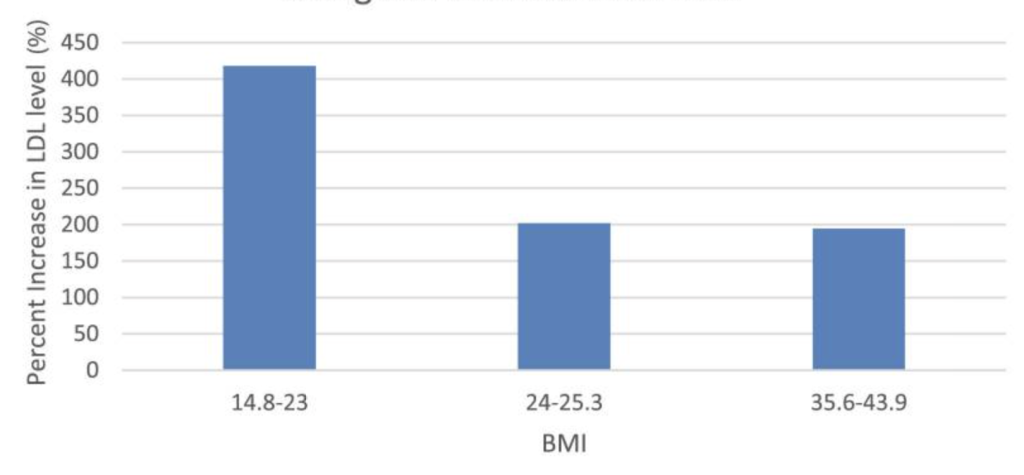
Figure 1: Graph depicting the percent increase in LDL levels based on BMI.The results were taken from people on a keto diet, which replicates similar effects to the carnivore diet (Schmidt et al. 2023).
But why is it that people are so insistent on straying away from modern food? As Stated by Loren Cordain, an evolutionary nutritionist at Colorado State University, the stone age diet is “the one and only diet that ideally fits our genetic makeup” (Gibbons 2014). There rests a belief within people that human beings have not evolved quickly enough to adapt to all the processed versions of foods. In addition, many draw evidence from the introduction of agriculture into our society. When agriculture was invented, human health took a sharp decline. In fact, mortality rates were indicated to sharply increase as a result of a decrease in nutritional diversity (Milner 2019). The consumption of the same grain daily gave early people cavities and periodontal disease not present in the hunter gatherers of the time (Gibbons 2014).
All this might lead you to believe that the diet of the hunter gatherers are superior to the diets of the modern age. That human beings haven’t evolved quickly enough to digest foods of our time properly. After all, we know evolution takes place over hundreds of thousands of years.
However, this is not the case. Humans have never stopped evolving. Since the invention of agriculture, our DNA still continues to change. As stated by geneticist Sarah Tishkoff at the University of Pennsylvania, “Are humans still evolving? Yes!” (Gibbons 2014). The real reason the modern diet has been viewed as harmful is due to the energy rich nature of processed foods. Processed foods provide so much energy for a human being that for the first time in the evolutionary line of humans, many of us consume more calories than we burn per day. Stated by Harvard primatologist Richard Wrangham, “We need to become more aware of the calorie-raising consequences of a highly processed diet” (Gibbons 2014).
So to put it simply, don’t start eating raw meat. Just have a balanced healthy diet, get plenty of exercise, and you’ll probably be all right.
References
Gibbons, Ann. 2014. “The Evolution of Diet.” National Geographic. https://www.nationalgeographic.com/foodfeatures/evolution-of-diet/.
LeWine, Howard E. MD. 2024. “What Is the Carnivore Diet?” Harvard Health, May 8. https://www.health.harvard.edu/diet-and-nutrition/what-is-the-carnivore-diet.
Lietz, Almiera, Janina Dapprich, and Tobias Fischer. 2026. “Carnivore Diet: A Scoping Review of the Current Evidence, Potential Benefits and Risks.” Nutrients 18 (2): 348. https://doi.org/10.3390/nu18020348.
Milner, George R. 2019. “Early Agriculture’s Toll on Human Health.” Proceedings of the National Academy of Sciences 116 (28): 13721–23. https://doi.org/10.1073/pnas.1908960116.
Schmidt, Tyler, David M Harmon, Erica Kludtke, Alicia Mickow, Vinaya Simha, and Stephen Kopecky. 2023. “Dramatic Elevation of LDL Cholesterol From Ketogenic-Dieting: A Case Series.” American Journal of Preventive Cardiology 14 (June): 100495. https://doi.org/10.1016/j.ajpc.2023.100495.


Leave a Reply
You must be logged in to post a comment.