From April 2014 to June 2016, a crisis occurred in Flint, Michigan, due to human-made measures to deliver water to residents (Ray 2026). On April 25, 2014, the state switched Flint’s water supply from Lake Huron to the Flint River to cut costs (Kwong et al. 2024). Corrosion control treatments were also dropped, and to make matters worse, ferric chloride was added to the treatment plan, which only increased the corrosivity of the river (Bellinger 2016). As a result, water was now nineteen times more corrosive than it was before, causing lead buildup to leach from the outdated pipes (Figure 1) (Bellinger 2016). In the end, nearly 100,000 residents were affected by the crisis, and officials had initially denied the claims of increased lead despite traces in children’s blood (Kwong et al. 2024; Ray 2026).
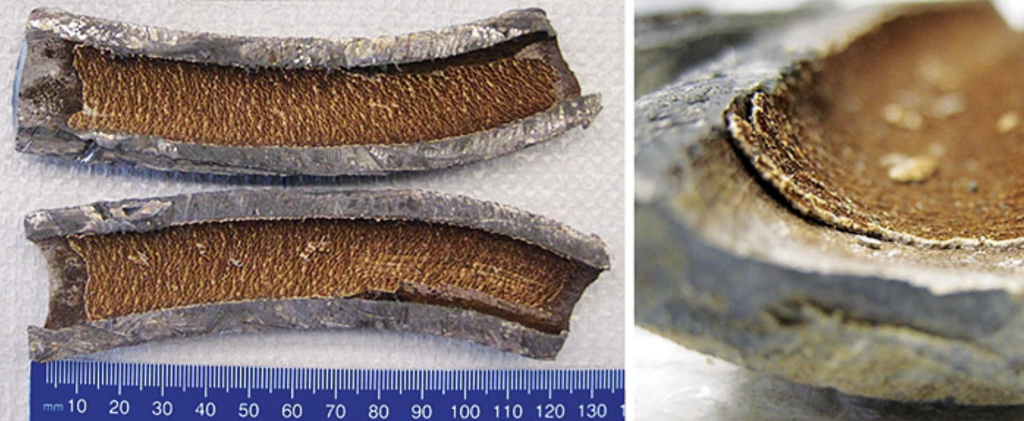
Figure 1. Interior of a lead water pipe from Flint, Michigan, showing the layers of rust and corrosion that line the inner pipe. Photo: courtesy of Terese Olson, via Hiolski(2017).
Proving the lead was there and the quantity of it came down to chemistry. Electrons sit at fixed energy levels, so each element absorbs light at certain wavelengths and it can be used to calculate the abundance of the elements in atomic absorption spectroscopy (Olson et al. 2017). Researchers in Michigan used a related tool: mass spectrometry (Olson et al. 2017). Specifically, inductively coupled plasma mass spectrometry, which sorted the ions by mass-to-charge ratio (Olson et al. 2017). Analysis from old Flint pipes estimated that 2.7 grams of lead was lost per meter of pipe (Olson et al. 2017). In practice, this meant around 18 grams of lead would enter a home’s water over 17.5 months, but no amount of lead exposure is safe, especially for children’s brains (Olson et al. 2017; Bellinger 2016). Lead is particularly dangerous for the brain because it deceives the body by posing as calcium, which then enters the neurons through calcium channels (Figure 2) and stops any real calcium from entering the channels (Turrentine 2023). Calcium helps produce brain-derived neurotrophic factor, which aids in the development of memory and learning (Turrentine 2023). Children are most vulnerable, since their brains are forming a million connections every second, so lead has more opportunities to interrupt neurotransmission and affect their growth (Turrentine 2023).
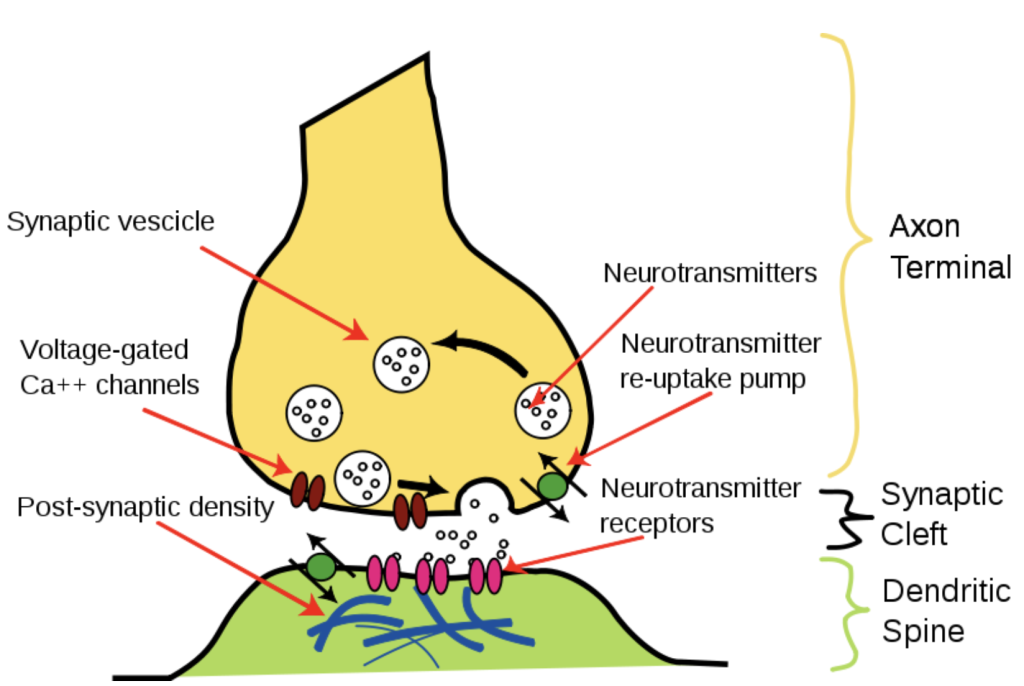
Figure 2. Ca²⁺ channels (dark red) in the axon terminal let calcium in, which then triggers neurotransmitter release at a synapse. Lead can enter these channels. Image: Lindshield, Nutrition Flexbook, via Lindshield (n.d.).
Ten years later, data from the Flint Registry, which tracks over 21,000 participants, reveals that 15% of children were diagnosed with anxiety and 10% with depression, nearly double national rates (Riley 2024). Furthermore, new mothers were given 7,500 dollars from Rx Kids to improve calcium, iron and vitamin C nutrition, as it inhibited lead absorption for kids (Kwong et al. 2024; Riley 2024). On the infrastructure side of things in July of 2024, the city celebrated that they completed replacing all the old lead-filled pipes, but days later the city found 3,200 addresses skipped, and many families are still relying on bottled water today (Rogin and Yang 2025). Beyond Flint, major cities in America continue to have lead pipes, risking it seeping into water systems like Chicago, where 400,000 homes get water through lead pipes (Kwong et al. 2024). Ultimately, powered by cost-cutting measures, Flint’s crisis exposed the environmental injustice where science showed the dangers of the pipes, yet America is still using many even 10 years later.
References
Bellinger, David C. 2016. “Lead Contamination in Flint — An Abject Failure to Protect Public Health.” New England Journal of Medicine 374 (12): 1101–1103. https://doi.org/10.1056/NEJMp1601013.
Hiolski, Emma. 2017. “Researchers Estimate Amount of Lead Released from Flint Water Pipes.” Chemical & Engineering News 95 (33). https://cen.acs.org/articles/95/i33/Researchers-estimate-amount-lead-released.html.
Kwong, Emily, Pien Huang, Rachel Carlson, and Rebecca Ramirez. 2024. “10 Years After Flint, the Fight to Replace Lead Pipes Across the U.S. Continues.” Short Wave, NPR, April 26, 2024. https://www.npr.org/2024/04/26/1198909905/flint-water-lead-poisoning-anniversary-chicago.
Lindshield, Brian. n.d. “12.23 Calcium Functions.” In Nutrition Flexbook. Kansas State University and Lumen Learning. Accessed October 25, 2026. https://courses.lumenlearning.com/suny-nutrition/chapter/12-23-calcium-functions/.
Olson, Terese M., Madeleine Wax, James Yonts, Keith Heidecorn, Sarah-Jane Haig, David Yeoman, Zachary Hayes, Lutgarde Raskin, and Brian R. Ellis. 2017. “Forensic Estimates of Lead Release from Lead Service Lines during the Water Crisis in Flint, Michigan.” Environmental Science & Technology Letters 4 (9): 356–361. https://doi.org/10.1021/acs.estlett.7b00226.
Ray, Michael. 2026. “Flint Water Crisis.” Encyclopædia Britannica, October 18, 2026. https://www.britannica.com/event/Flint-water-crisis.
Riley, Shantal. 2024. “The Children of Flint, Ten Years Later.” Harvard Public Health Magazine, April 25, 2024. https://hsph.harvard.edu/news/the-children-of-flint-ten-years-later/.
Rogin, Ali, and John Yang. 2025. “Flint removes thousands of lead pipes in major milestone, but these problems remain.” Interview with Erik Olson. PBS News Hour, July 2025. https://www.pbs.org/newshour/show/flint-removes-thousands-of-lead-pipes-in-major-milestone-but-these-problems-remain.
Turrentine, Jeff. 2023. “How Exactly Does Lead Exposure Harm the Brain?” Natural Resources Defense Council (NRDC), September 28, 2023. Updated October 2024. https://www.nrdc.org/stories/how-exactly-does-lead-exposure-harm-brain.
Comments
7 Responses to “Lead and Lasting Damage: The Flint Water Crisis 10 Years Later”
Hi iSci!
I was always curious about the Finch Water Crisis that Dr. Greenburg touched on especially how it impacted the city and the psychological impacts of lead exposure. It overlapped with what we learned about neurotransmission in psychology as well as how the abundance of lead was measured which also used spectroscopy something we learned a bit about in Atomic Structure and Theory. Surprisingly 10 years later their are still some things left unresolved and I hope you find this an interesting read!
I am excited to hear all your feedback!
-Asad Baig
Hi Asad,
This was such an interesting blog post! It is disheartening to see how the government can make such a big mistake and still continue to let the citizens down again and again. You did a really good job incorporating science components into the social issue. Below are a few comments to help with your editing process:
– In the last sentence of your first paragraph, I don’t think you should start a sentence with a number. Instead you could say that “Over 100,000 residents…”. You can also make a similar change with the first sentence of your last paragraph.
– I think you have an extra space in between the first and second paragraph that you can remove
– You could consider coming up with a smoother transition between the first and second paragraph as it is pretty abrupt right now
– When doing your citations, I don’t believe that you have to include the page numbers
– You can consider adding in a figure to help visualize some of the information you are explaining. Potentially one of the plasma mass spectrometry could be beneficial.
Great work!
Happy editing,
Julianna
Hi Julianna,
I really appreciate the compliment! I am glad I was successful with connecting the science wihth a social issue.
As per your feedback I changed the 100,000 sentence to “Nearly a 100,000” and for the other sentence. I have also removed the extra spaces and tried to improve my transition to my second paragraph by including specifically why I bring up chemistry. I fixed the citation and included to visual pices of media to help the readers.
Thank You,
Asad
Hello Asad,
I thought your explanation of the study was clear and easy to understand!
One thing I was curious about was the description of how lead levels were measured. Since the paper used ICP-MS, it might be more accurate to explain that the method measures ions based on their mass-to-charge ratios rather than through light absorption (Thomas 2013). Even a brief sentence on this could make the methods section a little clearer.
Nice work overall. I look forward to your final version!
Reference
Thomas, Robert J. 2013. Practical Guide to ICP-MS: A Tutorial for Beginners. 3rd ed. Boca Raton, FL: CRC Press.
Hello Hassan,
I appreciate the in depth feedback! I reread my source and tried to keep in mind your feedback and adjusted my explanation of the methods I talked about with more accuracy and clarity. Thank your for pointing and finding out the discrepancy.
Thanks,
Asad
Hey Asad,
I really like your topic of choice and how important it is for us to acknowledge the negative impacts of chemicals like lead on our bodies. Some suggestions I have for you are:
– You could add a photo or figure to support your analysis. For example, you could add a picture of the corroded lead pipes or a scientific image of the neuronal impacts of lead.
– Remove the additional spacing between the first large paragraph and your second one.
– Use more transition words between each major point for smoother flow.
– Your third sentence, “However, the corrosion control treatments were… ” is rather lengthy, and I’d suggest you separate it into two sentences to make it clearer.
Overall, great work, and I look forward to reading your final draft!
Best,
Swetha S
Hi Swetha,
Firstly, thank you for the acknowledgement of the negative impacts, I am glad to hear more people understand the impact lead has on the body.
I added a figure of the calcium channels I discuessed about for readers to visualize it better and removing the extra spacing. I tried to incoporate the additional transitioning words to ehance the flow and cutting long sentences in half.
Thank You,
Asad