The entire world is made up of tiny entities known as atoms. These are not something you or I could ever see directly; however, despite this, they make up every aspect of our lives, including you. Atoms consist of a nucleus filled with protons and neutrons, with electrons orbiting this inner core. Protons are positively charged while electrons are negatively charged, allowing for many attraction properties within and amongst atoms. Neutrons are neutrally charged and help stabilize atoms; however, if their number becomes incongruent, the atom can become erratic, forming what we call an isotope.
An isotope is an atom of a given element that has the proper number of protons, but a different number of neutrons (Figure 1) (Nuclear @ McMaster 2018). An atom can gain or lose neutrons naturally through decay or artificially in a lab through processes such as fission (IAEA 2023; Canadian Nuclear Safety 2019). Fission involves an atom being struck by a neutron, causing it to split into two or more daughter nuclei while releasing energy and additional neutrons that continue the chain reaction. These daughter nuclei and the energy produced can then be harnessed for various forms of medical research.
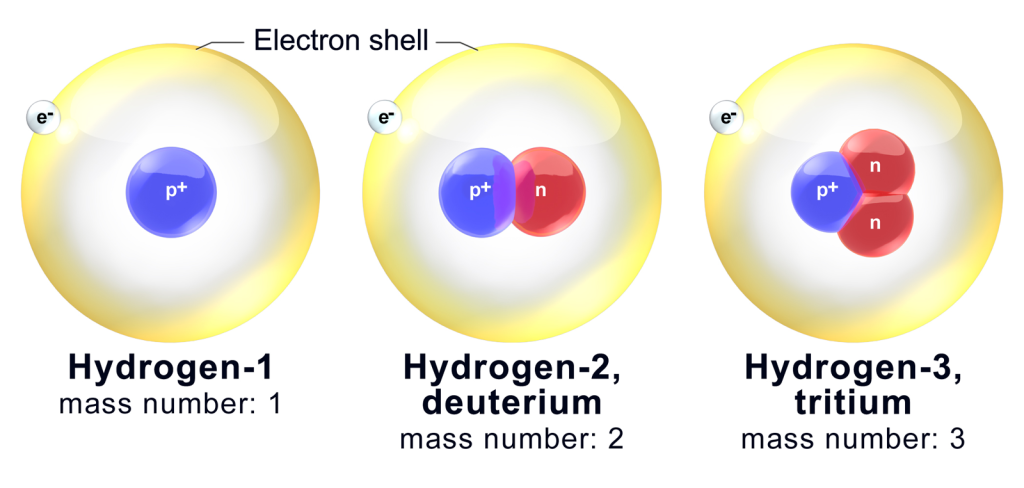
Figure 1. Exemplary figure showing hydrogen isotopes (Office of Science 2023). As you move to the right, the number of protons remains constant while the number of neutrons increases, demonstrating how isotopes of the same element differ only in neutron number.
Established in 2001, the Bruce Power Plant, located in the municipality of Tiverton, Ontario, is Canada’s only private sector nuclear generator, supplying Canada with 30% of its overall energy (Bruce Power 2026). In recent years, Bruce Power has been harnessing the medical isotopes formed during fission, a major development in the biological field. Bruce Power specializes in the formation of Cobalt-60, which naturally radiates gamma rays that have shown benefits in cancer research (Bruce Power 2026).
More specifically, Bruce Power mines non-reactive Cobalt-59 as this is the parent atom for Cobalt-60 (Bruce Power 2025). As seen in Figure 2, specially designed adjuster rods of Cobalt-59 are lowered into Bruce Power’s nuclear reactors while the uranium fission chain reaction proceeds.
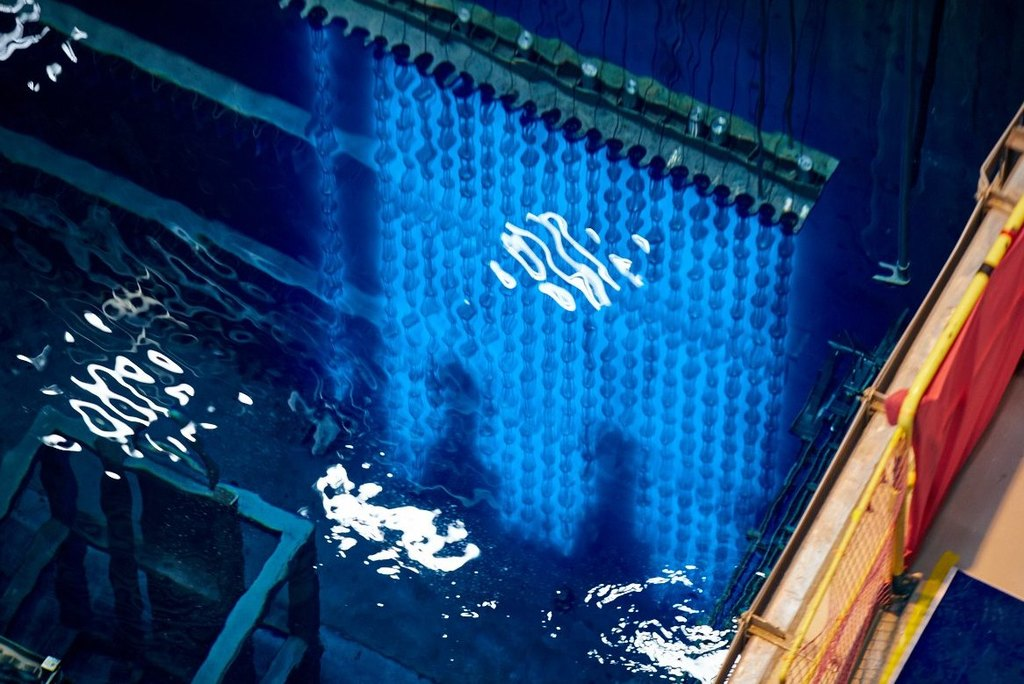
Figure 2. Cobalt-59 adjuster rods held within the nuclear reactor (Bruce Power 2023). Excess neutrons produced during uranium fission activate the conversion of stable cobalt-59 into cobalt-60.
Cobalt-60 has been at the forefront of current cancer research. For brain cancers, Cobalt-60 therapy allows for the delivery of high-dose radiation to tumors while limiting damage to surrounding healthy tissue and organs (Bruce Power 2025). Because of this, gamma radiation has been considered one of the most precise forms of radiation available. The Gamma Knife specifically is a new development in cancer surgeries, being a non-invasive tool (Bruce Power 2025; Bader et al. 2019).
The radiation itself originates from Cobalt-60, an unstable radioactive isotope with an unbalanced nucleus that spontaneously breaks down to become stable (Canadian Nuclear Safety 2025). During this process, a neutron within the Cobalt-60 nucleus is converted into a proton, forming an excited Nickel-60 atom (Sandle 2013). To gain further stability, the Nickel-60 atom releases energy as gamma photons (IAEA 2023). In gamma ray radiosurgery, specialized equipment harnesses this reaction and focuses approximately 200 tiny beams of gamma photons on a cancerous target (Bruce Power 2025). Individually, these beams have little to no effect, allowing surrounding healthy tissue to remain virtually unaffected; however, together they deliver a strong dose of radiation where they intersect. More specifically, the cobalt-60 system has been designed to deliver radiation in a spherical pattern, surrounding the entire tumor (Zhu 2010). With the use of multiple systems, irregularly shaped tumors can be treated as well.
As the world of nuclear energy continues to grow, scientists are working to harness its byproducts into effective solutions to worldly issues like cancer. Thus, not only has Bruce Power provided effective, clean energy, but it has also birthed an entirely new method towards effective cancer research.
Works Cited
Bader, Kenneth B., et al. “For Whom the Bubble Grows: Physical Principles of Bubble Nucleation and Dynamics in Histotripsy Ultrasound Therapy.” Ultrasound in Medicine & Biology, vol. 45, no. 5, May 2019, pp. 1056–1080, www.umbjournal.org/article/S0301-5629(19)30082-1/fulltext, 10.1016/j.ultrasmedbio.2018.10.035.
Bruce Power. “Bruce Power Completes Largest Delivery of Cobalt-60 to Sterilize Medical Devices, Fight Cancer Worldwide.” Brucepower.Com, 2023, www.brucepower.com/2023/11/23/bruce-power-completes-largest-delivery-of-cobalt-60-to-sterilize-medical-devices-fight-cancer-worldwide/.
—. “Cobalt-60 – Bruce Power.” Bruce Power, 2025, www.brucepower.com/isotopes-and-medical-innovation/cobalt-60-isotopes/
“Bruce Power Cobalt-60 Harvest Builds on Innovation and Partnerships, Strengthens Canada’s Role as Medical Isotope Superpower.” Bruce Power, 31 Mar. 2026, www.brucepower.com/2026/03/31/bruce-power-cobalt-60-harvest-builds-on-innovation-and-partnerships-strengthens-canadas-role-as-medical-isotope-superpower/.
Commission, Canadian Nuclear Safety. “Atoms – Nuclides, Isotopes and Radioactivity.” Cnsc-Ccsn.Gc.Ca, 2025, www.cnsc-ccsn.gc.ca/eng/nuclear-safety-security/educational-resources/radiation/atoms-nuclides-radioisotopes/.
—. “What Is Radiation?” Cnsc-Ccsn.Gc.Ca, 2019, www.cnsc-ccsn.gc.ca/eng/nuclear-safety-security/educational-resources/radiation/what-is-radiation/.
Galindo, Andrea. “What Is Radiation?” IAEA, International Atomic Energy Agency, 25 Jan. 2023, www.iaea.org/newscenter/news/what-is-radiation.
Office of Science. “DOE Explains…Isotopes.” Energy.Gov, 2023, www.energy.gov/science/doe-explainsisotopes.
Sandle, Tim. “Gamma Radiation.” Sterility, Sterilisation and Sterility Assurance for Pharmaceuticals, 2013, pp. 55–68, 10.1533/9781908818638.55.
“What Is an Isotope? – Nuclear @ McMaster.” Nuclear @ McMaster, 30 Aug. 2018, nuclear.mcmaster.ca/resources/make-a-radioisotope/.
Zhu, Dengsong, et al. “Study of a Spherical Phantom for Gamma Knife Dosimetry.” Journal of Applied Clinical Medical Physics, vol. 11, no. 2, Mar. 2010, pp. 222–229, 10.1120/jacmp.v11i2.3130.
Comments
9 Responses to “Bruce Power Isotopes”
Hiii, my name is Ava, and this is my blog post on Bruce Power isotopes.
My family grew up in Kincardine, Ontario, right near the Bruce Power plant, so I have always remembered it as that little grey box in the distance. Since coming to Mac, I have had the privilege of learning more about nuclear energy through our research projects in iSci, and I have found it to be a fascinating topic!
This blog integrates chemistry and physics with a specific focus on nuclear energy and the role it can play beyond power generation. Thank you so much for reading, and I look forward to your comments!
– Ava Petteplace
Hi Ava,
Great post! I thought it very cool to learn that nuclear sciences was progressing in the direction of figuring out effective waste usage and repurposing, and that this scientific development is also assisting cancer treatments!
A couple suggestions
P2 – a citation for the explanation of daughter nuclei in the process of fission may be needed.
P5 – The sentence “In gamma ray radiosurgery, specialized equipment focuses approximately 200 tiny beams of radiation on a cancerous target”, defining the tiny beams of radiation can help enrich understanding.
P5, you jump from discussing the use of Cobalt-60 in high dose radiation to the concept of using gamma radiation and the gamma knife. In regular cancer treatments using radiation, they typically use high-energy x-rays among other methods. As far as I can see, the use of Gamma radiation in cancer treatments is newer. I feel as though it would be a good idea to introduce the gamma radiation and cancer treatment a bit more in-depth before explaining the gamma knife.
Overall, I very much enjoyed the reading, and love the concept of a Gamma knife for cancer treatments!
Happy editing!
Timothy
Hello Timothy, thank you so so much for your edits! I will scope through and make those changes now! – Ava
Hi Ava,
Super cool blog post I really enjoyed reading it! Its super interesting that Bruce Power supplies 30% of electricity!! A few comments that I have for you are the following:
– In P1 you start a sentence with “conversely” but it doesn’t really oppose your previous sentence. Consider taking it out and simply saying “Neutrons are neutrally charged ….”
– In P2 make sure that you properly reference your figure and citations separately, so change (Figure 1; Nuclear @ McMaster 2018) to (Figure 1)(Nuclear @ McMaster 2018)
– In P5 try to reorder your paragraph more to emphasize the idea that having the rays intersect increases efficiency of tumor removal – that’s the main point of the technology!!
Overall great work! I look forward to reading the final edits!!!
– Audrey
Hii Audrey, thank you so much for your edits, I will make those changes now! – Ava
Hi Ava
Great job on your blog post! Here are a few pieces of feedback:
– I would recommend including more peer reviewed journals to strengthen your blog
– P1S5; isotope doesn’t need to be capitalized here
– add in intext citations for your figure captions
Overall, great job! Happy editing!
Maya Kumar
Hello Maya, thank you very much for each of your edits, I really appreciate them!! – Ava
Hi Ava,
I knew about nuclear energy and medical isotopes, such as those produced at McMaster, but I didn’t know that a single reactor could produce both at once! Here are a few small suggestions I had for your edits:
P2S1: I would edit this sentence slightly to clarify that isotopes are atoms of a given element that have different numbers of neutrons, rather than just “an irregular number” of neutrons. (i.e. Carbon-12 is an isotope but has what could be considered the “regular” number of neutrons.)
P2S2: Similarly, I would rephrase this sentence to say that atoms can gain or lose neutrons, rather than become an isotope.
P3S1: To make it slightly less wordy, you could simply start the sentence with “Established in 2001…”
P6S2: I recommend double-checking whether the information in this sentence requires a citation. (Unless it is your own thoughts, in which case, you’re all good!)
Figures 1 & 2: Make sure to include a citation in each figure caption to indicate where you got the figure.
Well done and good luck with your edits!
– Kristen
Hi Kristen, thank you so much for each of your edits. I’ll look through and make changes now! – Ava