What if one of the most familiar materials on Earth could be transformed into something entirely new? Something that combines the strength of wood with the ability to transmit light, redefining what renewable design can look like. But how could we possibly make wood transparent?
Wood is all around us, from furniture to houses, however, we rarely think of it as something that could allow light through. A solid appearance seems to be inseparable from the idea of wood. So, when scientists began developing transparent wood, their most difficult challenge was answering the question: How can a material known for blocking light be transformed into one that allows it to pass through?
Structurally, wood consists of two basic ingredients: cellulose, which are tiny transparent fibres, and lignin, which bonds those fibres together to give it strength (Zhang 2022). Wood’s capacity to block off light is largely determined by its primary chemical component, lignin .
To make wood transparent, scientists need to remove much of the lignin. As seen in Figure 1, The delignification process can involve chemicals such as hydrogen peroxide combined with UV light, to break down the lignin (Hai et al. 2025). The wood’s color then becomes much lighter, while the cellulose framework stays intact. This remaining framework provides the wood with most of its natural strength and structure. The remaining spaces can then be filled with a transparent epoxy resin, often under vacuum to ensure the polymer penetrates the wood structure. By matching the refractive index of the cellulose and polymer, light is scattered less, transforming ordinary wood into a transparent composite.
At its core, the entire procedure relies on the refractive index. In ordinary wood, differences between the refractive indices of wood and air cause light to scatter. Filling these spaces with a polymer of similar refractive index reduces the difference between mediums, which in turn lessens scattering and allows more light to pass through.
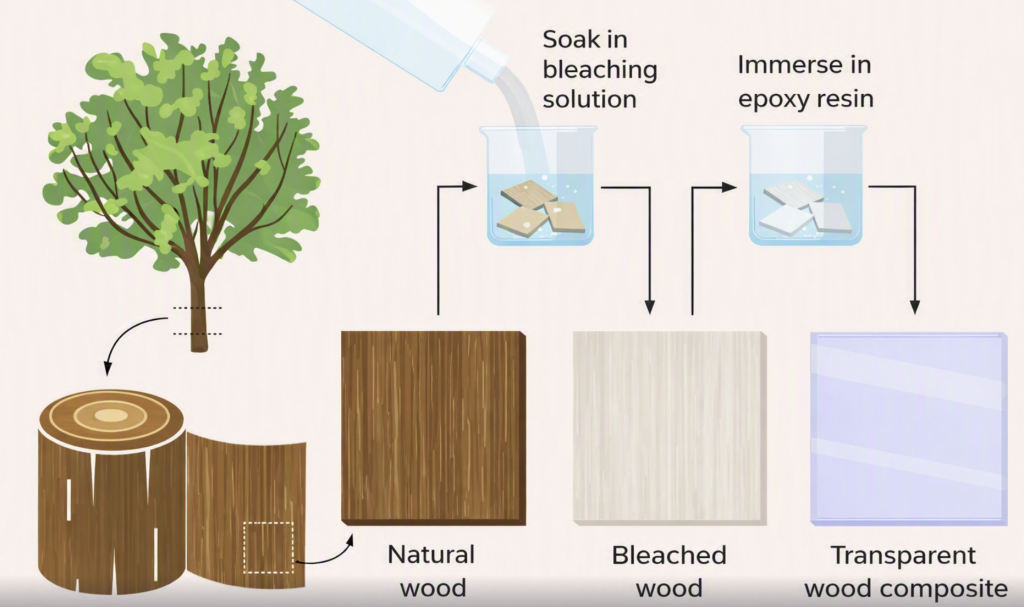
So, what would transparent wood be useful for? The combination of strength and light transmission could make it a useful substitute for any application where glass is conventionally used, such as windows (Mariani 2024). Additionally, unlike glass, transparent wood can also grant better thermal insulation while remaining lightweight, which finds several applications in housing .
However, being made from wood does not automatically make transparent wood environmentally friendly. Producing it requires chemical treatments, energy, and synthetic polymers, creating environmental impacts of its own. Advances utilizing green chemistry could reduce these impacts over time, improving transparent wood’s potential to be an increasingly sustainable alternative (Malucelli 2022). Accounting for production, processing, transportation, use, and disposal is important because improvements at one stage may be offset by environmental impacts elsewhere. Considering wood’s entire life cycle can give a more complete picture of whether transparent wood can be a sustainable alternative.
The question is not whether wood can be made transparent, but if its applications to replace glass will truly improve lives physically, economically and environmentally. With benefits ranging from better insulation to having an alternative for energy intensive glass production, its real impact will depend on how widely it can be adopted and how realistic implementation will be. As research in this field progresses, it raises the question: Could altering other familiar materials be the key to advance the future of sustainable design?
References
Giulio Malucelli. 2022. “Transparent Wood-Based Materials: Current State-of-the-Art and Future Perspectives.” Materials 15 (24): 9069. https://doi.org/10.3390/ma15249069.
Hai, Le Van, Narayanan Srikanth, Tin Diep Trung Le, Seung Hyeon Park, and Tae Hyun Kim. 2025. “Transparent Wood Fabrication and Applications: A Review.” Molecules 30 (7): 1506. https://doi.org/10.3390/molecules30071506.
Jude Coleman. 2023. “Why Scientists Are Making Transparent Wood.” Popular Science, December 14. https://knowablemagazine.org/article/technology/2023/why-scientists-are-making-transparent-wood.
Mariani, Alberto. 2024. “Transparent Wood-Based Materials: A New Step Toward Sustainability and Circularity.” Next Materials 5 (May): 100255–55. https://doi.org/10.1016/j.nxmate.2024.100255.
Zhang, Jingfa, Ahmed Koubaa, Yubo Tao, Peng Li, and Dan Xing. 2022. “The Emerging Development of Transparent Wood: Materials, Characteristics, and Applications.” Current Forestry Reports 8 (4): 333–45. https://doi.org/10.1007/s40725-022-00172-z.
Comments
13 Responses to “Transparent Wood: A Window to the Future?”
Hi Teddy,
Great blog post – this is super cool and something I have yet to hear about! A few suggestions I have for you are the following:
– Try to refrain from using website articles as sources and try to use more peer-reviewed scientific articles.
– Maybe reword your figure caption to “Process of turning natural wood into transparent wood through bleaching and polymer infusion, and the chemicals required for restructuring the wood’s pores to reduce light scattering, creating a clear composite material” to be a bit more concise. Also watch your citation in the figure caption
.- Make sure to center your figure caption to the figure.
– Your structuring made the writing clear and it flowed nicely!
Overall, great work!!
-Audrey
Hi Audrey,
Thank you for your great advice! I’ve switched the majority of website articles and found the original peer reviewed scientific publications and articles the websites had taken their info from. I’ve also implemented the majority of your grammar and formatting advice. For the centering of the figure caption to the figure, I see other posts without the centering and instead the caption is aligned to the left, just assuming centering the figure caption means using the “Align Center” function.
Hi Teddy,
This was a very interesting topic! Here are some minor suggestions I have:
– Make sure you leave a comment explaining why you chose this topic and how it connects to class material
– The figure should be references somewhere in your writing as (Figure 1)
– The sources at the end should be listed as “References” and not “Citations”
Overall, this was a great blog post! I look forward to the final edit
Maybel
Hi Maybel,
Thank you for reminding me to leave a comment! I’ve implemented all of your advice.
Thanks again,
Teddy
Hi Teddy,
I really enjoyed reading your blog! It was a very interesting topic. I have a few suggestions:
– Consider combining your first 2 paragraphs. I would just have one sentence as your hook and then get right into explaining your main idea. This would help reduce word count and help with flow. Your second paragraph alone works as a good introduction!
– If all your information in a paragraph is from the same source, make sure you put the in-text after the first sentence you use the source.
– Reference the figure in the text.
Overall, well done, and I am looking forward to reading your final copy!
– Ava
Hi Ava,
Thank you for your advice! I’ve integrated all your advice into the blog. Although for the 2 paragraphs at the beginning, I feel as if the presence of a strong hook at the beginning as its own paragraph would help heavily in starting the blog off in a more digestible way for the reader instead of a larger singular paragraph as the introduction, which can give the reader a more pleasant start in reading the blog.
Thanks again,
Teddy
Hello Teddy,
I have actually watched a video on this, so it’s very interesting to see you get more in depth using an interdisciplinary approach.
I agree with what others have said with regards to formatting, namely to reference your figure in your reference section, as well as to leave a comment with the interdisciplinary fields that you considered during your blog as well as why you chose this topic. I already really like your integration of green chemistry in your blog, and this would strengthen it even further.
Something that would be interesting to see more of would be the light absorbance and transmittance we have gone over in chemistry lectures and the lab recently. I feel like discussing it more in reference to what we are learning currently would allow for a greater connection between your topic and in-class learning.
I think you would also consider comparing the environmental sustainability of glass as well, so that you can draw more concrete conclusions with regards to the sustainability of wood.
Very good start, excited to see the final product!
Nima
Hi Nima,
Thank you for your advice and your reminder to post the comment. I wish I could add more on the light absorbance aspect as well, but the word count prevents this from being added, which is why the blog is focusing more on the applications and implementing of the material rather than the optical science of the topic, I’ve added a small mention of glass’ energy intensive processes.
Thank you again,
Teddy
Hi iSci,
Hope you enjoyed reading my post, I chose transparent wood because of its easy connections with several areas of iSci that we’ve been exploring so far. Specifically for the chemistry behind delignification, chemical processes with polymers, and refractive index all connecting directly to our discussions of light and matter, green chemistry’s principles, and using life-cycle assessments.
Since I’ve done experiments with testing procedures to create transparent wood before, I was happy to share this topic with you all today.
I would love any feedback.
Hi Teddy,
Great job on your blog post! I think this topic is very cool, and I enjoyed learning about it. I have a few minor suggestions that I think could help you:
-P2S3: There should be a colon after the word “question” instead of a comma.
-I really liked how you introduced this topic in your first paragraph. However, your second paragraph does not provide any new information and feels more like a build-on of your first paragraph. Consider merging the two paragraphs and cutting out any redundancies.
-P6S2: Consider tweaking this sentence slightly to make it flow better, like this: “ The combination of strength and light transmission could make it a useful substitute for any application where glass is conventionally used, such as windows.”
-Consider strengthening your conclusion a bit, if word count permits. You do a good job wrapping up the key ideas of your blog post, however, it could be beneficial to conclude by further examining the scope of transparent wood, like how exactly it could “improve lives.” You could also conclude with a question that allows the reader to think more deeply about this topic.
Overall great work! This was a very interesting topic, and I look forward to reading the final draft!
Hafsa
Hi Hafsa,
Thank you for your helpful feedback! I’ve implemented most of your suggestions. On the topic of your point of combining the 1st and 2nd paragraph, I feel as if separation allows for stronger readability of the blog itself. Giving the standalone hook its own space I feel will stand out and draw readers in more before actually diving into the main subject.
Thank you again for your feedback,
Teddy
Hi Teddy,
An interesting topic! I enjoy reading your post as the structure has made the transition between ideas smooth.
A small suggestion, I have noticed that you have been inconsistent with your in-text citation. Case in point, (Zhang 2022) in the third paragraph, and (Coleman, 2023) in your caption of figure 1. Since we are using Chicago style, I would just stick with (name year).
From my understanding, the role of lignin in wood resembles melanin pigment in human skin, where both act as a protective layer against solar radiation. Would the replacing material, epoxy resin, have similar function? I know some of the epoxy resin based products undergo yellowing over time due to ultraviolet light exposure. The underlying mechanism is similar to what we have covered in class, where incoming photons transmit quantized energy to a bound electron. This is a stimulating factor that triggers many reactions within the epoxy resin polymer network, like breaking its chemical bonds.
Love,
Edgar 🙂
Hi Edgar,
Thanks for your advice I’ve implemented your intext citation suggestion. And you’re right about epoxy: unlike lignin, it doesn’t offer UV protection, which is why many resins yellow over time as UV light breaks bonds in the polymer network. So, future edits to the process will likely show UV protection implemented into the process, which I’m excited to see in the future.
Really appreciate your comment,
Teddy