Did you know that there is a Canadian government program that provides prescribed opioids, stimulants, and benzodiazepines to individuals using illicit drugs? While providing pharmaceutical-grade drugs may seem counterintuitive at first glance, the program’s primary goal is to combat the toxic drug crisis, which currently claims an average of 15 Canadian lives each day due to opioid toxicity (H. Canada 2021a; P. H. A. of Canada 2019). This initiative started in 2016 and aims to directly reduce fatalities by offering safer, regulated alternatives (H. Canada 2021a). The program operates on a medicalized harm-reduction model (Chang et al. 2023). Instead of relying on traditional addiction treatments that require immediate abstinence, healthcare providers prescribe a pharmaceutical-grade opioid, most commonly Dilaudid (hydromorphone), as a regulated alternative to toxic street fentanyl (Karamouzian et al. 2023; Roberts and Humphreys 2023; Young et al. 2022).
This transition is crucial because illicit fentanyl is a potent full agonist at the μ-opioid receptor (Garnett et al. 2026). Fentanyl binds to the μ-opioid receptor with high intrinsic efficacy, triggering intense intracellular signalling cascades that suppress pain, induce euphoria, and directly shut down the respiratory center in the brainstem (Herman et al. 2024; Theriot et al. 2026; Dhaliwal and Gupta 2023; Saunders et al. 2022). Fentanyl is highly lipophilic, enabling it to cross the blood-brain barrier almost instantaneously; this rapid onset causes severe respiratory depression to set in within minutes, often before bystanders can react (Bird et al. 2023).
Compounding this mechanism is fentanyl’s extreme potency, estimated at 50 to 100 times stronger than morphine and up to 50 times stronger than heroin, with a lethal dose as tiny as 2 milligrams (Bird et al. 2023). Compared to heroin and morphine, a much larger mass is needed to achieve effects equivalent to fentanyl (Bird et al. 2023). This is directly tied to its unique chemical structure (Figure 1) (Ramos-Matos et al. 2023).
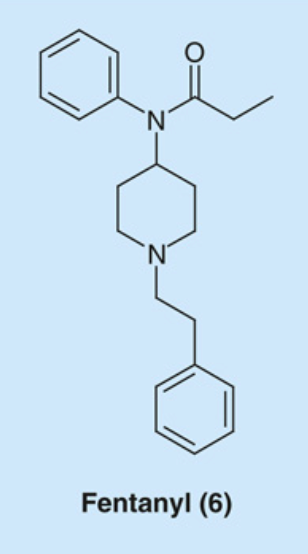
Figure 1: Fentanyl is a synthetic 4-anilidopiperidine derivative and features a flexible, elongated carbon backbone consisting of a central piperidine ring attached to a phenethyl group and an anilide chain (Vardanyan and Hruby 2014). The number six in the figure is the shorthand designation for fentanyl within the series of pethidine derivatives (Vardanyan and Hruby 2014).
To understand why fentanyl creates such a powerful cycle of dependency, we have to look at the brain’s mesolimbic reward pathway, specifically the connection between the ventral tegmental area (VTA) and the nucleus accumbens (Volkow et al. 2019). Under normal conditions, GABAergic interneurons in the VTA act as natural brakes to limit dopamine release. However, when fentanyl binds to μ-opioid receptors on these GABA interneurons, it inhibits them (Volkow et al. 2019). With the GABA “brakes” removed, VTA neurons fire uncontrollably, causing a massive, rapid surge of dopamine into the nucleus accumbens (Volkow et al. 2019; Niehaus et al. 2010). This intense dopamine spike reinforces the drug-seeking behaviour by signalling extreme reward to the brain (Volkow et al. 2019). Over time, repeated exposure alters synaptic plasticity and downregulates natural dopamine production, driving severe physical dependence and intense cravings just to feel baseline normal (Niehaus et al. 2010).
In turn, Dilaudid is used in this mesolimbic pathway to safely meet these receptor requirements(Karamouzian et al. 2023; Roberts and Humphreys 2023; Young et al. 2022). By providing a controlled dose of hydromorphone, participants can manage their dependence and avoid acute withdrawal (H. Canada 2021a). However, law enforcers argue that these individual benefits are often undermined, as the take-home Dilaudid tablets are frequently resold on the black market to fund the purchase of street fentanyl (Bird et al. 2023).
References
Bird, H. Elizabeth, Andrew S. Huhn, and Kelly E. Dunn. 2023. “Fentanyl Absorption, Distribution, Metabolism, and Excretion (ADME): Narrative Review and Clinical Significance Related to Illicitly-Manufactured Fentanyl.” Journal of Addiction Medicine 17 (5): 503–8. https://doi.org/10.1097/ADM.0000000000001185.
Canada, Health. 2021a. “Safer Supply: Prescribed Medications as a Safer Alternative to Toxic Illegal Drugs.” Service description. July 22. https://www.canada.ca/en/health-canada/services/opioids/responding-canada-opioid-crisis/safer-supply.html.
Canada, Health. 2021b. “Substance-Related Poisonings and Homelessness in Canada: A Descriptive Analysis of Hospitalization Data.” Datasets. June 23. https://www.canada.ca/en/health-canada/services/opioids/hospitalizations-substance-related-poisonings-homelessness.html.
Canada, Public Health Agency of. 2019. “Key Findings: Opioid- and Stimulant-Related Harms in Canada — Canada.Ca.” Datasets;statistics;education and awareness. December 11. https://health-infobase.canada.ca/substance-related-harms/opioids-stimulants/.
Chang, Ji Eun, Zoe Lindenfeld, and Holly Hagan. 2023. “Integrating Harm Reduction into Medical Care: Lessons from Three Models.” Journal of the American Board of Family Medicine : JABFM 36 (3): 449–61. https://doi.org/10.3122/jabfm.2022.220303R3.
Dhaliwal, Armaan, and Mohit Gupta. 2023. “Physiology, Opioid Receptor.” In StatPearls. StatPearls Publishing. http://www.ncbi.nlm.nih.gov/books/NBK546642/.
Garnett, Matthew F., Jodi A. Cisewski, and Farida B. Ahmad. 2026. “Drugs Most Frequently Involved in Drug Overdose Deaths: United States, 2017–2023.” In National Vital Statistics Reports [Internet]. National Center for Health Statistics (US). https://doi.org/10.15620/cdc/174640.
Herman, Timothy F., Marco Cascella, and Maria Rosaria Muzio. 2024. “Mu Receptors.” In StatPearls. StatPearls Publishing. http://www.ncbi.nlm.nih.gov/books/NBK551554/.
Karamouzian, Mohammad, Bijan Rafat, Gillian Kolla, et al. 2023. “Challenges of Implementing Safer Supply Programs in Canada during the COVID-19 Pandemic: A Qualitative Analysis.” International Journal of Drug Policy 120 (October): 104157. https://doi.org/10.1016/j.drugpo.2023.104157.
Niehaus, Jason L., Manjari Murali, and Julie A. Kauer. 2010. “Drugs of Abuse and Stress Impair LTP at Inhibitory Synapses in the Ventral Tegmental Area.” The European Journal of Neuroscience 32 (1): 108–17. https://doi.org/10.1111/j.1460-9568.2010.07256.x.
Ramos-Matos, Carlos F., Karlyle G. Bistas, and Wilfredo Lopez-Ojeda. 2023. “Fentanyl.” In StatPearls. StatPearls Publishing. http://www.ncbi.nlm.nih.gov/books/NBK459275/.
Roberts, Emmert, and Keith Humphreys. 2023. “‘Safe Supply’ Initiatives: Are They a Recipe for Harm Through Reduced Health Care Input and Supply-Induced Toxicity and Overdose?” Journal of Studies on Alcohol and Drugs 84 (4): 644–47. https://doi.org/10.15288/jsad.23-00054.
Saunders, Sandy E., David M. Baekey, and Erica S. Levitt. 2022. “Fentanyl Effects on Respiratory Neuron Activity in the Dorsolateral Pons.” Journal of Neurophysiology 128 (5): 1117–32. https://doi.org/10.1152/jn.00113.2022.
Theriot, Jonathan, Sarah Sabir, and Mohammadreza Azadfard. 2026. “Opioid Antagonists.” In StatPearls. StatPearls Publishing. http://www.ncbi.nlm.nih.gov/books/NBK537079/.
Vardanyan, Ruben S., and Victor J. Hruby. 2014. “Fentanyl-Related Compounds and Derivatives: Current Status and Future Prospects for Pharmaceutical Applications.” Future Medicinal Chemistry 6 (4): 385–412. https://doi.org/10.4155/fmc.13.215.
Volkow, Nora D., Michael Michaelides, and Ruben Baler. 2019. “The Neuroscience of Drug Reward and Addiction.” Physiological Reviews 99 (4): 2115–40. https://doi.org/10.1152/physrev.00014.2018.
Young, Samantha, Gillian Kolla, Daniel McCormack, et al. 2022. “Characterizing Safer Supply Prescribing of Immediate Release Hydromorphone for Individuals with Opioid Use Disorder across Ontario, Canada.” International Journal of Drug Policy 102 (April): 103601. https://doi.org/10.1016/j.drugpo.2022.103601.
Comments
9 Responses to “Dealing Fentanyl Legally: What Safe Supply Really Means in Canada”
Hey iSci! Over the summer, I learned about a unique government program called Safe Supply, and I thought it would be the perfect topic to examine through an interdisciplinary lens. Since our blog post was due early in the semester, I was worried there wouldn’t be enough content to work with, so I drew on several concepts from our second-year courses. I included drug discovery principles to explain the specific biological targets, brought in the mesolimbic system from our lab practicum, and added key concepts from my neuroscience class to cover different aspects of the brain. To make it even more interdisciplinary, I also highlighted the drug’s chemical compounds to add a chemistry perspective. I hope you enjoy the post, and please let me know if you have any feedback or suggestions for edits!
Hello Abbie!
I thoroughly enjoyed your blog post! You explained the process of fentanyl and how it affects the human brain extremely well! I just have a few suggestions to improve:
1. There is a small typo in paragraph 3. Ensure you add a space when writing “50 to 100 times stronger”.
2. Although I enjoyed reading about how fentanyl works and the science behind it, I believe you could cut back on it slightly and add more detail to how Dilaudid works and why it is a safer alternative. This would add more to the “synthesis” part of the assignment.
3. You could add an enticing closing sentence to wrap the post up and leave your readers wanting more. I believe you did this very well in the opening, and could base it off of that.
Amazing work! I’m excited to read the finalized version of your blog post.
Sincerely,
Lily McCormick
Thank you for all of your feedback!
Really cool post Abbie!
I really liked how you explained the science behind fentanyl’s effects on the brain before connecting it back to why safe supply programs use alternatives like Hydromorphone. One suggestion I would add is to briefly explore some of the criticisms surrounding safe supply programs, (i.e how prescribed drugs can end up being sold to others instead of the patients they’re intended for). I think that would provide another interesting perspective and make your blog a lot more well rounded while simultaneously making the core aspects of the post even stronger. Great job overall, I look forwards to seeing your edits!
Thanks for the feedback!
Hi Abbie!
I thought this post explained this topic really well and opened the door for a larger conversation about government involvement with drug use. I really liked that you explained the chemistry thoroughly enough and gave some social impacts.
Here are some suggestions I had after reading:
-I think the figure caption is a bit large. Usually figure captions are smaller to conserve space or the same size as the rest of the text to make it less distracting.
-In what year did this initiative start? Since it is fairly new, what are some concerns with the effectiveness of this drug (physically or socially)? Has there been noticeable progress for how many years it has been around?
Again, this was really well done and I can’t wait to see if you address more social/political issues with science in future posts!
Happy editing,
Brooklyn
Thank you for all of your feedback! I will definitely add the social context of this program starting and the year it started.
Hi Abbie,
I LOVED your blog post! I knew next to nothing about fentanyl regulation laws in Canada before reading your post, and now I have a new conversation starter 🙂 I have a few suggestions for you to consider:
– Don’t forget that figure captions should be in italics!
– On the topic of figures, I would mention what the (6) means in the figure caption for readers who haven’t taken organic chemistry yet.
– In your third paragraph, you mention that a lethal dose can be 2 milligrams. It might be a good idea to include how many milligrams of morphine/heroin/fentanyl are “normally” taken at a time. I just have no point of reference as to what is considered a high dose (i.e. do people need 0.001 mg of fentanyl to feel like affects or 1 mg?). I believe having this reference point would make your statement more impactful.
– In your fourth paragraph, I would add a brief definition as to what mesolimbic means as the term is not considered common knowledge. Is it only the VTA-nucleus accumbens connection or is this just one small portion of a larger system? Also, adding the general location of these regions in the brain (i.e. frontal, hindbrain, etc.) would be a good idea if word count allows.
Overall, I thought your blog was very well written and researched. I cannot wait to read the final version!
Happy editing,
Chloe
Thank you Chloe!!! This feedback was really helpful!