Butter? I Hardly Know Her!

If you’ve seen me around campus, you’ve almost certainly seen my laptop with a huge butter sticker. But have you ever stopped to wonder why humans love butter so much? 

Milk

To understand butter’s appeal, we need to start with milk. Butter is primarily made of milk fat, separated from other cream components through churning. Milk fat exists in globules surrounded by the milk fat globule membrane, which stabilizes the fat droplets while helping to protect them from hydrolysis and oxidation (Rønholt et al. 2013; Popescu et al. 2025).

Milk fat is composed primarily of triglycerides: molecules with a glycerol backbone attached to three fatty acids. They have a wide range of melting points, which contributes directly to milk fat’s complex physical properties. Its composition also varies depending on factors such as the cow’s diet, lactation stage, and stress (Popescu et al. 2025).

What Makes Butter Different From Milk?

Milk is an oil-in-water emulsion, so fat droplets are dispersed throughout water, making it fluid and drinkable. In contrast, butter is a water-in-oil emulsion, so water is dispersed throughout the oil, as seen in Figure 1 (Panchal and Bhandari 2020a).
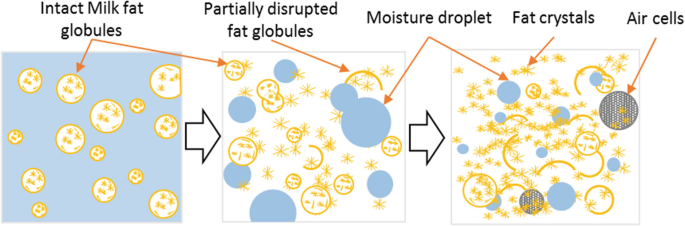
Figure 1. An illustration of the phase inversion during butter production. From left to right: cream, buttermilk, then butter. Blue indicates the continuous water phase, and the yellow circles are the milk fat globules. The yellow snowflake-esque structures are the crystal network present in the buttermilk and butter stages. Within butter, fat forms the continuous phase; its texture is dependent on the delicate balance of liquid and solid fat; liquid fat ensures spreadability, while solid fat crystals give the butter structure. The crystal network of butter is vital in allowing for butter’s distinctive texture, flavour, and shelf life. Image from Panchal and Bhandari (2020b)

But butter is more than just a mix of fats; it’s a way of concentrating the energy-rich lipids of milk into a versatile food. Although butter’s physical properties explain its versatility in cooking, they only partly explain why people enjoy eating it. To understand why fatty foods in general are so rewarding to eat and irresistible, we need to look beyond the butter bell and into the human brain.

But(ter) Why Do We Love Butter?

The human brain yearns for fat. Our brains are energy-dependent organs, which has made energy-dense foods, like fat, vital throughout human evolution. Our attraction to fatty foods is an evolutionary advantage: obtaining more energy from limited food resources (Fasano 2025). Fatty foods also engage the brain’s mesocorticolimbic dopamine reward system. Eating them can involve the release of dopamine, endocannabinoids, and endogenous opioids, as seen in Figure 2. Brain imaging shows that high-fat food cues strongly activate reward regions, particularly in individuals with obesity, indicating a heightened neural response to food triggers (Fasano 2025; Ayyad 2026).
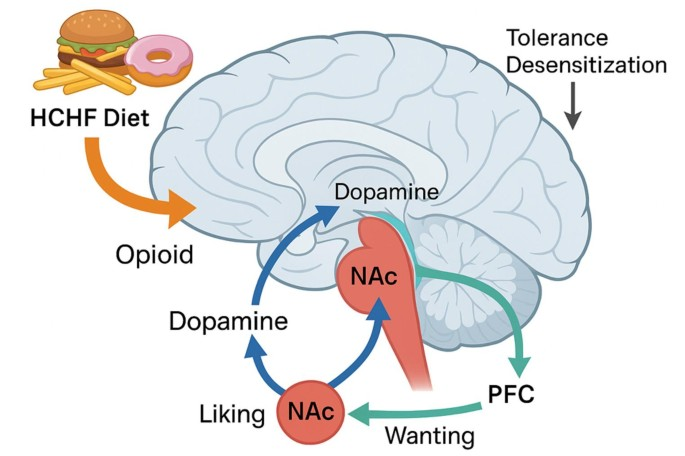
Figure 2. A figure showing the mesolimbic dopamine reward system, specifically showing how a High Cholesterol High Fat (HCHF) diet can trigger the circuit. Specifically, this figure shows the three main components of the system: the ventral tegmental area (VTA), N-acetylcysteine (NAc), and the pre-fontal cortex (PFC). When an HCHF food enters the system, the VTA links the mesolimbic and mesocorticol pathways of the reward circuit. it sends t hte dopamine signals to regions of the limic system to control memory and motivation. It also connects the PFC which is vital for executive control and decision making. The NAc translates motivational signals into behaviour. It shapes the responses and influences the strength to which external rewards are experienced. The NAc processes the drive to obtain reward, not just the actual value. Image from Atar (2026)

Perhaps the most wonderful thing about butter is the stark contrast between its simplicity and complexity. A familiar ingredient made from milk depends on the intricate arrangements of crystals, liquid fat, and water droplets to become its unique texture. Meanwhile, our attraction to energy-rich foods reflects a broad story on human biology and sensory pleasure. Butter did not evolve to make us smarter, and our love for it isn’t explainable with a single mechanism. It offers a fascinating window into the relationship between the foods we create, biology we inherit, and the preferences that shape what we eat. For something as simple as a spread on toast, butter has a compelling story to tell

References

Atar, Aslıhan. 2026. “Neurobiological Consequences of High-Fat High-Sugar Diets on the Mesocorticolimbic System: A Narrative Review.” Current Nutrition Reports 15 (1): 6. https://doi.org/10.1007/s13668-026-00729-5.

Ayyad, Mohammed. 2026. “Burgers, Brains, and Evolution: Biological and Philosophical Roots of Fat Craving.” International Journal of Obesity 50 (5): 947–49. https://doi.org/10.1038/s41366-026-02029-y. 

Fasano, Alessio. 2025. “The Physiology of Hunger.” New England Journal of Medicine 392 (4): 372–81. https://doi.org/10.1056/NEJMra2402679. 

Panchal, Bhavesh, and Bhesh Bhandari. 2020a. “Butter and Dairy Fat Spreads.” In Dairy Fat Products and Functionality: Fundamental Science and Technology, edited by Tuyen Truong, Christelle Lopez, Bhesh Bhandari, and Sangeeta Prakash. Springer International Publishing. https://doi.org/10.1007/978-3-030-41661-4_21. 

Panchal, Bhavesh, and Bhesh Bhandari. 2020b. “Butter and Dairy Fat Spreads.” In Dairy Fat Products and Functionality: Fundamental Science and Technology, edited by Tuyen Truong, Christelle Lopez, Bhesh Bhandari, and Sangeeta Prakash. Springer International Publishing. https://doi.org/10.1007/978-3-030-41661-4_21. 

Popescu, Silvana, Daniela Elena Babiciu, Eva Andrea Lazar, Anamaria Blaga Petrean, and Sorana Daina. 2025. “Positive Emotional States in Dairy Cows: Reflections in Milk Quality and Udder Health.” Animals : An Open Access Journal from MDPI 15 (22): 3290. https://doi.org/10.3390/ani15223290. 

Rønholt, Stine, Kell Mortensen, and Jes C. Knudsen. 2013. “The Effective Factors on the Structure of Butter and Other Milk Fat-Based Products.” Comprehensive Reviews in Food Science and Food Safety 12 (5): 468–82. https://doi.org/10.1111/1541-4337.12022.

Comments

14 Responses to “Butter? I Hardly Know Her!”

  1. Aven Leblanc Avatar
    Aven Leblanc

    Hi Bohmie,

    Well done with your blog! As a butter lover I was intrigued by your title, and it’s really cool to learn the neuroscience of why we love butter. Below are some suggestions to help improve your blog:

    Don’t forget your general isci comment (although I know this was just posted)

    P2S3: I would change ‘while protecting the fat droplets’ to ‘ while helping protect them’ to avoid repeating ‘fat droplets’

    P3S2: You mention here that the fatty acids have a wide range of melting points, if you have the words I think it would be interesting to how differences in fatty acid composition impact the melting points

    P2S4: to be more concise I would reword to something like “In contrast, butter is a water-in-oil emulsion”

    P6S2: I think there’s a small typo here! “Our brains are a energy dependanting organ” should be changed to “Our brains are energy-dependent organs”

    Overall, such a fun read!

    Happy editing,

    Aven 🙂

    1. Bohmie Song Avatar
      Bohmie Song

      Hi Aven,

      Thank you so much for your suggestions! I will be implementing them promptly.

      Happy reading,
      Bohmie

  2. Bohmie Song Avatar
    Bohmie Song

    Hi iSci!
    I decided to talk about butter after thinking about the parallels between butter and wine during Winesci. I think it’s fascinating that both these ancient foods have persisted for so long, and I think there are many interesting practices in wine that directly apply to butter, for example, butter experts, like wine experts, butter sommeliers! You can also age butter and have butter pairings. I wanted to look at an everyday item and explore why we love it and what it looks like at a molecular level.
    Happy Reading,
    Bohmie

  3. Laura Forgrave Avatar
    Laura Forgrave

    Hi Bohmie,

    I really enjoyed reading this post! It was funny and engaging, and as an enthusiastic lover of dairy products, I was curious to see what makes them so delicious.

    I agree with all of Aven’s suggestions, and here are a couple more:
    1. I would combine P2 and P3 into one longer paragraph, as they are both talking about the physical composition of milk.
    2. In P6, I had to infer that fatty foods are energy dense. Although this makes sense, I would add a sentence explicitly stating that to make it easier for the reader to understand. If you have the word count to do it, you could even discuss how the physical composition of fatty foods lead to their high density.
    3. In many of your references, a space between the journal title and the volume number would help readability.

    Happy editing!
    Laura

    1. Bohmie Song Avatar
      Bohmie Song

      Thanks for your suggestions.
      Happy Reading,
      Bohmie

  4. Swetha Subramanian Avatar
    Swetha Subramanian

    Hey Bohmie,

    I really loved the hook at the beginning about your laptop sticker! Overall, great job on this blog; here are a few suggestions I have:

    – For P3, if your word count allows, you can add a brief sentence explaining why the triglycerides and chemical properties matter for milk fat.
    – I would take some of the information from your figure caption and add it as a paragraph to the blog. So you can separate it by writing the phrase “Within butter, fat forms the continuous phase…” as a paragraph.

    Looking forward to reading your final draft!
    – Swetha S

    1. Bohmie Song Avatar
      Bohmie Song

      Hi Swetha,

      Thanks for the suggestions!

      Happy reading,
      Bohmie

  5. Amelia Nolan Avatar
    Amelia Nolan

    Hi Bohmie!

    This was such an interesting read. I appreciated the structured layout with the subtitles!

    A few suggestions:

    – In P3, make sure you add a period to the end of the citation. Also, double check the formatting of your figure caption; I believe it should have a period, not a colon for Chicago Style (ie. “Figure. ___”).
    – P5 and your final paragraph were very good flowing/summarizing statements that tied your ideas together. I think strengthening the introduction to connect these topics from the very beginning would help tie the blog together.
    – The psychology section was interesting. I think it could be even stronger with a statistic or a deeper explanation of why we enjoy fatty foods. For example, you could briefly describe what dopamine, endocannabinoids, and endogenous opioids do for a person. You could also consider adding a figure of brain activity associated with food rewards to help readers visualize this.

    Can’t wait to read your final draft!

    Regards,

    Amelia

    1. Bohmie Song Avatar
      Bohmie Song

      Hi Amelia,

      Thanks for the feedback.

      Happy Reading,
      Bohmie

  6. Jaden Chiang Avatar
    Jaden Chiang

    Hi Bohmie,

    Great work on your blog post! What an interesting topic; I like how you divided the post into sub-sections with very clear (and engaging) questions. There are so many different sub-branches of this topic that popped into my head while reading this, such as how butter is used differently across different cuisines and cultures, and the varying “mechanisms” of different butter types such as butter made with milk other than cow’s or plant-based butter. I think these are really cool topics to investigate but also not central to your current topic!

    I only have a couple grammatical suggestions, which I’ve put below:
    – P5S3: consider removing the second ‘look’ for better readability
    – P7S5: consider adding a ‘the’ before the word ‘foods’ and the word ‘biology’

    I would also suggest including a figure in your section, “But(ter) Why Do We Love Butter?” to expand upon some of the processes you are describing, such as the mesolimbic dopamine reward system.

    Once again, this was a great read and I know the final version will be just as great!

    Jaden

    1. Bohmie Song Avatar
      Bohmie Song

      Hi Jaden,

      Thank you so much for your feedback!

      Happy reading,
      Bohmie

  7. Tvara Parikh Avatar
    Tvara Parikh

    Hi Bohmie!
    I really enjoyed reading your post, this was such an intresting topic. One small suggestion is to revise the sentence in paragraph 3: “Its composition also varies depending on things like the cow’s diet, lactation stage, and stress.” You could change “things like” to “factors such as” to make the sentence sound more formal and precise.

    In the paragraph beginning “But butter is more than just a mix of fats,” I would suggest revising “The properties that make butter so appealing within the kitchen only partly explain its appeal” to avoid repeating the word “appeal.” For example, you could write, “Although butter’s physical properties explain its versatility in cooking, they only partly explain why people enjoy eating it.”

    Lastly, maybe revise the final sentence of your conclusion: “For just a spread on toast, butter has a compelling story to tell.” Consider changing it to “For something as simple as a spread on toast, butter has a compelling story to tell.” This makes the sentence flow more naturally while preserving your engaging tone.

    Overall, I thought this was a creative and engaging way to explore the science behind an everyday experience. Great job!

    1. Bohmie Song Avatar
      Bohmie Song

      Hi Tvara,

      Thank you so much for your suggestions!

      Happy reading,
      Bohmie

  8. Ria Chhabra Avatar
    Ria Chhabra

    Hi Bohmie,
    Your title immediately captured my interest and your blog was so much fun to read! Here are a few suggestions:
    P2: Perhaps use a more descriptive phrase for the milk fat globule membrane as you just mentioned earlier in the sentence that milk fat exists in globules.
    Figure 1 caption: you can place the 2020b citation in the first sentence of the caption if this is where the image came from. If you used the 2020a paper for the explanation then you can place this citation in the second sentence of the caption.
    P6: Sentence 1 is a great hook, but sentences 2 and 3 overlap in content. Perhaps, you can combine these two into one.
    Last paragraph: don’t forget the punctuation on your very last sentence!

    Happy editing,
    Ria

Leave a Reply