In October 2026, just 9% of young Americans thought their country was headed in the right direction. Another 69% felt more fearful than hopeful about its future (Harvard Institute of Politics 2026). Then November happened. An estimated 27% of eligible young people voted in the midterms, tying 2022 for the second-highest youth turnout in 30 years, and 66% of young voters backed Democratic House candidates, the largest Democratic youth margin CIRCLE has recorded nationally (CIRCLE 2026a, 2026b; see Figure 1). Nothing was magically fixed on election night. But, at least to me, the future stopped feeling quite so pre-written.
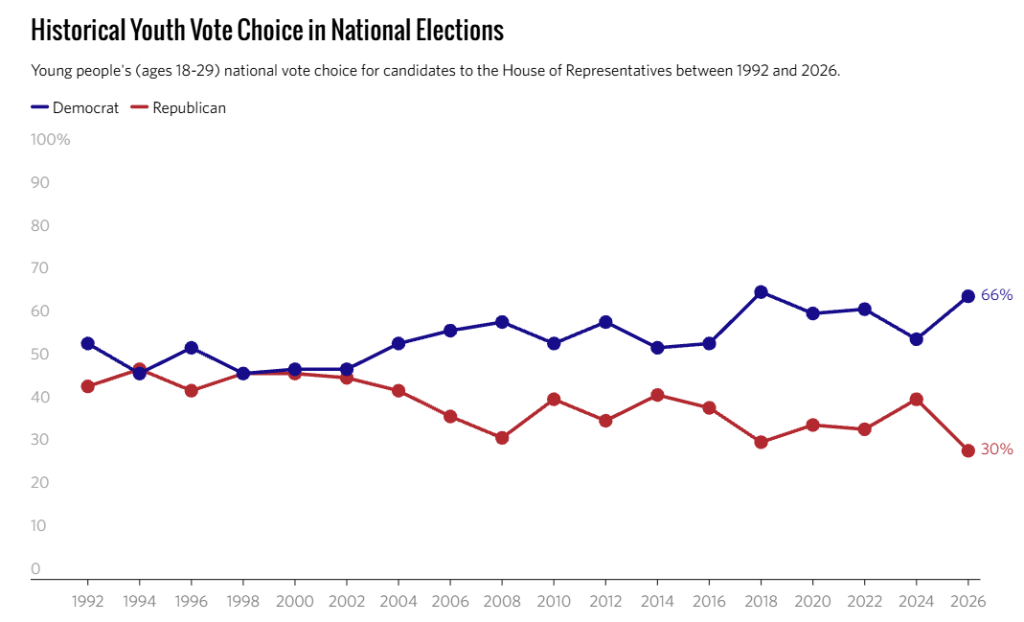
If hope is supposed to come before action, that sequence is strange. Maybe hope wasn’t what brought people to the polls at all. Before the election, 63% of likely young voters described their intended congressional vote as opposition to President Trump and his policies (Harvard Institute of Politics 2026). Anger can motivate people too. The more interesting question is what happens after people act and realize others acted alongside them.
A 2026 meta-analysis of 40 experimental effect sizes found that imagining sustainable futures modestly increased intentions to take collective action (Eckerle et al. 2026). But hope was not a significant explanation for that effect in the researchers’ model. Instead, two mechanisms mattered: cognitive alternatives, the ability to imagine a different future, and collective efficacy, the belief that people acting together have the power to change their circumstances. You don’t have to expect a happy ending to believe you can influence the story.
That distinction feels familiar from climate doomism. Marlon et al. (2019) found that both “constructive hope” and “constructive doubt” were associated with greater climate-policy support and political engagement. People could recognize that humanity wasn’t responding adequately to climate change without concluding that responding was pointless. Fatalistic doubt, the belief that nothing meaningful could be done, was associated with the opposite.
Perhaps pessimism is not the enemy of action. Powerlessness is.
And hope may not always come first. Nairn et al. (2025) studied six youth activist groups in Aotearoa New Zealand, interviewing 90 participants. They found that collective hope developed through acting together, supported by shared goals and a sense of community. As one participant put it: “I get hope through action.”
Of course, the Harvard poll and CIRCLE’s election data didn’t follow the same young people from pessimism to the polling booth. CIRCLE’s 27% turnout figure is an early estimate, and climate change was a top-three issue for only 20% of young voters, behind the economy and healthcare (CIRCLE 2026a; 2026c). We cannot conclude that the blue wave created hope, or that climate concerns drove it.
But it does challenge one of doomism’s most persistent assumptions: that collective action is pointless.
No single ballot explains an election. Together, millions of them helped produce a visible political shift. Maybe hope works similarly. It doesn’t always arrive first and convince us to act. Sometimes we act while angry, scared, or doubtful, and hope appears afterward, when we discover that we weren’t acting alone.
Maybe that is what hope looks like before it feels like hope.
References
Center for Information & Research on Civic Learning and Engagement (CIRCLE). 2026a. “2026 Youth Voter Turnout Second-Highest for a Midterm Election in the Last 30 Years.” November 5, 2026. https://circle.tufts.edu/latest-research/2026-youth-voter-turnout-second-highest-last-30-years.
Center for Information & Research on Civic Learning and Engagement (CIRCLE). 2026b. “Historic +36 Youth Vote Choice for Democrats in the 2026 Midterm Election.” November 4, 2026. https://circle.tufts.edu/national-youth-vote-choice-2026-midterms.
Center for Information & Research on Civic Learning and Engagement (CIRCLE). 2026c. “Young Voters Prioritized the Economy, Sought Drastic Political Change.” November 4, 2026. https://circle.tufts.edu/latest-research/young-voters-prioritized-economy-sought-drastic-political-change.
Eckerle, Frank, Felicia Winter, Heiko Mikolajczak, and Helen Landmann. 2026. “Does Thinking about a Sustainable Future Motivate Collective Action? A Meta-Analysis of Utopian Thinking Experiments.” Journal of Environmental Psychology 114: 103179. https://doi.org/10.1016/j.jenvp.2026.103179.
Harvard Institute of Politics. 2026. “53rd Edition: Fall 2026.” Harvard Youth Poll. https://iop.harvard.edu/youth-poll/53rd-edition-fall-2026.
Marlon, Jennifer R., Brittany Bloodhart, Matthew T. Ballew, Justin Rolfe-Redding, Connie Roser-Renouf, Anthony Leiserowitz, and Edward Maibach. 2019. “How Hope and Doubt Affect Climate Change Mobilization.” Frontiers in Communication 4: 20. https://doi.org/10.3389/fcomm.2019.00020.
Nairn, Karen, Carisa R. Showden, Kyle R. Matthews, Joanna Kidman, and Judith Sligo. 2025. “Scaffolding Collective Hope and Agency in Youth Activist Groups: ‘I Get Hope through Action.’” The Sociological Review 73 (2): 431–48. https://doi.org/10.1177/00380261241245546.


Leave a Reply
You must be logged in to post a comment.