A fish about the length of your finger hangs under the surface of a mangrove swamp. Above it, a beetle sits on a leaf. The fish can’t see where the beetle really is, but it fires anyway, and the beetle tumbles into the water. In order to hit its target, the fish must account for light bending at the surface, called refraction, and the curved path of its water, known as projectile motion. Is the archerfish really a tiny physicist? Not quite. Physics and evolution each do part of the work.
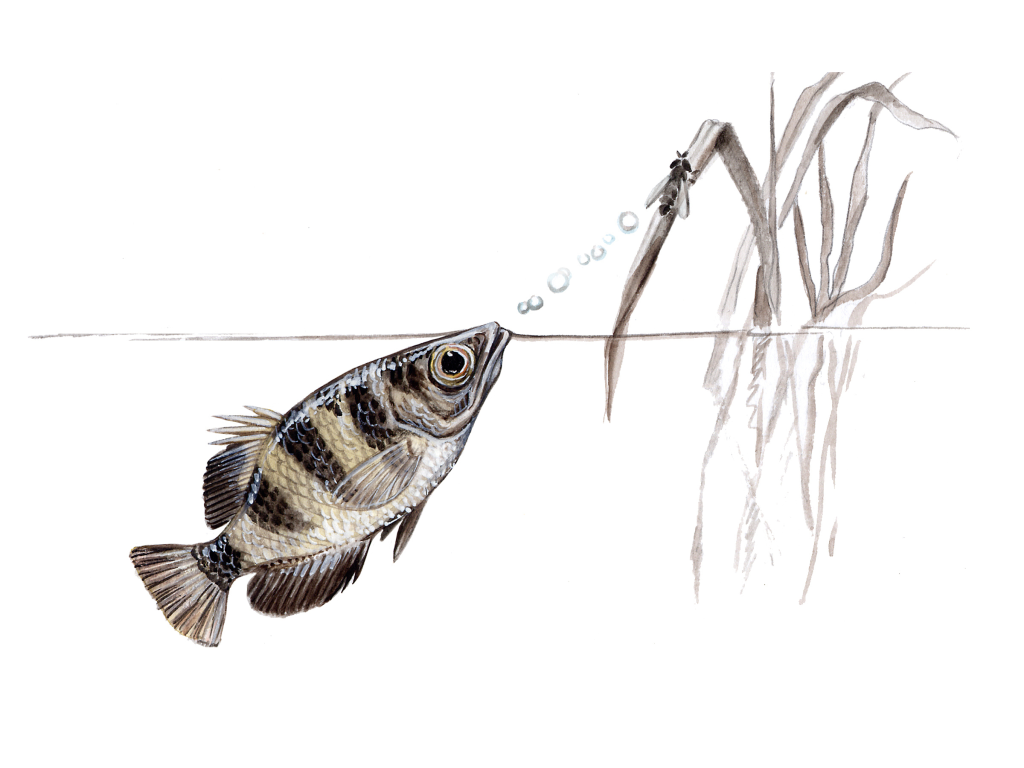
Figure 1. Illustration of an archerfish shooting a stream of water toward an insect perched on overhanging vegetation, a hunting technique that dislodges prey above the water’s surface. Credit: COMAP (2022).
The archerfish, Toxotes jaculatrix, lives in the shallow, mangrove-lined waters of tropical Asia and northern Australia (Denver Zoo Conservation Alliance 2024). It hunts by ejecting jets of water from its mouth to knock insects off overhanging plants (Figure 1) (MacDonald 2019). High-speed video shows the jet delivers roughly six times the power the fish’s own muscles could produce, because the fish speeds up the jet so water from the back catches up with the front and forms one large drop (Vailati, Zinnato, and Cerbino 2012). But a powerful shot is useless if it misses.
Aiming is the archerfish’s biggest challenge, and it faces two obstacles. The first is refraction. Archerfish keep their eyes underwater when they stalk prey, but light bends as it crosses the surface, so the insect appears somewhere other than where it really is (MacDonald 2019). Lüling (1963) reported that the fish moves almost directly below its prey, where there is little or no refraction. Dill (1977) found that a related species, Toxotes chatareus, shoots from many positions and corrects for the distortion by adjusting its spitting angle. The second obstacle is gravity. Gravity pulls the droplet downward, so it follows a curved path (MacDonald 2019). Therefore, the fish must aim above the insect and choose an angle that lets gravity bring the water down onto it.
So how does a fish end up with this peculiar ability? A study led by Matthew Girard traced the archerfish through genetics and morphology to determine how its spitting mechanism may have evolved (Girard et al. 2022). By comparing it to a closely related species, the beach salmon, the researchers discovered that the two share similar structures in their oral cavity, including a toothed tongue bone (Figure 2).
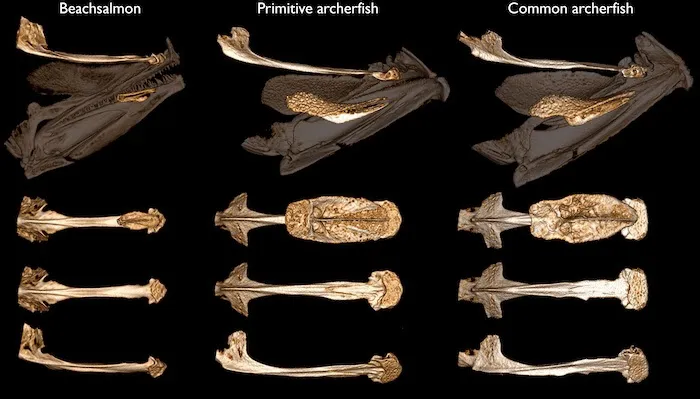
Figure 2. Tongue and mouth bones of the beach salmon, primitive archerfish, and common archerfish, from left to right. Credit: Matthew Girard (ECO 2022).
Beach salmon use these structures to crush hard-bodied prey, which suggests that the archerfish already had most of the mechanisms they needed (ECO 2022). This is called co-option, meaning existing parts were modified for a new function (Girard et al. 2022). They developed their shooting abilities by evolving existing structures in their mouths to adapt to their environment, as they usually live in areas where vegetation or prey is overhanging the water surface (NBC News 2022).
Physics sets the path of every shot and amplifies its power, while evolution repurposed old mouth structures to make the shot possible. So the archerfish is not quite a tiny physicist, just a fish that makes good use of old parts and the laws of physics.
References
COMAP. 2022. “Math in Pictures: Archer Fish, Natural Mathematicians.” COMAP (blog), October 28, 2022. https://comap.org/blog/item/math-in-pictures-archer-fish-natural-mathematicians.
Denver Zoo Conservation Alliance. 2024. “Archerfish.” Last modified July 3, 2024. https://denverzoo.org/animals/archerfish/.
Dill, Lawrence M. 1977. “Refraction and the Spitting Behavior of the Archerfish (Toxotes chatareus).” Behavioral Ecology and Sociobiology 2 (2): 169–84. https://www.jstor.org/stable/4599128.
ECO. 2022. “Researchers Publish Most Thorough Study Yet of ‘Smart’ Spitting Archerfishes.” Environment Coastal & Offshore, April 18, 2022. https://ecomagazine.com/news/fisheries-aquaculture/researchers-publish-most-thorough-study-yet-of-smart-spitting-archerfishes/.
Girard, M. G., M. P. Davis, H. H. Tan, D. J. Wedd, P. Chakrabarty, W. B. Ludt, A. P. Summers, and W. L. Smith. 2022. “Phylogenetics of Archerfishes (Toxotidae) and Evolution of the Toxotid Shooting Apparatus.” Integrative Organismal Biology 4 (1): obac013. https://doi.org/10.1093/iob/obac013.
Lüling, K. H. 1963. “The Archer Fish.” Scientific American 209 (1): 100–109. https://www.jstor.org/stable/24936221.
MacDonald, James. 2019. “The Amazing Eyes of the Archerfish.” JSTOR Daily, June 10, 2019. https://daily.jstor.org/the-amazing-eyes-of-the-archerfish/.
NBC News. 2022. “How Did Archerfish Learn to Shoot Down Their Prey?” April 24, 2022. http://nbcnews.com/science/science-news/archerfish-learn-shoot-prey-new-study-idea-rcna24556.
Vailati, Alberto, Luca Zinnato, and Roberto Cerbino. 2012. “How Archer Fish Achieve a Powerful Impact: Hydrodynamic Instability of a Pulsed Jet in Toxotes jaculatrix.” PLoS ONE 7 (10): e47867. https://doi.org/10.1371/journal.pone.0047867.
Comments
7 Responses to “Is the Archerfish a Tiny Physicist?”
Hey iSci!
I chose to write about the archerfish because I’m interested in aquatic life, and it connects nicely to what we’ve been learning in life sciences and physics. I thought it was really interesting how this fish’s hunting skill comes from evolution repurposing old body parts and the same 2D projectile motion we’ve been studying. Hopefully you find it interesting too!
Emily
Hi Emily, this was a very interesting blog and I enjoyed reading about the archerfish. Here is some feedback which could improve your blog:
P1: This is a cool introduction, but the connection between the seemingly “random” firing and this resembling a physics problem is a bit lost on me. Maybe add another sentence describing that (ie. refraction and projectile motion).
P2S1: italicize the Latin name of the fish
It would benefit your blog is if you could expand on how the fish can see the bug from underwater, and how refraction is involved.
A picture of the fish shooting water would be cool if it exists.
The concluding paragraph is repetitive, try: “The archerfish is not quite a tiny physicist, just a fish making use of old parts and the laws of physics”.
Looking forward to reading the final and happy editing!
Olivia
Hi Olivia,
Thank you for all the helpful feedback! I added a sentence to the introduction linking the shot to refraction and projectile motion, italicized the Latin name, and trimmed the conclusion so it is less repetitive. I also expanded the refraction section to explain how the insect’s position appears shifted and how archerfish adjust for it, and added an illustration of an archerfish in action (Figure 1). In terms of the fish’s eyesight, I wanted to keep the focus on physics and evolution rather than the specific details, and the word limit also left me with very little room to explain how the fish sees from underwater.
Thanks so much for editing!
Emily Tai
Hi Emily,
Really fun read, and the ending landed well. I liked that the answer turned out to be “old parts used cleverly” rather than fish genius.
Two things:
You explain that refraction makes the insect appear somewhere other than where it is, but you never say how the fish deals with it. That’s the most interesting part of the aiming problem, so even one sentence on how it compensates would help.
Most of your sources are news sites and blogs rather than the studies themselves. Since the Girard study and the jet-power research are both published papers, citing those directly would make the post stronger.
Happy editing!
Gurdit
Hi Gurdit,
Thanks for your feedback! I’m so glad the ending worked! I added how the archerfish deals with refraction, and I now cite the original studies for the refraction, evolution and jet-power claims.
Thank you for reviewing my blog post,
Emily Tai
Hi Emily,
I really enjoyed reading your blog post! I thought the connection between physics, evolution, and the archerfish’s hunting strategy was fascinating. Here are three points of feedback:
1. You explain that refraction makes the insect appear in a different position underwater, but it would be interesting to elaborate on how the archerfish compensates for this distortion when aiming. This would help readers better understand how the fish successfully targets prey above the water.
2. Consider including more detail about the evidence supporting the evolutionary explanation. For example, briefly explaining how the similarities between the beach salmon’s and archerfish’s mouth structures support the idea that existing structures were adapted for a new function would strengthen your argument.
3. While your sources provide an accessible introduction to the topic, incorporating the original research papers behind the findings on jet propulsion and archerfish evolution would strengthen the scientific credibility of the post and allow readers to explore the evidence directly.
Overall, great job making a complex scientific topic engaging and accessible by connecting biology and physics!
-Tvara
Hi Tvara,
Thank you for all your helpful advice! I added how archerfish compensate for refraction, and I strengthened the evolution section by naming a shared structure, the toothed tongue bone, and explaining that the beach salmon use it to crush prey. I also cited the original studies for the jet-power and evolution claims.
Thanks so much for editing!
Emily Tai