Earthquakes are a scary reality for people living on active plate boundaries. Not only does the initial earthquake cause destruction, the secondary events caused by the seismic activity can lead to the evolution of a species through allopatric speciation.
Speciation is the genealogical separation of a population due to environmental alterations (Manthey et al. 2021). In particular, earthquakes can have dramatic effects on the evolution of a population. The earthquake itself is not the only factor that leads to speciation; the secondary effects of the earthquake, including surface faulting, fires, and landslides can also decrease a population’s gene flow.
Allopatric speciation occurs when a new geological feature separates a population (April et al. 2013). This results in a genetically different species to form on the other side of the barrier. Allopatric speciation can happen when surface faulting transpires after an earthquake. Surface faulting, the separation of ground, is caused by surface waves. Even a small break in the ground can lead to populations being torn apart, resulting in a new species emerging.
Fires can also happen as a result of an earthquake. For instance, when electrical cables are damaged from the trembling ground, flames can erupt destroying parts of communities and populations. This can lead to allopatric speciation since a thriving population has now been separated by a natural disaster. The more devastation that occurs the farther apart a population moves away from each other. This leads to groups of the species adapting to their new environments, causing genetic changes over time.
Additionally, landslides can happen after an earthquake which can lead to allopatric speciation. This natural disaster is the flowing of rock and debris, often down an elevated surface (Gariano and Fausto 2016). Landslides can lead to a new species forming, since the separation can move parts of a population to a new environment. These new conditions cause organisms to adapt in order to survive which gradually leads to evolution.
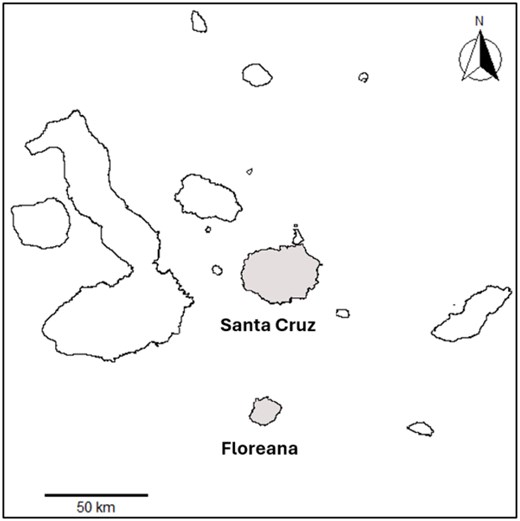
A recent study on Darwin’s Galapagos Finches is a prime example of what could lead to allopatric speciation (Kaluppa et al. 2025). The separation of islands Santa Cruz and Floreana (seen in figure 1) could have led to the evolution of a new species. The cactus finches typically have a certain tune that they sing. When they were separated into two islands, not only were their song patterns different, but the birds varied in beak and body sizes. A very likely explanation as to why these changes occurred relates to divergent plate tectonics. As the plates moved away from each other, a new ocean formed separating the cactus finches leading to their evolution.
Overall, it is evident that the consequences of earthquakes can cause evolutionary changes in populations. Earthquakes not only have direct impacts on societies, but they also have repercussions that can be seen years later. Since allopatric speciation happens gradually over many generations, it will take time to link a specific earthquake to the evolution of a species.
References
April, Julien, Robert H. Hanner, Anne‐Marie Dion‐Côté, and Louis Bernatchez. “Glacial Cycles as an Allopatric Speciation Pump in North‐eastern American Freshwater Fishes.” Molecular Ecology (Oxford) 22, no. 2 (2013): 409–22. https://doi.org/10.1111/mec.12116.
Gariano, Stefano Luigi, and Fausto Guzzetti. “Landslides in a Changing Climate.” Earth-Science Reviews (Amsterdam) 162 (November 2016): 227–52. https://doi.org/10.1016/j.earscirev.2016.08.011.
Kaluppa, Melanie, Jefferson García-Loor, Alper Yelimlieş, Çağlar Akçay, and Sonia Kleindorfer. “Cultural and Morphological Divergence of Darwin’s Cactus Finches (Geospiza Scandens) across Galápagos Islands.” Biological Journal of the Linnean Society (England) 146, no. 2 (2025): blaf098. https://doi.org/10.1093/biolinnean/blaf098.
Manthey, Joseph D., John Klicka, and Garth M. Spellman. “The Genomic Signature of Allopatric Speciation in a Songbird Is Shaped by Genome Architecture (Aves: Certhia Americana).” Genome Biology and Evolution (England) 13, no. 8 (2021). https://doi.org/10.1093/gbe/evab120.
Comments
7 Responses to “How the Secondary Effects of Earthquakes Impact Evolution”
My topic directly correlates to the content we have been learning about in life science and in earth science! In life science, evolution has been our main topic of study. I decided to focus on allopatric speciation and how that mechanism leads to a population’s evolution over time. I connected this with earth science since we had a whole lesson on earthquakes. At the end of the lesson, Dr. Pérez talks about the secondary effects that can happen after an earthquake. I decided to relate how these secondary disasters can lead to allopatric spectation, over time resulting in genetically different species.
Hi Emma,
I really liked your post and I think your topic integrates the topic of biology and earth science very well! Here are a couple suggestions:
– P2S1: I think you meant “altering its environment” instead of “alternating its environment”
– P6S1: You can change “mechanisms of specification” to “mechanisms of speciation”
– In paragraph 6, I think you might be able to combine some sentences to free up word count in case there’s more information you want to add. For example, you can merge sentences 2 and 3 to say something like: ” However, research conducted on the genus Sclomina led to the discovery of five different species(Du et al. 2023)…” and then you can go on to talk about the origins. If your word count allows, you might also be able to explain how geological phenomena (like the ice age) lead to allopatric speciation as well, since earthquake-driven speciation is difficult to identify.
Overall, I really enjoyed your post and you did really well integrating these topics.
Happy Editing!
Naomi
Hi Naomi!
Thank you for the feedback. I have made the changes to my spelling errors in P2S1 and P6S1, thanks for the catch! For the example in paragraph 6, I ended up finding a different example that shows allopatric speciation better. Thank you for your feedback on that paragraph though!
Best,
Emma
Hi Emma! Great start for your blog. If possible, try to find a unique example which demonstrates the ideas discussed in this blog, to make it more relevant. Here is some feedback:
– no need to cite lecture slides, instead, find an academic article which discusses those concepts, and cite that.
– make paragraph 2 more concise by combining some sentences. For example, “Speciation is the genealogical separation of a population due to environmental alterations.”
– the example with Sclomina is good, but an example that confirms allopatric speciation would be more effective. Also, avoid saying uncertain statements like “it will be difficult to create a concrete idea on the evolution of these species, since scientists were not actually present during this time.” Although this is true, it discredits your blog.
Happy editing!
Olivia
Hi Olivia!
Thank you for the feedback!
I removed the lecture slide citations and found an academic article for the information that I think might not be common knowledge. I combined the first two sentences in paragraph 2 using your suggestion. I found a new example that emphasizes allopatric speciation better. I also removed the statement that you suggested.
Thank you for all of your helpful tips!
Best,
Emma
Hi Emma!
I enjoyed reading this post! This is a really good integration of earthquakes from earth science and speciation from life science.
A few feedback points:
– The first paragraph is a good hook. However, the current wording of ti makes it sound as though speciation itself is a scary consequence of an earthquake. You could add a sentence clarifying the transition between the first couple of sentences.
– As well, since the lecture material is considered familiar concepts among iScis, you could consider removing all the lecture citations. This will give you more room in your word count.
– For the conclusion, I think you could strengthen your argument by emphasizing that speciation is a gradual process that occurs over many generations. It can also be challenging to link a certain earthquake directly to the evolution of a new species.
I can’t wait to read your final product!
Regards,
Amelia
Hi Amelia!
Thank you for the feedback!
I removed the lecture citations and found academic articles for the information that I think could use some support. I added a sentence to my concluding paragraph to strengthen my argument using your suggestions. For the introduction, I am trying to convey that speciation could result from the secondary effects of an earthquake over time. In saying this, I will leave my introduction paragraph as is.
Best,
Emma