Alzheimer’s is one of the most prevalent and devastating neurodegenerative diseases globally, and affects approximately 35.8% of people over the age of 85 (Alzheimer’s Association 2026). Alzheimer’s disease is primarily attributed to the buildup of amyloid-beta (Aβ) peptides (plaque) within the brain parenchyma, which occurs when non-functional microglia and astrocytes, both types of glial cells, fail to clear extracellular waste (Zheng and Wang 2024; Mitroshina et al. 2023). This buildup disrupts cellular function and induces the hyperphosphorylation of the tau protein, which aggregates into highly toxic tau oligomers (Zheng and Wang 2024). These alterations, in combination with weakening of cerebral gamma waves, which coordinate multiple neural circuits across the brain (Etter et al. 2019), result in the neurodegeneration and cognitive decline characteristic of Alzheimer’s disease.
Despite heavy investment in Alzheimer’s treatment, many treatments remain ineffective, slowing symptom progression rather than reversing damage. However, recent advances in optogenetics has shown it to hold potential in Alzheimer’s treatment, allowing for the direct reversal of brain circuit and memory impairments (Mirzayi et al. 2022).
Optogenetics is a technique which utilizes genetic engineering to express light-sensitive transmembrane proteins called opsins in specific cell subpopulations (Ledri et al. 2023). Altered cells are then exposed to targeted bursts of light, which activate or deactivate opsin channels, and regulate ion flow and chemical signalling. This allows for the manipulation of electrical and biochemical activity in select cells (Figure 1).
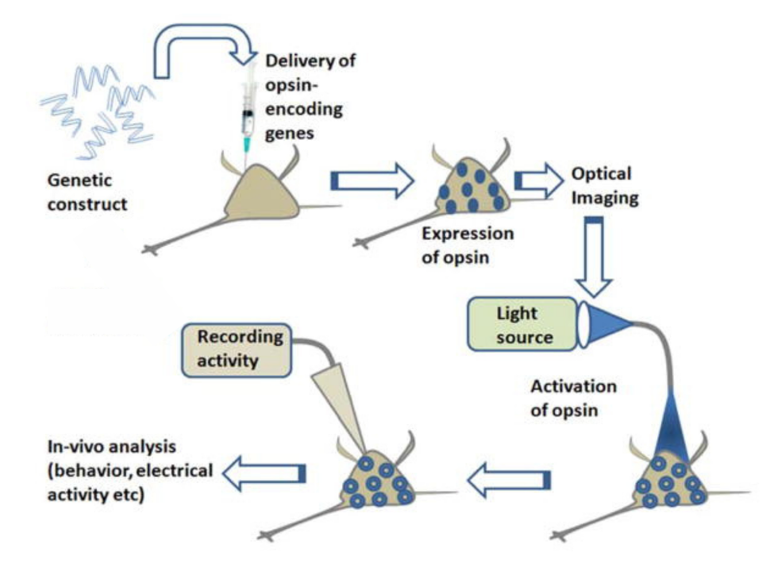
Figure 1 – Description of optogenetic methodology and activation. Microbial opsin-encoding genes are injected directly into the target area using a viral vector, causing cells to express opsin, a light-sensitive transmembrane protein. A light source is then inserted near target cells, and targeted bursts of electromagnetic light are shone at specified cells, causing the activation of opsins and artificially stimulating a cellular response. Cell response is measured using a patch clamp. Adapted from (Mohanty and Lakshminarayananan 2015)
This technology’s exceptional spatiotemporal precision allows researchers to target not only individual cells, but entire neural circuits, enabling the restoration of key brain functions which are disrupted in Alzheimer’s patients. A 2016 study by Iaccarino et al. found that optogenetic stimulation of fast-spiking parvalbumin-positive interneurons, a class of GABAergic inhibitory neurons which regulate brain activity and signal synchrony, temporarily activated gamma oscillations, significantly reducing plaque buildup in brain parenchyma and promoting microglial-mediated clearance. These findings suggest that influencing neuronal activity in one region produces beneficial effects throughout the brain. A 2019 study by Etter et al. similarly found that optogenetic stimulation of medial septal parvalbumin neurons, another GABAergic neuron, restored hippocampal slow gamma oscillations, which present abnormally in Alzheimer’s patients. Because slow gamma oscillations are critical in multisystemic coordination and memory retrieval, their recovery repaired network level damage and resulted in the restoration of memory deficits, helping to reverse neural damage. Furthermore, optogenetics has been used to stimulate in vitro neurogenesis, a process frequently disrupted by chronic neurodegenerative conditions like Alzheimer’s (Mitroshina et al. 2023), but which is essential in driving learning and memory formation (Kumar et al. 2019). Preclinical studies indicate that stimulating neurogenesis could therefore improve cognition and reduce Alzheimer’s pathology by replenishing damaged neural networks (Dwamena et al. 2025).
Though research into optogenetics-based Alzheimer’s therapies is largely preclinical, this technology holds great promise as the future of Alzheimer’s treatment. It is able to restore cerebral systemic functions, improving upon traditional treatments which focus largely on symptom management. As such, it is shifting the paradigm from targeted symptom management to a system-wide treatment approach, which is essential when dealing with complex, multisystemic neurodegenerative diseases.
Resources
Alzheimer’s Association. 2026. “Alzheimer’s Disease Facts and Figures.” Alzheimer’s & Dementia 22 (4): e71345. https://doi.org/10.1002/alz.71345.
Dwamena, Abena, Rashini Beragama-Arachchi, and Hongmin Wang. 2025. “Boosting Neurogenesis as a Strategy in Treating Alzheimer’s Disease.” International Journal of Molecular Sciences 26 (18): 8926. https://doi.org/10.3390/ijms26188926.
Etter, Guillaume, Suzanne van der Veldt, Frédéric Manseau, Iman Zarrinkoub, Emilie Trillaud-Doppia, and Sylvain Williams. 2019. “Optogenetic Gamma Stimulation Rescues Memory Impairments in an Alzheimer’s Disease Mouse Model.” Nature Communications 10 (1): 5322. https://doi.org/10.1038/s41467-019-13260-9.
Iaccarino, Hunter F., Annabelle C. Singer, Anthony J. Martorell, et al. 2016. “Gamma Frequency Entrainment Attenuates Amyloid Load and Modifies Microglia.” Nature 540 (7632): 230–35. https://doi.org/10.1038/nature20587.
Kumar, Ashutosh, Vikas Pareek, Muneeb A. Faiq, Sanjib K. Ghosh, and Chiman Kumari. 2019. “ADULT NEUROGENESIS IN HUMANS: A Review of Basic Concepts, History, Current Research, and Clinical Implications.” Innovations in Clinical Neuroscience 16 (5–6): 30–37.
Ledri, Marco, My Andersson, Jenny Wickham, and Merab Kokaia. 2023. “Optogenetics for Controlling Seizure Circuits for Translational Approaches.” Neurobiology of Disease 184 (August): 106234. https://doi.org/10.1016/j.nbd.2023.106234.
Mirzayi, Parsa, Parnian Shobeiri, Amirali Kalantari, George Perry, and Nima Rezaei. 2022. “Optogenetics: Implications for Alzheimer’s Disease Research and Therapy.” Molecular Brain 15 (February): 20. https://doi.org/10.1186/s13041-022-00905-y.
Mitroshina, Elena, Elizaveta Kalinina, and Maria Vedunova. 2023. “Optogenetics in Alzheimer’s Disease: Focus on Astrocytes.” Antioxidants 12 (10): 1856. https://doi.org/10.3390/antiox12101856.
Mohanty, Samarendra K., and Vasudevan Lakshminarayananan. 2015. “Optical Techniques in Optogenetics.” Journal of Modern Optics 62 (12): 949–70. https://doi.org/10.1080/09500340.2015.1010620. Zheng, Qiuyang, and Xin Wang. 2024. “Alzheimer’s Disease: Insights into Pathology, Molecular Mechanisms, and Therapy.” Protein & Cell 16 (2): 83–120. https://doi.org/10.1093/procel/pwae026.


Leave a Reply
You must be logged in to post a comment.