You may have heard that chocolate consumption is directly proportional to Nobel Laureates, where more chocolate corresponds to more Nobel winners. This claim is based on an analysis that looked at connections between chocolate consumption and Nobel Laureates, which showed a surprisingly strong fit between the two variables (Figure 1) (Messerli 2012). The significant p-value, 0.0001, and high Pearson’s r value, 0.791, suggest a strong, non-random linear relationship (Mcleod 2023; Sheposh 2022). Although it is unlikely that this correlation means that increasing chocolate consumption causes Nobel Laureates to increase as well, the statistical findings push us to ask can chocolate support our learning in any way?
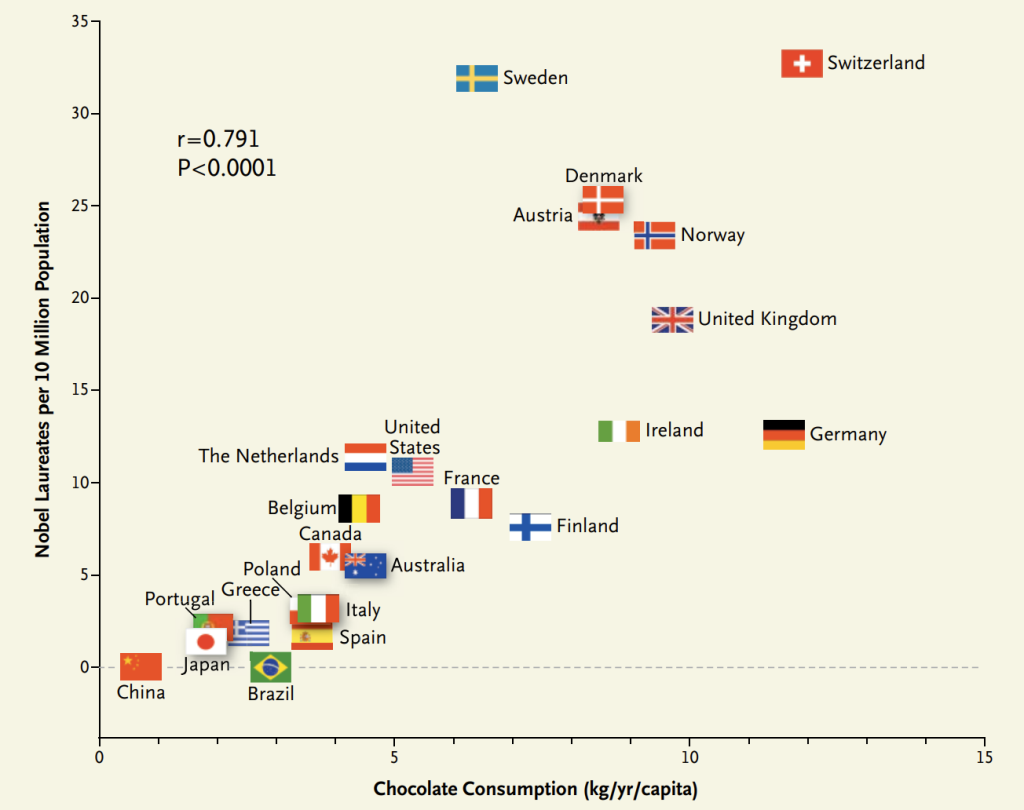
Figure 1. Scatter plot showing a strong positive linear correlation between chocolate consumption per capita and Nobel Laureates per 10 million citizens in 2012 (Messerli 2012). Pearson’s r, valued at 0.791, can range from +/- 1 to 0, where closer to +/- 1 indicates stronger linear relationships (Sheposh 2022). The p-value, 0.0001, can range from close to 0 to 1, where a low value, below the 0.05 baseline, indicates that results are not random, and could be repeated (Mcleod 2023). The given statistical parameters therefore demonstrate a strong relationship. The data follows a linear line of best fit, and shows two main outliers, Sweden, and Germany. Based on chocolate consumption, it would be expected that Sweden would have 10 to 15 Laureates, but instead has 32. On the other hand, Germany falls lower than presumed, as based on chocolate consumption, it should have 25 to 30 Laureates, but actually has about 13. Source: Messerli (2012).
One of the primary drugs found in dark chocolate is theobromine, chemically known as 3,7-dimethylxanthine (C7H8N4O2) (Figure 2) (PubChem 2026). The drug is amphiphilic, possessing a polar region composed of carbonyl and nitrogen groups, as well as a nonpolar region consisting of carbon-nitrogen rings and methyl groups (Mane et al. 2026). These characteristics, combined with its relatively small molar mass, about 180.17 g/mol, allow it to cross biological membranes through passive diffusion (PubChem 2026; Sugano et al. 2010). The polar features form hydrogen bonds with water to reach cell surfaces, while the nonpolar parts allow it to cross the hydrophobic section of the phospholipid bilayer without needing energy (Schuster and Mitchell 2019).
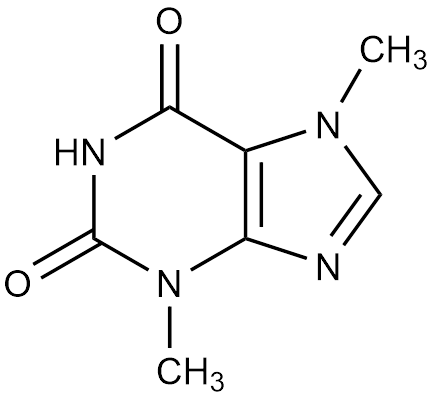
Figure 2. Chemical structure of theobromine (C7H8N4O2), also known as 3,7-dimethylxanthine (PubChem 2026). The molecule is made up of two rings with carbon and nitrogen elements. It has two carbonyl groups, at positions 2 and 6, and two methyl groups, at place 3 and 7. Source: Designed with ChemDraw based on a structure from PubChem (2026).
When consumed through chocolate, theobromine is exogenous, as it enters from outside of the body. As a result of its chemical characteristics, it is able to pass through the blood-brain barrier, where it can bind to A1 adenosine receptors (Schuster and Mitchell 2019). Adenosine is an endogenous neurotransmitter, which binds to receptors throughout the day, causing a feeling of tiredness (Valada et al. 2022). Theobromine binds to A1, acting as an antagonist, and blocks adenosine from binding, which can support focus (Schuster and Mitchell 2019). Simultaneously, theobromine inhibits phosphodiesterase enzyme (PDE) activity, by acting as a competitor, and binding to the active sites, preventing cyclic AMP (cAMP) from binding to it (MartÃnez-Pinilla et al. 2015; Schuster and Mitchell 2019). Together, these actions increase the production of, and decrease the breaking down of cAMP, respectively (Yoneda et al. 2017; Sassone-Corsi 2012). CAMP is a cellular messenger, which transmits extracellular signals to the cell, allowing for intracellular communication. As cAMP builds up, it promotes protein kinase A (PKA), an enzyme that manages cellular processes, to work, activating the cAMP response element binding protein (CREB). CREB, instructs cells to produce and release brain-derived neurotrophic factor (BDNF) (Schuster and Mitchell 2019). BDNF is a protein that maintains neurons and their growth, while supporting new neural connections, improving memory and learning (Bathina and Das 2015). Overall, one small molecule creates the conditions for a series of reactions to take place, involving numerous different components, and ultimately supporting cognition in small ways.
Overall, the reasoning for the proportionality between chocolate consumption and Nobel Laureates remains unknown. Further research on the consumption of dark chocolate in particular, as well as the eating habits of Nobel Laureates could allow us to broaden our understanding on this trend. Nonetheless, while consuming dark chocolate will not exactly send you to Stockholm, research shows that it can support alertness, understanding, and focus. So, next time you need a study snack, consider grabbing a piece of dark chocolate.
References
Bathina, Siresha, and Undurti N. Das. 2015. “Brain-Derived Neurotrophic Factor and Its Clinical Implications.” Archives of Medical Science 11 (6): 1164–78. https://doi.org/10.5114/aoms.2015.56342.
Mane, Rohan, Rukayya Shaikh, Priyanka Paulzagade, and Rohan Balasaheb. 2026. “Theobromine: A Comprehensive Review of Its Pharmaceutical Profile, Analytical Methods, and Clinical Insights.” International Journal of Pharmaceutical Research and Applications 11 (1): 2456–4494. https://doi.org/10.35629/4494-11013644.
MartÃnez-Pinilla, Eva, Ainhoa Onatibia-Astibia, and Rafael Franco. 2015. “The Relevance of Theobromine for the Beneficial Effects of Cocoa Consumption.” Frontiers in Pharmacology 6 (30). https://doi.org/10.3389/fphar.2015.00030.
Mcleod, Saul. 2023. “P-Value and Statistical Significance: What It Is & Why It Matters.” Simply Psychology, October 13. https://www.simplypsychology.org/p-value.html.
Messerli, Franz H. 2012. “Chocolate Consumption, Cognitive Function, and Nobel Laureates.” New England Journal of Medicine 367 (16): 1562–64. https://doi.org/10.1056/nejmon1211064.
PubChem. 2026. “Compound Summary for CID 5429, Theobromine.” National Center for Biotechnology Information. https://pubchem.ncbi.nlm.nih.gov/compound/Theobromine.
Sassone-Corsi, Paolo. 2012. “The Cyclic AMP Pathway.” Cold Spring Harbor Perspectives in Biology 4 (12): a011148–48. https://doi.org/10.1101/cshperspect.a011148.
Schuster, Julius, and Ellen S. Mitchell. 2019. “More than Just Caffeine: Psychopharmacology of Methylxanthine Interactions with Plant-Derived Phytochemicals.” Progress in Neuro-Psychopharmacology and Biological Psychiatry 89 (March): 263–74. https://doi.org/10.1016/j.pnpbp.2018.09.005.
Sheposh, Richard. 2022. “Pearson Correlation Coefficient (PCC).” In Research Starters. EBSCO. https://www.ebsco.com/research-starters/science/pearson-correlation-coefficient-pcc/.
Sugano, Kiyohiko, Manfred Kansy, Per Artursson, et al. 2010. “Coexistence of Passive and Carrier-Mediated Processes in Drug Transport.” Nature Reviews Drug Discovery 9 (8): 597–614. https://doi.org/10.1038/nrd3187.
Valada, Pedro, Sofia Alçada-Morais, Rodrigo A. Cunha, and João Pedro Lopes. 2022. “Thebromine Targets Adenosine Receptors to Control Hippocampal Neuronal Function and Damage.” International Journal of Molecular Sciences 23 (18): 10510. https://doi.org/10.3390/ijms231810510.
Yoneda, Mitsugu, Naotoshi Sugimoto, Masanori Katakura, et al. 2017. “Theobromine Up-Regulates Cerebral Brain-Derived Neurotrophic Factor and Facilitates Motor Learning in Mice.” The Journal of Nutritional Biochemistry 39 (January): 110–16. https://doi.org/10.1016/j.jnutbio.2016.10.002.


Leave a Reply
You must be logged in to post a comment.