If you were to ask your first year self how long the first semester felt, many would say it felt like a lifetime and fast forward now to third year and fall semester was over in a blink of an eye. The clocks didn’t change but something in the brain did, and the explanation for what changed is not completely solidified.
The Brain’s clock
Putting a semester into a lab as a unit of time is not possible. So researchers measure on a scale they can actually control such as seconds.
Figure 1 demonstrates an experiment where young and older adults were trained to reproduce intervals of 8 and 21 seconds, and then were tested for two hours with no feedback. Over the recorded session, the older group drifted steadily, producing intervals longer than the target by the final group. The younger group barely moved (Malapani et al. 1998; Rakitin et al. 1998).
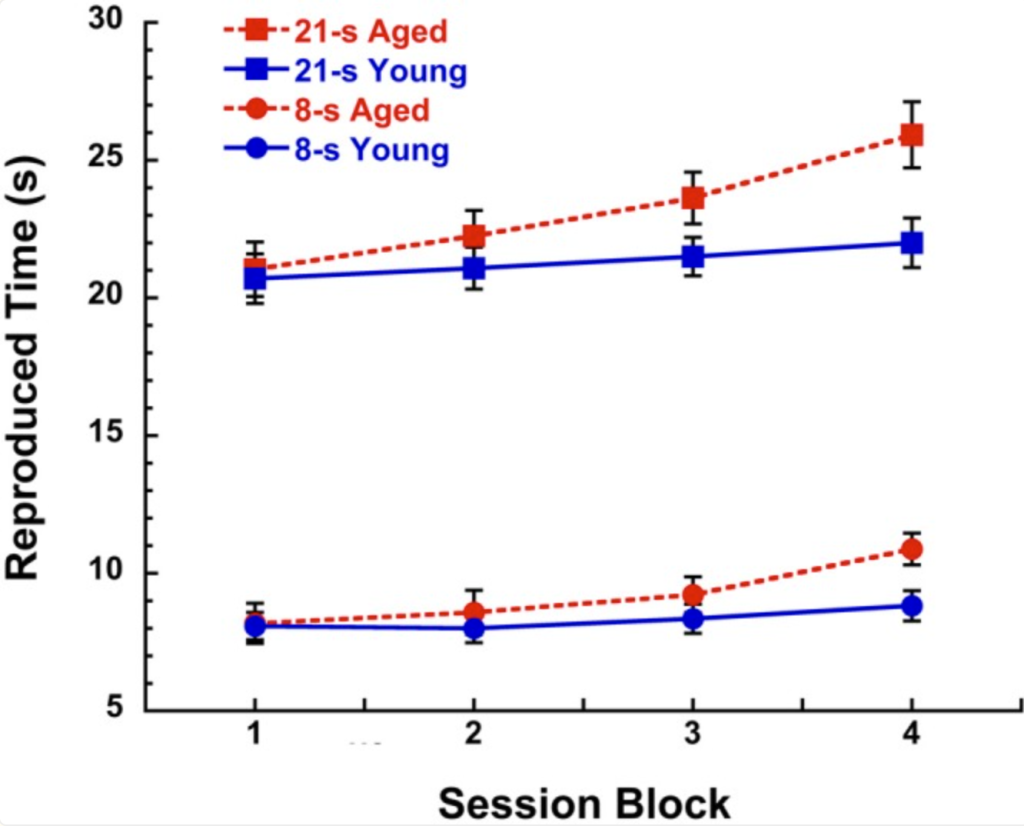
Producing a longer interval correlates to the clock running slow. More simply, fewer internal ticks means you need more real seconds to reach what feels like 21, creating an overshoot. A review by Turgeon, Lustig, and Meck (2016) links this to dopamine. The review explains this is due to striatal dopamine depleting during sustained mental effort, and also notes that the cortico-striatal circuits supporting our sense of time are vulnerable to age-related decline (Bäckman et al. 2010; Turgeon, Lustig, and Meck 2016). This causes a perceived speed up of the world while the internal clock slows down. Across ages 19 to 98, unpaced tapping rates become both slower and more variable with age (Turgeon and Wing 2012).
Except that might not be the clock at all
A timing study done with a sample size of 647 people found timing performance tracked general cognitive scores. Control for those scores and the relationship with age vanishes (Bartholomew, Meck, and Cirulli 2015). The clock we all like to blame might be completely fine, but the attention and working memory may just be doing the job worse (Lustig and Meck 2001).
This can be applied even to our perception of time from just our first year. First year needed constant attention, whether it went from navigating a new campus to even trying out different techniques in the lab. By third year the lectures, walks to class and the routine you have made the last two years are so ingrained you don’t think twice about it.
The gap that hasn’t been closed
Everything that was talked about above happens in mere seconds and minutes. We do not realize the time passed until we think retrospectively (Janssen, Naka, and Friedman 2013). A semester occurs over the span of months, and you only notice how fast it has passed when it is almost done. Researchers believe the feeling of time passing by faster the more you age applies mostly to looking back on the years passed, and that timing on that scale depends heavily on different neural systems (Wittmann and Lehnhoff 2005; Turgeon, Lustig, and Meck 2016).
There is a measurable mechanism that operates on seconds and a vivid experience operating on months but the bridge between these two spans of time doesn’t yet exist. As much as the dopamine connection seems biologically plausible it isn’t the whole story.
A plausible story and an actual common feeling are not the same as a plausible explanation. Sometimes the honest answer is that we do not currently know and are still guessing about how the semester passed by so fast. It serves as a reminder to be present everyday because everything will pass by fast.
References
Bäckman, Lars, Ulman Lindenberger, Shu-Chen Li, and Lars Nyberg. 2010. “Linking Cognitive Aging to Alterations in Dopamine Neurotransmitter Functioning: Recent Data and Future Avenues.” Neuroscience & Biobehavioral Reviews 34 (5): 670–677. https://doi.org/10.1016/j.neubiorev.2009.12.008.
Bartholomew, Aaron J., Warren H. Meck, and Elizabeth T. Cirulli. 2015. “Analysis of Genetic and Non-Genetic Factors Influencing Timing and Time Perception.” PLoS ONE 10 (12): e0143873. https://doi.org/10.1371/journal.pone.0143873.
Janssen, Steve M. J., Makiko Naka, and William J. Friedman. 2013. “Why Does Life Appear to Speed Up as People Get Older?” Time & Society 22 (2): 274–290. https://doi.org/10.1177/0961463X13478052.
Lustig, Cindy, and Warren H. Meck. 2001. “Paying Attention to Time as One Gets Older.” Psychological Science 12 (6): 478–484. https://doi.org/10.1111/1467-9280.00389.
Malapani, Chara, Brian Rakitin, Richard Levy, Warren H. Meck, Bernard Deweer, Bruno Dubois, and John Gibbon. 1998. “Coupled Temporal Memories in Parkinson’s Disease: A Dopamine-Related Dysfunction.” Journal of Cognitive Neuroscience 10 (3): 316–331. https://doi.org/10.1162/089892998562762.
Rakitin, Brian C., John Gibbon, Trevor B. Penney, Chara Malapani, Sean C. Hinton, and Warren H. Meck. 1998. “Scalar Expectancy Theory and Peak-Interval Timing in Humans.” Journal of Experimental Psychology: Animal Behavior Processes 24 (1): 15–33. https://doi.org/10.1037/0097-7403.24.1.15.
Turgeon, Martine, and Alan M. Wing. 2012. “Late Onset of Age-Related Difference in Unpaced Tapping with No Age-Related Difference in Phase-Shift Error Detection and Correction.” Psychology and Aging 27 (4): 1152–1163. https://doi.org/10.1037/a0029925.
Turgeon, Martine, Cindy Lustig, and Warren H. Meck. 2016. “Cognitive Aging and Time Perception: Roles of Bayesian Optimization and Degeneracy.” Frontiers in Aging Neuroscience 8: 102. https://doi.org/10.3389/fnagi.2016.00102.
Wittmann, Marc, and Sandra Lehnhoff. 2005. “Age Effects in Perception of Time.” Psychological Reports 97 (3): 921–935. https://doi.org/10.2466/pr0.97.7.921-935.


Leave a Reply
You must be logged in to post a comment.