Poppy plants have become widely recognized in Canada as a symbol for Remembrance Day Poppy plants have become widely recognized in Canada as a symbol for Remembrance Day as they inspired the highly acclaimed poem ‘In Flanders Fields’ by Lieutenant Colonel John McCrae. However, poppies also have medicinal uses that continue to be used to this day, a drug used as a pain killer – morphine. While used medicinally, morphine is often abused, along with other opioids, causing an average of 15 deaths per day from April 2025 to May 2026 (Government of Canada 2025).
However, a pain reliever was not the intended purpose poppy plants had when they began synthesizing morphine. This initial purpose was a defense mechanism for the plants when they were damaged.
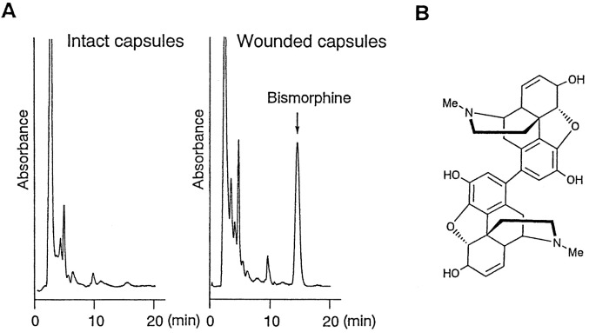
A 2001 study tested the effects of damage on poppy capsules vs. no damage done to the capsules (Morimoto et al. 2001). In response to induced stress, the damaged capsules began taking already present morphine and synthesizing bismorphine. Bismorphine consists of two morphine groups that cluster along the plant cell wall and acts as a structural glue that keeps the cell walls bound together (Braidwood et al. 2014). This binding of bismorphine to pectin further leads to a resistance of pectinases which are a group of enzymes that break down pectin and promote the degradation of the cell wall (Dong et al. 2024). The production of bismorphine following tissue damage helps activate the poppy plant’s defense response(Morimoto et al. 2001). A high-performance liquid chromatography (HPLC) method was used to identify bismorphine quantities in damaged and non-damaged capsules in figure 1.
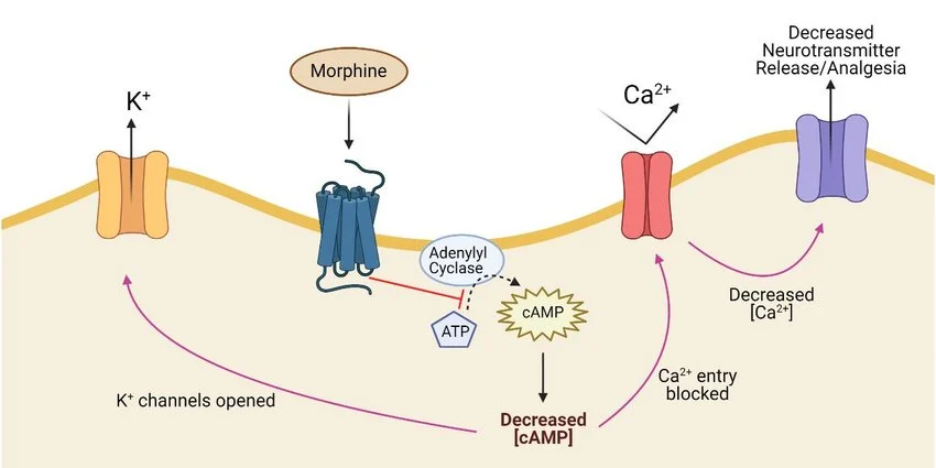
Morphine, while being used as a defense for plants, is also very addictive once patients require constant consumption(Listos et al. 2019). Once morphine enters the body, it binds to the opioid receptors within the brain such as the mu receptor. These receptors are a group of G-protein coupled receptors and cause critical molecular changes within the cell. For example, it activates the release of potassium channels, reduces calcium conductance, and inhibits adenylate cyclase activity (Listos et al. 2019)(Figure 2). Adenylate cyclase is an enzyme that is responsible for converting adenosine triphosphate (ATP) into cyclic adenosine monophosphate (cAMP). cAMP is a secondary messenger that is used in several pathways within a cell and executes precise cellular actions (Franziska 2025). By lowering the levels of cAMP within the neuron, it decreases the neurotransmission causing drowsiness, slow respiration, and overall pain relief (Kosten and George 2002).
When the molecule is bound to the mu receptors, morphine can be extremely addictive due to the irregular release of dopamine. Inhibitory neurons are linked to cells that release dopamine but have mu receptors on them. When morphine binds to the receptors, it “takes off the brakes” of the cell that produces dopamine, flooding the brain with mood enhancing neurotransmissions (Goldsmith 2024).
While the intended purposes of morphine are to be a repair agent for plants and to aid patients when dealing with the aftermath of painful procedures, the side effects of addiction should be considered before it is prescribed without a second thought.
References
Braidwood, L., C. Breuer, and K. Sugimoto. 2014. “My Body Is a Cage: Mechanisms and Modulation of Plant Cell Growth.” New Phytol 201: 388–402. https://doi.org/10.1111/nph.12473.
Dong, Yuhe, Tao Jiang, and Tong Wu. 2024. “Enzyme-Responsive Controlled-Release Materials for Food Preservation and Crop Protection – a Review.” International Journal of Biological Macromolecules 254 (January): 128051. https://doi.org/https://doi.org/10.1016/j.ijbiomac.2023.128051.
Franziska. 2025. “cAMP – a Currency of Cell Signaling – Biocrates Life Sciences Gmbh.” Biocrates Life Sciences Gmbh, October 14. https://biocrates.com/camp/.
Goldsmith, Sarah. 2024. “Hooked on a Feeling: Opioids Evoke Positive Feelings Through a Newly Identified Brain Region | MUSC Health.” Muschealth.Org. https://muschealth.org/content-hub/News/2024/08/09/opioid-addiction.
Government of Canada. 2025. “Opioid- and Stimulant-Related Harms in Canada.” Health Infobase, Government of Canada, March 7. https://health-infobase.canada.ca/substance-related-harms/opioids-stimulants/.
Kosten, Thomas, and Tony George. 2002. “The Neurobiology of Opioid Dependence: Implications for Treatment.” Science & Practice Perspectives 1 (1): 13–20. https://doi.org/10.1151/spp021113.
Listos, Joanna, Małgorzata Łupina, Sylwia Talarek, Antonina Mazur, et al. 2019. “The Mechanisms Involved in Morphine Addiction: An Overview.” International Journal of Molecular Sciences 20 (17): 4302. https://doi.org/10.3390/ijms20174302.
Matthews, Simon. 2021. Oral Morphine Patient Information University Hospitals Sussex NHS Foundation Trust. https://www.uhsussex.nhs.uk/wp-content/uploads/2022/09/Oral-morphine.pdf.
Morimoto, Satoshi, Kazunari Suemori, Jun Moriwaki, et al. 2001. “Morphine Metabolism in the Opium Poppy and Its Possible Physiological Function: BIOCHEMICAL CHARACTERIZATION of the MORPHINE METABOLITE, BISMORPHINE *.” Journal of Biological Chemistry 276 (41): 38179–84. https://doi.org/10.1074/jbc.M107105200.
Odegaard, Katherine E., “In utero and Postnatal Oxycodone Exposure: Implications for Intergenerational Effects” (2021). Theses & Dissertations. 518.
https://digitalcommons.unmc.edu/etd/518
Comments
20 Responses to “Poppy Plants, the New Drug Dealers”
Hello iSci!
I chose to do this topic because I find it so fascinating that plants can make chemicals that we can use in alternative ways. I also wanted to dive deeper into plant defense mechanisms and how specific and everyday used opioids affect the neurons in our brain. I would love any feedback and thoughts!
Emily
Hi Emily,
Your blog post is super fascinating! I love the topic you chose and how it connects both PAIx and neuroscience!
Some quick suggestions:
-In P1, when you mention the poem “In Flanders Fields” make sure to capitalize the whole title and put it in quotation marks
-I think a comma would improve flow after morphine and between while “Morphine while used medicinally, has constant..”
Overall, awesome blog post and happy editing!
Heer
Hi Heer!
Thank you for taking the time to read my blog post, I have implemented your suggestions.
-Emily
Hey Emily,
Really interesting topic! A couple suggestions I have:
– Either italicize or put quotations around the title “In Flander Field”, to show it is the title of the poem
– In paragraph 4, watch out with the word significant!!!! (“These receptors are a group of G-protein coupled receptors and cause significant molecular changes”) Chad might find you…
– For your citations (Listos, Joanna…) when you have more than six authors, list the first three and follow with “et al.”
Happy editting!
Hanna
Hi Hanna!
Thank you for reading my blog post! I have made the changes you suggested (so chad won’t come for me)
-Emily
Hi Emily,
This was a very cool topic!! A couple suggestions you can think if you want to include are:
– When you say “takes of the breaks”, if you’re referring to it similarly to a car, it should be brake!
– “In Flanders Fields” should be in quotation marks and capitalized
– At the end of p3, you say bimorphine, but before that you referred to bismorphine, so that may be a spelling error to correct!
Good luck editing!
Emma
Hi Emma!
Thank you for taking the time to read my blog post! I have made the changes you suggested.
-Emily
Hi Emily,
I love how you blended plant defense mechanisms and human physiology in your blog post! I have heard stories about athletes falsely testing positive on doping tests after having eaten foods with poppy seeds, but I didn’t realize it was because of the traces of morphine from the plant (which is typically banned in sports). Here are a few suggestions I had for your edits:
P1S3: I would rephrase this sentence to say “While used medicinally, morphine is often abused, along with other opioids, causing an average of 15 deaths per day from April 2025 to May 2026”.
P3S1: I recommend changing “testing” to “tested”.
Figure 1: I would suggest including an explicit reference to part B of the figure as you did for part A (or remove the explicit reference to part A to keep it consistent).
P4S1-3: Do any of these sentences require a citation?
P5S1: Consider changing “caused by” to something like “due to” or “because of”.
Great job and good luck with your edits!
Kristen
Hi Kristen!
Thank you so much for all the suggestions! I have added them all to my post, from P4 S1-3 are all a part of the same citation but I added it to the first sentence so it stays consistant!
– Emily
Hi Emily,
Very interesting and informative blog post! I have only a few small suggestions:
– I would reword the first sentence of P3 to something such as, “A 2001 study tested the effects of damage on poppy capsules vs. no damage done to capsules”.
– In P4S1, consider adding commas and slightly rewording this to improve flow. For example, “Morphine, while typically used as a defense for plants, is also very addictive once patients require constant consumption of the opioid.”
Great work overall!
Naya
Hello Naya,
Thank you for reading my blog post! I have included your suggestions.
– Emily
Hi Emily,
Great blog post with a really nice connection there at the beginning. I just have a few suggestions to elevate the paper as follows:
P1S3: I would swap ‘for’ to ‘reaching’ as it solidifies the significance better
P3: This may just be confusion on my part, but it might be helpful to explain if the morphine is given to the plants or if it is a derivative from the damage.
P4S1: I would remove “of the opioid ” as it is implied at the start of the sentence
Great paper, and I can’t wait to read it once all of the edits have been put in place.
Hi Isabella!
Thank you for reading my blog post! I have made clarifications to P3 and implemented your other suggestions.
– Emily
Hey,
P1 S3:
“Morphine while used medicinally, has constant abusive use along with other opioids for an average of 15 deaths per day from April 2025 to May 2026 (Government of Canada 2025). “
Your article focuses on poppy plants and the morphine found inside them, so the added phrase “along with other opioids” feels out of place and redundant. I think cutting that part out would make the introduction flow more smoothly. Also, “Morphine while” needs a comma after “while.”
In P5 S1:
“Morphine can be extremely addictive caused by the irregular release of dopamine when the molecule is bound to the mu receptors”
This sentence feels clunky and reads like a run-on sentence. I think restructuring it by putting “when the molecule is bound to the mu receptors” at the front would increase fluidity.
For example, “When the molecule is bound to the mu receptors, morphine can be extremely addictive due to the irregular release of dopamine” could sound much cleaner and flow better in the context of your paragraph.
Hey Emily,
(Disregard my previous comment, I accidentally sent a rough draft of it.)
I really like reading about your topic. It was engaging all the way through, combining two really interesting fields: neuropharmacology and biology. I do have a few comments.
P1 S3:
“Morphine while used medicinally, has constant abusive use along with other opioids for an average of 15 deaths per day from April 2025 to May 2026 (Government of Canada 2025). “
In this sentence, “Morphine while” needs a comma after “Morphine.” As well, “along with other opioids” needs commas around it.
In P5 S1:
“Morphine can be extremely addictive caused by the irregular release of dopamine when the molecule is bound to the mu receptors”
This sentence feels clunky and reads like a run-on sentence. I think restructuring it by putting “when the molecule is bound to the mu receptors” at the front would increase fluidity.
For example, “When the molecule is bound to the mu receptors, morphine can be extremely addictive due to the irregular release of dopamine” could sound much cleaner and flow better in the context of your paragraph.
Overall, great topic. Happy editing.
Hi Minglong!
Thank you for taking the time to read my blog post! All of your suggestions were super helpful and I have added them into my post.
-Emily
This was such a cool article, Emily! Here are some suggestions I had:
1. P4S1 – I would add some more commas to help with readability. Maybe changing it to something like this: “Morphine, while being used as a defence for plants, is also very addictive once patients require constant consumption of the opioid.”
2. P3S5 – The sentence was a bit hard to follow because “overall enables” is a bit vague. Another wording option you could consider is something like “The production of bismorphine following tissue damage helps activate the poppy plant’s defense response.”
Good luck editing!
Mansi
Hello Mansi!
Thank you for reading my blog post and I have edited according to your suggestions!
-Emily
Emilyyyyyyy, you ate this up, I want a t-shirt with a poppy on it and your face is the middle;)
I really like that you touch on Rememberance Day, however I feel like it is a tad clipped. I would maybe suggest elongating this sentence or adding another point to ease into your writing.
Here are some ideas:
“Poppy plants have become widely recognized in Canada as a symbol for Remembrance Day…
1. as they inspired the highly acclaimed poem ‘In Flanders Fields’ by Lieutenant Colonel John McCrae.
2. During November, people come together and don the poppy to show connection and resiliance, through war and pain.
I really loved your blog post, amazing job!!! – Ava;)
Hi Avaaaaaaaaa
Thank you for reading my blog post and I have added in your suggestions!
– Emily