The human cortex contains an estimated ten billion neurons. Using a cortical connectivity matrix, a form of square matrix used to map the probability of neural connections between nodes and parcels in the cortex, it would take, at a minimum, 10¹⁵ bits to specify the data represented by these neurons. Interestingly, however, the human genome only encodes for 6¹⁰ bits of data. As the genome encodes for the entire structure, function, and operation of the nervous system, including the cortex, how is it possible that the genome can contain so little information and construct such a complex, high-functioning, and large-capacity neural network (Shuvaev et al. 2024)?
This effect is known as the genomic bottleneck. It is suspected that the genome does not encode neurons one by one, but rather through a set of connectivity rules. For example, rather than explicitly stating which neural cell should connect during stimulus, a class of rules is outlined. These are based on specific chemical surface markers that axons may use to find synaptic destinations. This bottleneck effect is proposed to arise from an evolutionary drive to enable organisms with relatively low-capacity genomes to specify the complex neural circuits required for innate behaviours that improve fitness at birth (Shuvaev et al. 2024).
Artificial neural networks (ANNs), a type of machine learning model based on the structure of the human brain, face a similar dilemma (Lee 2021). For example, GPT-2, released in 2019, was estimated to have been trained on 4 billion tokens (small units of data, like words), compared to GPT-4, released in 2023, which was trained on almost 13 trillion tokens (Samborska 2025). 4 in 5 university students now use generative artificial intelligence (AI), with some models exceeding human baselines on PhD-level questioning, multimodal reasoning, and complex mathematics (Gil and Perrault 2026). AI’s growing magnitude, capabilities, and presence demand more computational power, complex networking, and, consequently, novel data compression and bottlenecking techniques (see Figure 1).
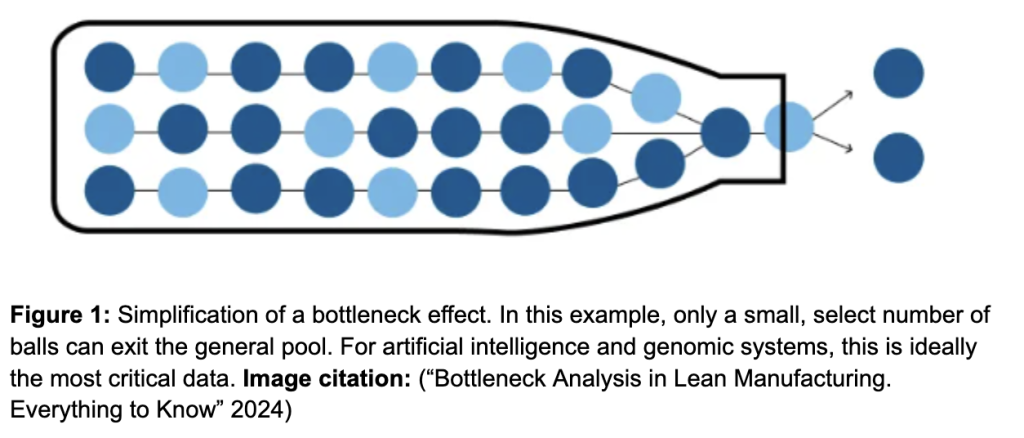
Artificial Intelligence, by definition, mimics human neural networks. Naturally, it should also be possible to mimic natural genomic bottlenecking by compressing artificial neural data in the same way, creating complex systems through simple rules. A study conducted by Cold Spring Harbour Laboratory outlined the possibility of compressing artificial neural networks through genomic bottlenecking to capture essential data, portray complex systems, and enhance performance (Shuvaev et al. 2024).
Their study found that by dividing machine learning problems into nested loops with restrictions (the bottleneck), the data needed was greatly reduced. This is observed in Figure 2. In this system, the outer loop, called the “evolutionary loop,” generates the connectivity rules and an inner “learning loop” finds general rules that can be reused and adapted to different situations. The algorithm neatly parallels Darwinian evolution, where systems that can “learn” a behaviour rapidly that gives them a selective advantage result in the loop being naturally selected for its capacity to learn. The evolutionary loop selects for sparse and functionally important connections, complementary to preexisting compression methods like network pruning (Shuvaev et al. 2024).
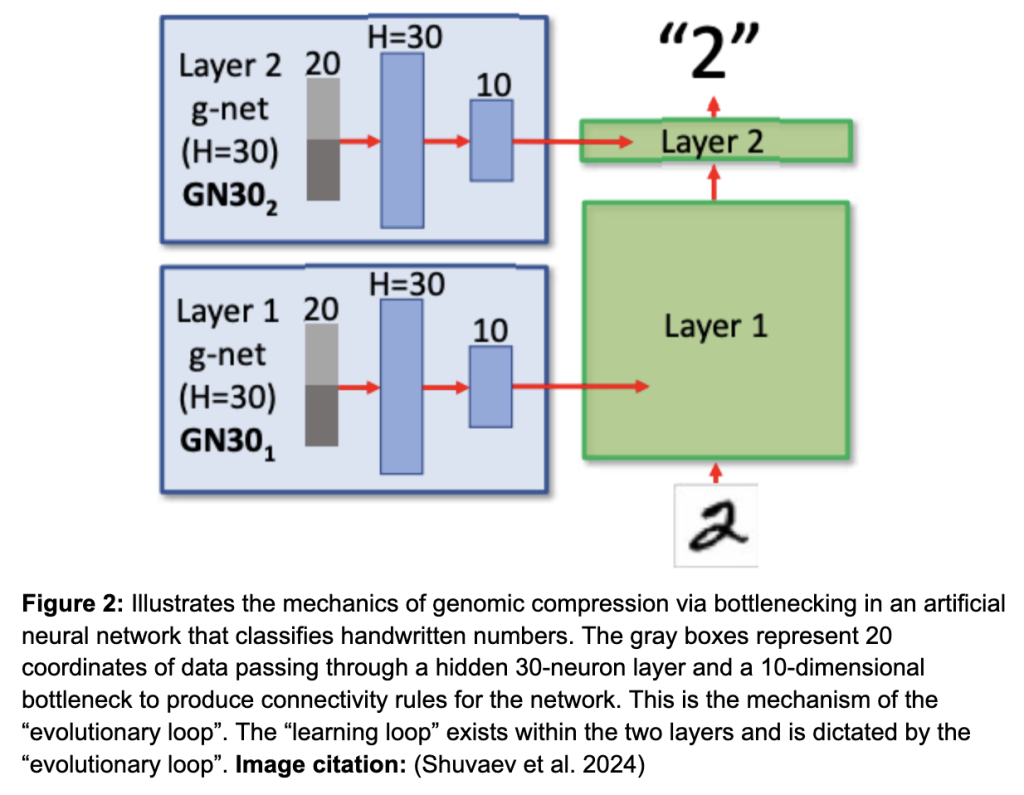
The genomic bottleneck algorithm condensing method, as presented by Shuvaev and peers, shows promise in condensing the information required to output complex systems in ANNs, aiding in improving the efficiency and computational capacities of artificial systems. It serves as a reminder of the synergistic nature of learning, through application of the known in combination with the vastly expanding unknown.
References
“Bottleneck Analysis in Lean Manufacturing. Everything to Know.” 2024. Six Sigma. https://www.6sigma.us/manufacturing/bottleneck-analysis-in-lean-manufacturing/.
Gil, Yolanda, and Raymond Perrault. 2026. “Artificial Intelligence Index Report.” Stanford University Human-Centered Artificial Intelligence. https://hai.stanford.edu/ai-index/2026-ai-index-report.
Lee, Fangfang. 2021. “What Is a Neural Network?” IBM. https://www.ibm.com/think/topics/neural-networks.
Samborska, Veronika. 2025. “Scaling up: how increasing inputs has made artificial intelligence more capable.” Our World in Data. https://ourworldindata.org/scaling-up-ai.
Shuvaev, Sergey, Divyansha Lanchi, Alexei Koulakov, and Anthony Zador. 2024. “Encoding innate ability through a genomic bottleneck.” Proceedings of the National Academy of Sciences – PNAS (United States) 121, no.38 (2024): e2409160121 https://doi.org/10.1073/pnas.2409160121.
Comments
13 Responses to “The Storage Dilemma”
Hi iSci,
This blog was inspired by our psychology and evolutionary life science lectures, and my own interest in artificial intelligence! I thought it was really neat how we were able to learn from the complexities of nature to streamline our own technologies. Hopefully you find it interesting too!
Claire
Hi Claire!
First off, I loved your blog! I found it a really interesting read, and I’m really impressed with how you managed to link Darwinian evolution to artificial intelligence. I’d like to add a couple small notes, though.
It would be great if you could insert one or two different figures in the blog just to help provide a visual example of what you’re talking about, and to break up the wall of text as well.
I also think that, if your word count permits it, you could explain what a token is in paragraph 3. I also think paragraph 4 could use a little bit of restructuring, as it feels a little bit wordy right now.
Other than that, I think your blog post was really well written!
Best,
Daniel
Hi Daniel, thanks so much for your feedback! I added the definition of a token and two images to hopefully improve comprehension!
Hi Claire!
I really enjoyed reading your blog, I thought you incorporated neuroscience and evolution very well and this was so interesting to read! I have a few suggestions that I hope will help in your editing process:
For your citations, try to find the doi links to use rather than McMaster library links, you can find it in the citation section of the web page.
I found the sentence “For example, rather than explicitly stating which neural cell should connect during stimulus, a class of rules is outlined instead based on chemical surface markers that axons may use to find synaptic destinations,” a little hard to follow, I would suggest removing “instead” to help it flow better with the sentence still making sense.
I thought your blog was really well written overall, and I hope you find these suggestions helpful!
Aveline
Hi Aveline! Thanks so much for the DOI reminder; I definitely forgot about that! I also broke up that sentence into two separate ones, and I think it improves the readability. Thanks so much for your feedback!
Hi Claire!
I really enjoyed your blog post on the genomic bottleneck, especially after coming off of the stressful exam week!!
Here are some final touches I would make to enhance your blog.
First I would add an image to tie your piece together. A photo depicting the genomic bottleneck can help readers have a deeper understanding of your topic. Remember to also include a figure caption with in-text citations.
Next, in Chicago 18th, author-date, citation style, the punctuation should follow the parentheses. In several of your in-text citations you put the punctuation before the in-text citation. Fixing this will help you ensure your references are completed properly.
Overall, great work Claire and I look forward to reading your final draft!
Emma I
Hi Emma! I added an image of the bottleneck effect as you suggested and moved all the citations within the punctuation. Thanks so much for your feedback!
Hi Claire!
First off, I loved reading this blog post! I never even imagined it’d be possible to connect AI with topics such as evolution, but you did it so seamlessly.
Here are a few suggestions to enhance your blog post:
P1:S2 A small change would be to change your 10^15 and 6^10 to 10¹⁵ and 6¹⁰. It would allow for better readability!
P5:S1 “Their study found that by dividing machine learning problems into nested loops restricted by a low-information bottleneck with one outer “evolutionary loop” that generates the connectivity rules and an inner generic “learning loop,” the system can find general circuits of rules that can be reused and adapted to different situations.” The first part of this sentence is quite long, and I believe splitting it into two sentences would allow for better readability and give the reader a chance to digest the information given.
It would be great if you could add a figure to support your writing!
You were adding punctuation before your in-text citations, but you should add it after.
All in all, a wonderful blog post, Claire!
Ayn 🙂
Hi Ayn, I definitely agree on the printed notation that makes it look more professional! Thank you also for your comment on P5. I read it back, and I agree it’s definitely a mouthful. I changed it up now, so hopefully it reads better! I also added two figures to support the text and fixed the punctuation regarding citations, which I think helps add to the comprehension. Thanks so much for all your feedback again!
Hi Claire!
Great blog post! I thought the comparison between the genome and the brain made the problem easy to understand, and linking it to AI was a clever way to make the topic feel relevant. Here are a few suggestions to improve your post.
I also think the “similar dilemma” in P3S1 could be explained more clearly. The examples that follow show that models are getting bigger, but they do not say what the problem is. A short sentence or two explaining that larger models need far more data and storage would better link the two ideas.
Additionally, in P3S4, it would help to name what “Its” refers to, since it could mean the students, the models, or AI in general. This would make the sentence clearer and help readers better follow your point.
Finally, in P5, a simple diagram of the “evolutionary loop” and the “learning loop” would help readers see how one loop sets the rules while the other learns inside them.
Overall, this was a very well written blog post. I look forward to reading your final draft!
Emily
Hi Emily. Thanks for all your feedback! I added a figure that hopefully helps in understanding the two loops, and I clarified the subject in P3S4 as artificial intelligence. Additionally, for the concluding statement in that paragraph, I was trying to do what you suggested, but I think it might not have come across that clearly. I changed the wording now, so hopefully that reads a little bit better. Thanks again!
Hi Claire,
I really enjoyed reading your blog. I never knew that ANNs had the potential to replicate humanity’s evolutionary data storage techniques.
Here’s some feedback that I think will do you good:
1. A lot of your paragraphs have large bodies of text followed by a single citation. Maybe finding more sources that support the claims made would help make your blog more scholarly.
2. Some of the concepts used here would benefit from definitions and figures to support the concept, such as neural networks.
All in all, this was a fun read.
Happy editing,
Praise
Hi Praise, thanks for the feedback! I’ve added definitions for terms like tokens and ANNs to make things clearer. Regarding the single source, I deliberately focused this post on Shuvaev’s study to highlight their unique, evolutionary-based approach to training ANNs!