If you’ve ever used one of those analog television sets with a bunny-ear antenna, you may know that the static “snow” seen when flipping between channels is a result of electromagnetic waves interfering with the TV signal. The majority of this interference originates as thermal noise from the earth (approximately 300K), but you may be surprised to hear that a portion of this noise, an estimated 1%, can be traced all the way back to a cosmic event event that occurred 13.8 billion years ago (Jones and Lasenby 1998; Moore 2003). This relic radiation is called the Cosmic Microwave Background (CMB) (Figure 1) (Jones and Lasenby 1998).
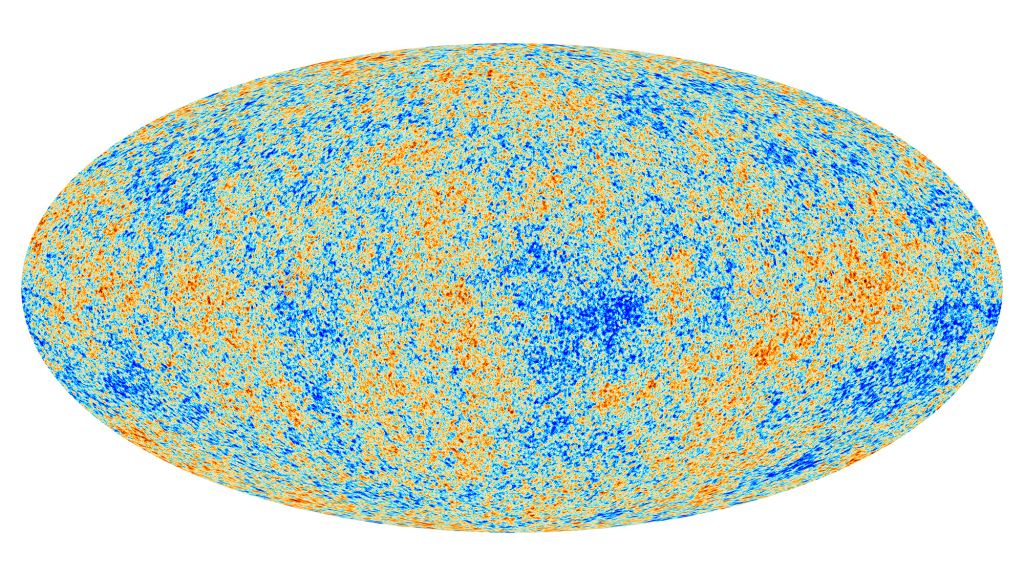
The CMB is the oldest detectable light in the universe, dated around 380,000 years after the Big Bang (Jones and Lasenby 1998). It originated from a key transition point in cosmic history. The early universe was so hot, dense, and high-energy that it was composed of a thick, fluid mass of continually ionized protons, electrons, and photons (Jones and Lasenby 1998). Photons were trapped in this mass, continually being scattered off free electrons and unable to move freely through the universe (Mather et al. 2013). Only as the universe expanded was this opaque mass able to disperse and cool. The transition happened at a temperature of approximately 3000 K, where lower thermal energy meant it was more energetically favourable for protons and electrons to combine into hydrogen atoms. This event, called recombination, caused massive amounts of high-energy photons, no longer scattering off electrons, to be released across the universe (Figure 2) (Mather et al. 2013; Jones and Lasenby 1998).
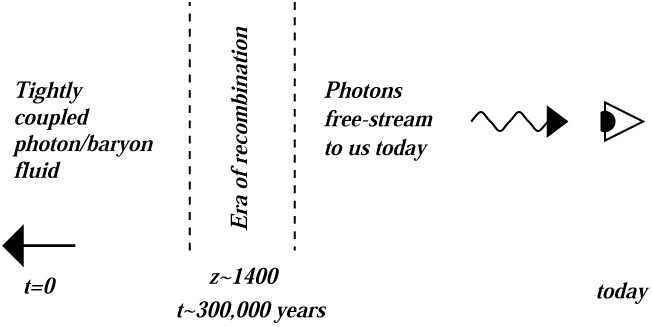
We can detect evidence of this event, and the energetic makeup of the early universe, through the CMB. Despite its high thermal energy after release (3000 K), the CMB permeates the current universe at a nearly uniform temperature of about 2.7255 K (Mather et al. 2013). This is due to a phenomenon called the cosmological redshift, wherein the expansion of the universe causes light within it to stretch. When these photons were first released in the much smaller ancient universe, they had wavelengths in the visible light and near-infrared spectrum, however, 13.8 billion years of expansion has stretched these wavelengths by a factor of approximately 1,100, shifting them entirely out of the visible light spectrum and into the microwave spectrum, corresponding with its low thermal energy (Aghanim et al. 2020).
Additionally, slight temperature variations across the CMB, amounting to only about 0.01%, can inform us on how cosmic structures formed. These radiation hot-spots are correlated with greater density of matter throughout the universe, These radiation hot-spots resulted from slight differences in density of matter pre-recombination, and would later seed the early formation of massive cosmic structures, (Aghanim et al. 2020; Boughn and Crittenden 2004; Mather et al. 2013).
Regardless of its age and low-energy, this small portion of TV static is evidence of one of the most important events in cosmic history. While it may seem insignificant, the existence of this relic radiation informs much of our understanding of what the ancient universe looked like.
References
Aghanim, N., Y. Akrami, M. Ashdown, J. Aumont, C. Baccigalupi, M. Ballardini, A. J. Banday, et al. 2020. “Planck 2018 Results: VI. Cosmological Parameters.” Astronomy & Astrophysics 641: A6. https://doi.org/10.1051/0004-6361/201833910.
Boughn, Stephen, and Robert Crittenden (Nature). 2004. “A Correlation between the Cosmic Microwave Background and Large-Scale Structure in the Universe.” England, January 1. PubMed. https://doi.org/10.1038/nature02139.
Howell, Elizabeth, and Daisy Dobrijevic. 2022. “What Is the Cosmic Microwave Background?” Space, January 28. https://www.space.com/33892-cosmic-microwave-background.html.
Jones, A. W., and A. N. Lasenby (Living Reviews in Relativity). 1998. “The Cosmic Microwave Background.” Switzerland. PubMed Central. https://doi.org/10.12942/lrr-1998-11.
Mather, John, Gary Hinshaw, and Lyman Page. 2013. “Cosmic Microwave Background”. Planets, Stars and Stellar Systems (Dordrecht), 609–84. https://doi.org/10.1007/978-94-007-5609-0_13.
Moore, Robert C. 2003. “Satellite RF Communications and Onboard Processing”. Encyclopedia of Physical Science and Technology, 439–55. https://doi.org/10.1016/b0-12-227410-5/00884-x.
Zhang, Wenzhong David. 2025. “Quantitative Derivation of the Cosmic Microwave Background Radiation Spectrum and Temperature and Its Relationship with the Hubble Constant”AIP Advances 15(7). https://doi.org/10.1063/5.0266308.
Comments
7 Responses to “What Your Grandma’s TV Can Tell Us About the Ancient Universe”
Hi Zoe,
Fascinating topic choice and great job on your blog post! Here are a few suggestions I had for your edits:
– In sentence 2 of paragraph 2, I believe “high energy” should be hyphenated (“high-energy”).
– In sentence 3 of paragraph 2, I recommend adding a comma after the word “freely”.
– Consider adding a figure to support your text!
– Don’t forget to add a comment to explain why you chose your topic.
Overall, great work and good luck with your edits!
Kristen
Hi Kristen,
Thank you for the feedback! I’ve taken your edits into my final draft 🙂 hope you enjoy !
Zoe
Hi iSci!
I chose this topic as in Neuro we’re looking at the brain as a circuit and the different electromagnetic signals within it, and it got me thinking about this fact that I half-remembered that some of old TV static is leftover from the big bang. I thought the electromagnetism of it all connected well, so I wrote a blog post on it!
Hi Zoe!
This was such a cool read, I love how you took something as everyday as TV static and connected it all the way back to the early universe. Here are some suggestions for improvements:
– P2S5: Hydrogen atoms forming once the universe cooled to ~3000 K is called “recombination,” not “primordial nucleosynthesis.” Nucleosynthesis happened only a few minutes after the Big Bang and formed the first nuclei, so it may be worth swapping the term.
– P3S2: “for how this light becomes red as its wavelength increases” reads a bit awkwardly; maybe “named because the light shifts toward the red end of the spectrum as its wavelength increases.”
– P4S1: “a very small amount of interference” could be made more concrete. A commonly cited estimate is that roughly 1% of analog TV static comes from the CMB, which would be a great hook to end on (with a citation).
– Bigger picture: P3S4 says the radiation “permeates uniformly,” but one of the coolest parts of the CMB is its tiny temperature fluctuations (about 1 part in 100,000) mapped by Planck, which seeded galaxies. A sentence on this would tie in nicely with your Aghanim et al. (2020) reference!
I learned a lot about where TV static actually comes from. Can’t wait to see the final copy!
– Kurtis
Hi Kurtis,
Thank you so much for the in-depth feedback, I really appreciate it and have included your recommendations in my final draft. 🙂
Zoe
Hi Zoe,
This was such a fun read! I loved how you were able to tie something common in our early lives as an analog TV back to the earliest moments of the universe. Something that I encourage you to do in the future would be to add a quick analogy to explain complex topics such as the stretching of wavelengths and cosmological redshift so that readers who might not know as much regarding this topic can visually understand how visible light would have gotten dragged all the way down to the microwave spectrum.
Overall, this was an fascinating post! Looking forward to reading your final version.
Best,
Avilash
Hi Avilash,
Thank you so much! I hope you appreciate the final version.
Zoe