Wonderful effects on my (radio)head

Humans have some of the “BEST” hearing in all of the animal kingdom. But most animals need their hearing to live, and have thusly gained more sensitive receptors to sounds than humans. Sometimes, it even takes over another sense’s purpose. So why can I say that a human’s hearing is “better” than those other animals? It’s not really because of a more acute sense of hearing – instead, it’s from our ability to interpret it, expressed in language and beautifully articulated in music.

Now what could a few sounds falling into place even do? As it turns out, a lot. A large and well-studied aspect of music is that it can activate parts of your brain while you’re listening to or creating music. Some of these parts can be particularly special and correlate to things like reward stimulus, motor control, and communication (Trost et al. 2011). It’s been shown that listening to songs of different moods can trigger more intense versions of emotions than other activities (Zentner et al. 2008). On top of stronger feelings, music has also demonstrated therapeutic effects for brain injury.

Mostly, the areas that the brain would activate would be dependent on how exciting the feeling elicited by the song was. Highly exciting music-related feelings, like tension, joy, or power would activate the parts of your brain that would control your sensory and motor functions. Less exciting music-related feelings would engage the ventromedial prefrontal cortex and the hippocampus, both associated with emotion regulation and memory (Trost et al. 2011). Sometimes, they would also excite certain areas based on a feeling. Songs that elicited positive feelings tended to excite the striatum, a part of the brain commonly associated with reward processing and motivation. Positive and exciting feelings you get from songs, like wonder and joy, excited the left striatum and insula, also associated with reward processing and emotion (Figure 1). Less exciting, but still positive emotions excited the right striatum and orbitofrontal cortex, associated with decision-making and emotional regulation. In general, music also activated areas of networks correlated to reward, memory, self-reflective, and sensorimotor processes, pointing towards music’s depth in felt emotions (Trost et al. 2011).

So what does this mean? In simple terms, listening to music can help you enjoy a task more (that is, if you’re not too busy enjoying the song). By listening to a song, you can reward your brain while you slog away at a task. It can even improve your focus on a task by reducing brain fog (Kiss and Linnell 2021).
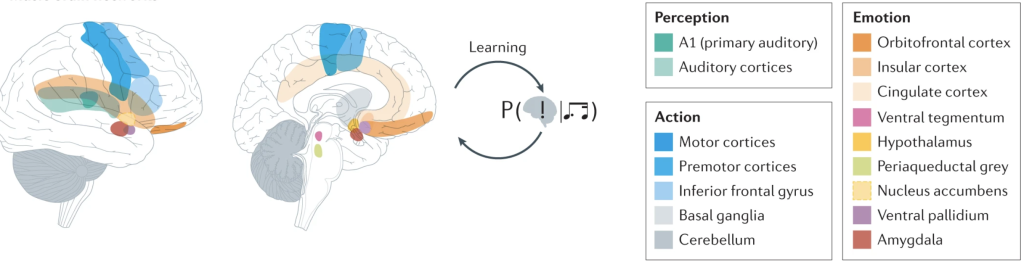
Figure 1: A map showing every key structure of the brain involved in processing information from music. The learning aspect shows the parts involved while the brain is receiving constant stimuli (Vuust et al. 2022).

On top of emotions, music has also shown to have limited healing effects. A study was performed on patients recovering from brain injury, which included things like strokes, injury, or neurodegenerative conditions. The music-based therapy that was employed suggested notable improvements in upper-body function, communication, and cognitive rehabilitation, among other improvements (Navarro et al. 2026). This therapy involved creating, listening, and improvising music. Moreover, it was found among dementia patients that those who listened to music while playing a game improved faster than other patients performing the same task (Sener et al. 2017).

In summary, music is more than the thing you put on when you’re working on an assignment/paper. It is a powerful emotional stimulant, and helps you study. It can even boost the healing of those with brain problems. And the next time you play your songs while you work, be grateful that we have the faculties to.

References

Kiss, Luca, and Karina J. Linnell. “The Effect of Preferred Background Music on Task-Focus in Sustained Attention.” Psychological Research 85, no. 6 (2021): 2313–25. https://doi.org/10.1007/s00426-020-01400-6.

Navarro, Laura, Nour EL Mallah, Jacobo Pardo-Seco, et al. Systematic Review and meta-analysis reveal positive therapeutic effects of music in Brain Damage Rehabilitation, January 12, 2026. https://doi.org/10.37766/inplasy2026.1.0042.

Sener, Ceylin G., Tuna Yelken, Hulya Ozen, and Demet Ozbabalik. “[P4–323]: The Effect of Listening to Rhythmic Music on Brain Training Game Scores in Patients with Alzheimer’s Dementia.” Alzheimer’s & Dementia 13, no. 7S_Part_29 (2017). https://doi.org/10.1016/j.jalz.2017.06.2193.

Trost, Wiebke, Thomas Ethofer, Marcel Zentner, and Patrik Vuilleumier. “Mapping Aesthetic Musical Emotions in the Brain.” Cerebral Cortex 22, no. 12 (2011): 2769–83. https://doi.org/10.1093/cercor/bhr353.

Vuust, Peter, Ole A. Heggli, Karl J. Friston, and Morten L. Kringelbach. “Music in the Brain.” Nature Reviews Neuroscience 23 (March 29, 2022). https://doi.org/https://doi.org/10.1038/s41583-022-00578-5.

Zentner, Marcel, Didier Grandjean, and Klaus R. Scherer. “Emotions Evoked by the Sound of Music: Characterization, Classification, and Measurement.” Emotion 8, no. 4 (2008): 494–521. https://doi.org/10.1037/1528-3542.8.4.494.

Comments

11 Responses to “Wonderful effects on my (radio)head”

  1. Joshua Yoon Avatar
    Joshua Yoon

    Hi Isci!

    As I was studying with music (and unashamedly belting lyrics), I got curious as to the actual effects music has on us, and how our brain chemistry gets influenced by these songs. I found that I could focus on my work better when I listened to music. That eventually led me down a rabbit hole of music’s various effects, like therapy, emotions, and usage in political messaging (but that’s not for today).

    Please enjoy the read and I wholeheartedly appreciate any and all feedback!

  2. Hassan Rasheed Avatar
    Hassan Rasheed

    Hi Joshua,
    Great post! I liked how you connected music to both emotions and brain function. I have a couple of suggestions:

    – P3S5: You refer to the striatum as a “gland” in the brain. ScienceDirect Topics describes the striatum as a brain region rather than a gland, so you may want to revise that wording (Elsevier n.d.).
    – P5S6: There seems to be a repeated “doing” in the sentence (“while doing doing something”).

    Overall, this was an interesting post and it was cool to think about the effects music can have on your brain.

    Good luck!
    Hassan

    1. Joshua Yoon Avatar
      Joshua Yoon

      Hi Hassan,

      Thank you so much for the reply! I have implemented both edits.

      Josh

  3. Carolinna Machado Pereira Avatar
    Carolinna Machado Pereira

    Hi Joshua!

    Good job on your post! What a great topic, it is really interesting to see just how much music can affect our brains. There are just a few suggestions I have for you:

    –> In P2 your Zentner et al. in-text citation should be without a comma.
    –> You make claims about the effects of high-energy vs low-energy music on areas of the brain in P3 that I believe should be supported by referencing the papers from which you took that information from.
    –> You should reference figure 1 somewhere in your text so that readers can understand the connection to your discussion
    -> For P3S1 I believe it should be “activate” instead of “activated”
    –> In P5 when you talk about the study with dementia patients the expression “study studied” feels a bit redundant, perhaps you could reword that to make it sound more concise. You also state that individuals that performed an activity while listening to music “got better” faster — that feels a bit vague. Perhaps instead of that you could mention one of the aspects that the study evaluated between participants that demonstrates how patients that listened to music elicited a positive response.
    –> Your Navarro reference currently does not appear anywhere in-text

    Overall, you have a solid base for a really interesting post!
    Happy editing!

    Best,
    Carolinna Machado

    1. Joshua Yoon Avatar
      Joshua Yoon

      Hi Carolinna,

      Thank you so much for the feedback! I’ve implemented all suggested edits.

      Josh

  4. Via Kim Avatar
    Via Kim

    Hi Joshua,

    This was SUCH a fun read! It is so interesting how the brain perceives music and how it also has certain healing properties! Here are a few suggestions:

    -Make sure that you are referencing your figure in your main body of text! For example, you can include it in your third paragraph when you are saying “Songs that elicited positive feelings tended to excite the striatum, a gland in the brain commonly associated with reward processing and motivation (Figure 1)” or include a sentence that is related to your figure.

    -P2: Take out the comma in your citation “(Zentner et al., 2008)”.

    -P5: I don’t think that “(strokes, injury, or neurodegenerative conditions, for example)” need to be in parentehsis! I would recommend integrating it into your sentence. Additionally, your first sentence, “Music has shown to have limited healing effects,” abruptly introduces a new concept. I would suggest rewording it to “Music has also been shown to have healing effects in patients recovering from…” for better flow.

    Overall, you did an amazing job, and I cannot wait to read your final draft!

    Happy editing,
    Via

    1. Joshua Yoon Avatar
      Joshua Yoon

      Hi Via,

      Thank you so much for the feedback! I implemented all suggested edits.

      Josh

  5. Daniel Messih Avatar
    Daniel Messih

    Hi Josh!

    Great work with this blog post! I found it to be a really interesting read, and I love the way that you explained everything in a way that was super easy to understand.

    Quick note, though. In paragraph 3, I don’t think you need to be repeating the same in text citation in two consecutive sentences.

    In addition, if your word count permits, in paragraphs 4 and 5, it would be really nice to see an explanation behind the reasons why listening to music clears brain fog/has limited healing effects.

    Overall, what an interesting read!

    All the best,
    Daniel

    1. Joshua Yoon Avatar
      Joshua Yoon

      Hi Daniel,

      Thank you so much for the feedback! I took out the in-text citation, but the word count wouldn’t allow me to expand on the brain fog part. Maybe another blog post?

      Josh

  6. Ethan Yoon Avatar
    Ethan Yoon

    Hey, Josh. Fantastic post! It was very interesting to hear about all the different faculties of the brain that music is able to activate in your brain. I guess we have good hearing in the sense that we make the most of it! Very florid and readable writing style as well. I just have a couple of suggestions:

    1. Paragraph 1, sentence 5: This sentence is a little incomplete. It would be awesome if you put something small in, like “…instead, [it’s from] our ability to…” to complete the clause.

    2. I agree with Daniel’s first point. If you do choose to keep it, though, make sure it’s at the end of the sentence, even if the information taken from it stops in the middle.

    3. Paragraph 3, sentence 5: Consider changing “study studied” to another verb. Maybe “looked at”?

    That’s all I have to say. Great work, and I can’t wait to see the final version!

    1. Joshua Yoon Avatar
      Joshua Yoon

      Hi Ethan,

      Thank you so much for the feedback! I implemented all edits, and completely reworked P3S5.

      Josh

Leave a Reply