The cultivation of grapes has a history that spans more than 7,000 years. Today the wine industry remains one of the world’s most economically significant agricultural sectors, producing over 26 billion litres of wine annually (Velaz et al. 2025). However, due to the increasing pressure on the environment caused by climate change, many winemakers are now faced with the challenge of adapting their vineyards to abiotic stress (Dagher et al. 2025).
Abiotic stressors such as drought, salinity, and extreme temperatures can negatively impact grapevines (Dagher et al. 2025). In particular, long-term drought conditions can lead to osmotic stress and the accumulation of reactive oxygen species (ROS) within the plant, which can harm vine growth and result in crop yield reduction (Ye et al. 2023). To mitigate the impacts of increasing adverse environmental conditions, many adaptation strategies for grapevine cultivation are being developed (Dagher et al. 2025).
One potential adaptive strategy involves exploring the symbiotic relationship between mycorrhizae and grapevines (Velaz et al. 2025). Beneficial microorganisms can help increase the quality and yield of crops while helping to lessen the impacts of climate stress (Velásquez et al. 2025). More specifically, arbuscular mycorrhizal fungi (AMF) have been shown to enhance grapevine tolerance to abiotic stress (Ye et al. 2023). AMF are beneficial fungi that can form mutualistic associations with grapevine roots. The grapevines provide the fungi with nutrients, while the fungi helps increase the absorption of water and minerals by the plant (Velaz et al. 2025).
AMF inoculation can improve grapevine resilience through several mechanisms (Ye et al. 2023). The extensive hyphal network of AMF is able to facilitate the uptake of nutrients and water by grapevines, enhance biomass production, and regulate stress-related signaling pathways related to osmotic balance, antioxidant defenses, and energy metabolism ( Figure 1) (Valenzuela-Aragon et al. 2025). Furthermore, AMF can strengthen the grapevine’s antioxidant defenses. Under drought conditions, AMF-colonized grapevines show increased activity of antioxidant enzymes, which can help limit oxidative damage caused by ROS (Ye et al. 2023).
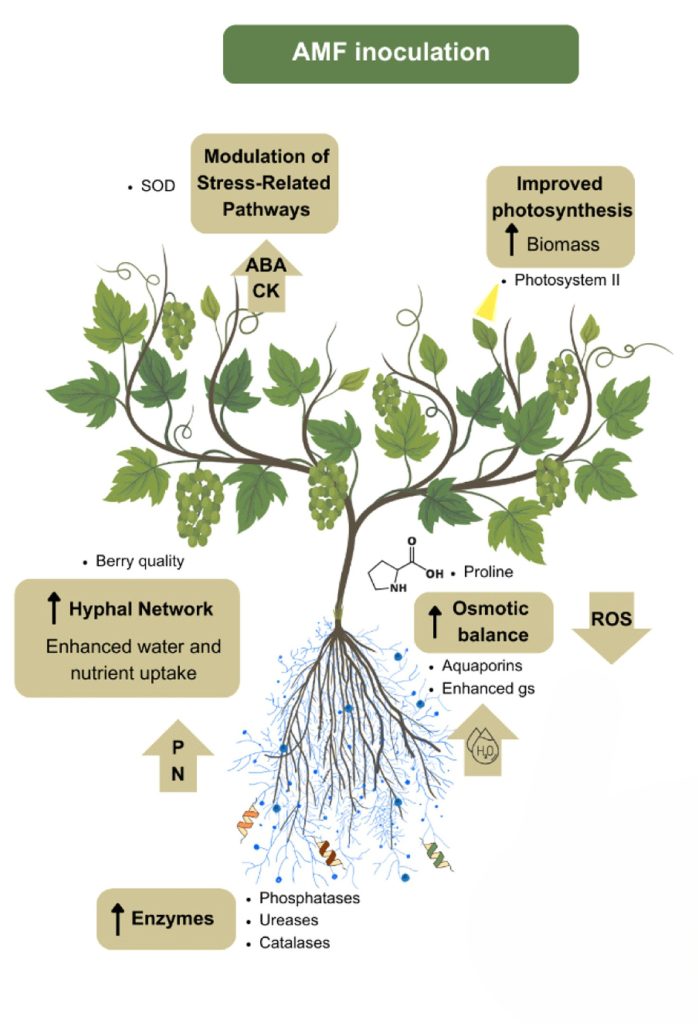
As climate change places increasing pressure on viticulture, AMF offers an intriguing biological approach to improving grapevine resilience. Their ability to influence water relations, antioxidant defenses, and stress-related processes suggests that the future of climate-resilient vineyards may depend not only on what happens above the soil but also on the microscopic partnerships developing beneath it.
References
Dagher, Diana, Dimitrios Taskos, Snezhana Mourouzidou, and Nikolaos Monokrousos. 2025. “Microbial-Enhanced Abiotic Stress Tolerance in Grapevines: Molecular Mechanisms and Synergistic Effects of Arbuscular Mycorrhizal Fungi, Plant Growth-Promoting Rhizobacteria, and Endophytes.” Horticulturae 11 (6): 592. https://doi.org/10.3390/horticulturae11060592.
Valenzuela-Aragon, Brenda, Massimiliano Cardinale, Eleonora Rolli, Laura Rustioni, and Davide Francioli. 2025. “The Role of Arbuscular Mycorrhizal Fungi in Abiotic Stress Management in Viticulture under Climatic Shifts.” Plant Stress 16 (June): 100863. https://doi.org/10.1016/j.stress.2025.100863.
Velásquez, Alexis, Pablo Cornejo, Marcela Carvajal, Claudio D’Onofrio, Michael Seeger, and Italo F. Cuneo. 2025. “A Comprehensive Review of the Transcriptomic and Metabolic Responses of Grapevines to Arbuscular Mycorrhizal Fungi.” Planta 262 (3): 58. https://doi.org/10.1007/s00425-025-04771-5.
Velaz, Maider, Luis Gonzaga Santesteban, and Nazareth Torres. 2025. “Mycorrhizae and Grapevines: The Known Unknowns of Their Interaction for Wine Growers’ Challenges.” Journal of Experimental Botany 76 (11): 3001–3015. https://doi.org/10.1093/jxb/eraf081.
Ye, Qiuhong, Hua Wang, and Hua Li. 2023. “Arbuscular Mycorrhizal Fungi Enhance Drought Stress Tolerance by Regulating Osmotic Balance, the Antioxidant System, and the Expression of Drought-Responsive Genes in Vitis Vinifera L.” Australian Journal of Grape and Wine Research 2023 (1): 7208341. https://doi.org/10.1155/2023/7208341.


Leave a Reply
You must be logged in to post a comment.