Press a single piano key, then strike several neighbouring keys together. The same instrument produces both sounds, yet the second may sound harsh or rough. Does that make it noise rather than music? Exploring this distinction requires examining the relationships between sound frequencies, how the auditory system processes them, and how familiarity, expectations, and cultural experience shape musical perception.
Harmonic structure helps explain why some sounds have a clear pitch, but it does not define music. Sound can contain several frequencies, measured in cycles per second, or hertz (Hz). Harmonics follow (f_n=nf_0), where (f_0) is the fundamental frequency and (f_n) is the frequency of harmonic number (n), a positive whole number. For a 200 Hz fundamental, the second and third harmonics are 400 and 600 Hz. These complete two and three cycles during each fundamental cycle, making the combined waveform repeat regularly and supporting a definite pitch.
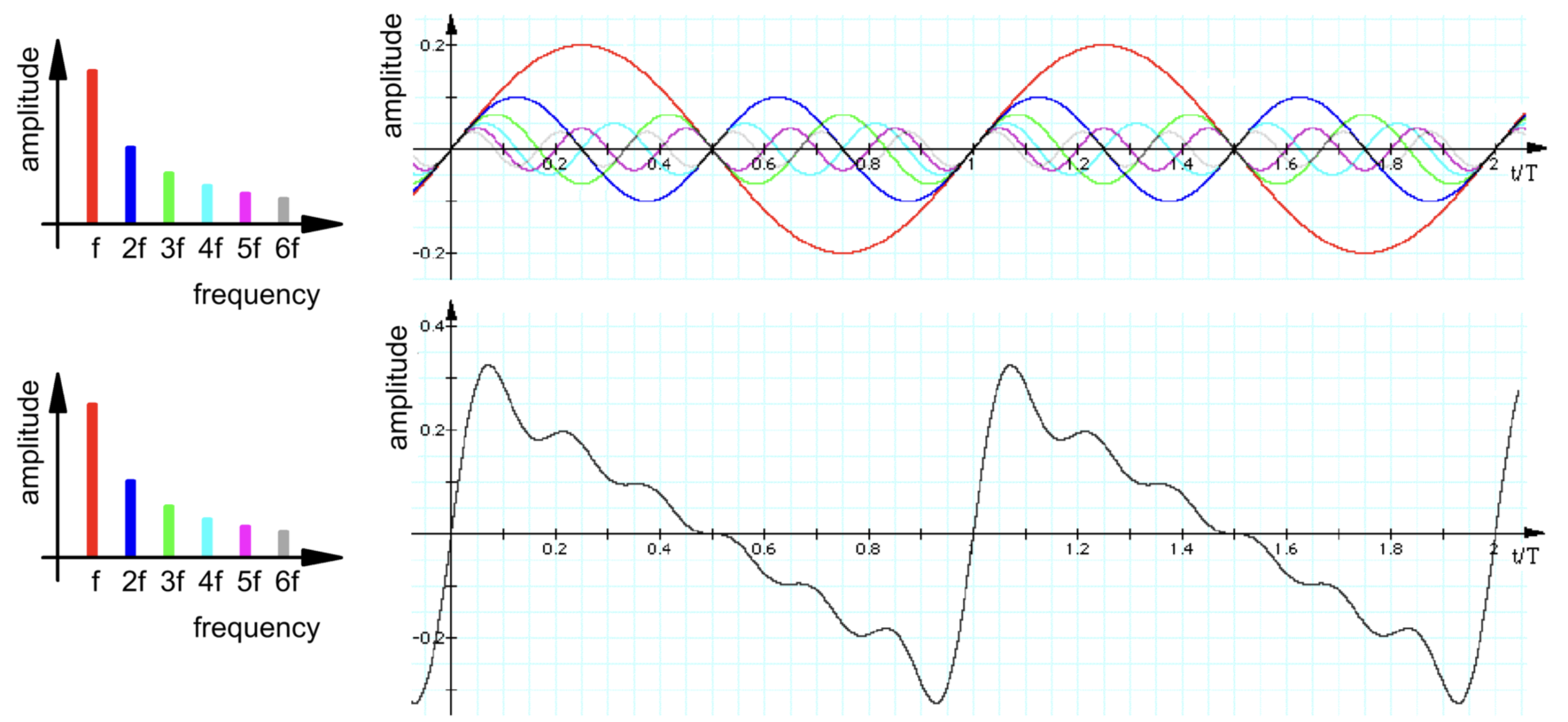
Figure 1: Harmonic components and their combined waveform. The left panels show the relative amplitudes of frequencies (f, 2f, 3f,6f). The upper-right panel shows their individual waves: each higher harmonic completes a whole-number multiple of the fundamental’s cycles. Adding these waves produces the lower-right waveform, which repeats every fundamental period, (T). The horizontal axis, (t/T), expresses time in fundamental periods (Wolfe 2012, fig. 4).
Preferences for harmonic sounds correlate with preferences for consonant, or harmonious-sounding, chords, linking this structure to perceived pleasantness (McDermott, Lehr, and Oxenham 2010). Yet music also includes sounds without this regularity: cymbals, the metal discs struck in a drum kit, produce noise-like sounds within musical performances (Quiroga-Martinez et al. 2022). Their use illustrates that acoustic noise and music are not mutually exclusive. Frequency structure contributes to what we hear, but understanding its musical role also requires examining perception and context.
The brain’s response to music is not fully explained by frequency and pitch alone. Researchers used functional magnetic resonance imaging (fMRI), which measures changes in blood oxygenation associated with neural activity, to record responses to 165 everyday sounds. By statistically separating overlapping responses, they identified a component concentrated in non-primary auditory cortex, a region involved in further processing sound, that responded more strongly to music than to speech and other sounds.
The acoustic measurements tested did not explain this selectivity (Norman-Haignere, Kanwisher, and McDermott 2015). This supports specialized processing of music, but leaves open how listeners develop their responses to it. To explore that question, we must also consider the roles of cultural exposure and individual experience.
The music people hear throughout their lives may influence which combinations of notes they enjoy. McDermott et al. (2016) found that Tsimane’ participants from the Bolivian Amazon, who had little exposure to Western music, did not consistently favour consonant chords over dissonant ones. US participants preferred consonance, while Bolivian town and city residents showed a weaker preference. The Tsimane’ could still hear disruptions in harmonic structure: they detected the differences but did not attach the same preference to them. This suggests that enjoying certain frequency relationships may depend partly on experience, although musical exposure cannot be separated from other cultural influences in this study. What sounds pleasing is therefore not universal, and disliking a sound does not mean it cannot be music.
Ultimately, the distinction between music and noise emerges from the interaction of sound, brain, and experience. Harmonics help explain how notes combine, while auditory processing and cultural exposure contribute to how listeners interpret and enjoy them. The harsh piano notes that opened this discussion are therefore not automatically noise: they may still serve a musical purpose. Equally, a familiar song can become unwanted noise in the wrong setting. Music and noise are overlapping categories whose meaning depends on both acoustic structure and listening context.
References
McDermott, Josh H., Alan F. Schultz, Eduardo A. Undurraga, and Ricardo A. Godoy. 2016. “Indifference to Dissonance in Native Amazonians Reveals Cultural Variation in Music Perception.” Nature 535 (7613): 547–50. https://doi.org/10.1038/nature18635.
McDermott, Josh H., Andriana J. Lehr, and Andrew J. Oxenham. 2010. “Individual Differences Reveal the Basis of Consonance.” Current Biology 20 (11): 1035–41. https://doi.org/10.1016/j.cub.2010.04.019.
Norman-Haignere, Sam, Nancy G. Kanwisher, and Josh H. McDermott. 2015. “Distinct Cortical Pathways for Music and Speech Revealed by Hypothesis-Free Voxel Decomposition.” Neuron 88 (6): 1281–96. https://doi.org/10.1016/j.neuron.2015.11.035.
Quiroga‐Martinez, David Ricardo, Krzysztof Basiński, Jonathan Nasielski, et al. 2022. “Enhanced Mismatch Negativity in Harmonic Compared With Inharmonic Sounds.” European Journal of Neuroscience 56 (5): 4583–99. https://doi.org/10.1111/ejn.15769.


Leave a Reply
You must be logged in to post a comment.