Music is ubiquitous in today’s world. It’s used in advertising, movies and film, and in establishments to influence people’s mood. People listen to music while they commute, work out, clean, and more. Is there a reason people are drawn to and influenced by melodies so much?
Charles Darwin’s theory of natural selection, or “survival of the fittest”, is well-known in the scientific world; indeed, it is the basis upon which many modern biological assumptions are made. However, it is not the only publication relating to evolution he wrote. One of his other writings explains his theory of sexual selection, which is the way animals (in this case, humans) have historically chosen mates/partners, and, specifically, how one of these ancient factors could be the reason humans nowadays have such an affinity for music.
In The Descent of Man, and Selection in Relation to Sex, one of Darwin’s publications, he asserts that music was likely a form of courtship in early humans (similar to how birds ‘sing’ to attract mates). He believed this was what eventually evolved into spoken words (Darwin 1871). If this is the case, it would imply that humans have been wired to respond to melodic sounds for millennia.
Building on this theory, Marin and Rathgeber (2022) conducted a study. They played different piano pieces for participants, and after, showed them photos of different faces and asked them to rate the photos from 1 to 7 on two metrics: attractiveness and dating desirability (1 was lowest, 7 highest). Participants were told that the faces were the people who composed the piano piece.
The researchers found that, on average, the ratings the participants gave were higher than those of the control group, no matter what kind of music was heard. This was even more visible in women participants.
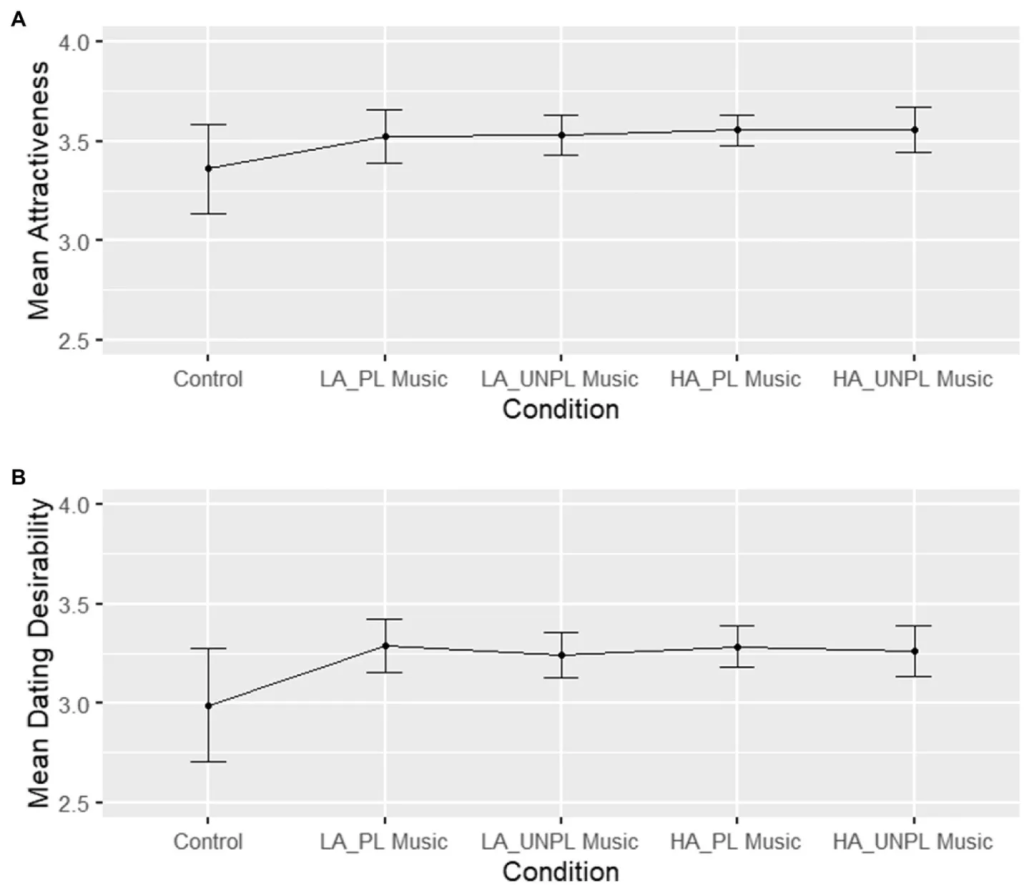
This figure shows the answers of women in the control group vs. the participant groups for the two metrics. The y-axis shows the ratings (out of 7), and the x-axis shows the different groups (different music).
Marin and Rathgeber’s study was based on another from 2017, which showed similar results (Marin et al., 2017)—namely, that the perceived musicality of another person increases one’s attraction to them. This supports Darwin’s theory about music and mating. That isn’t the only way music affects humans, however…
Neuroscientists at Stanford are experimenting with using music to improve the efficiency of transcranial magnetic stimulation (TMS). TMS is a relatively new technique, used both for brain research and to help with certain mental health conditions (such as depression or OCD) where neurons may not fire the ‘correct’ way. Essentially, nerve cells in the brain are stimulated via electromagnetic pulses to encourage normal activity (Healthline, 2024). These scientists discovered that if they play music, participants’ brainwaves synchronize with the beat. This makes it easier to time the pulses to improve the efficiency of the TMS (Collins, 2025). So far, this has only been used for research, but they are confident that it can be used for mental health as well.
These studies, and almost certainly more, imply that humans are intrinsically tied to music in some way. It affects the way we think, how we view others, and even the way our brainwaves move. It’s not known if Darwin was correct about why humans evolved to be so affected by music—it’s just one of many theories about this—but it’s undeniable that we are.
Citations:
Collins, Nathan. 2025. “Groove is in the brain: Music supercharges brain stimulation.” Wu Tsai Neurosciences Institute, September 22. https://neuroscience.stanford.edu/news/groove-brain-music-supercharges-brain-stimulation.
Darwin, C. R. 1871. The Descent of Man, and Selection in Relation to Sex.
Healthline. 2024. “What You Need to Know About Transcranial Magnetic Stimulation (TMS) Therapy.” Last updated August 5. https://www.healthline.com/health/tms-therapy.
Marin, M., and Ines Rathgeber. 2022. “Darwin’s sexual selection hypothesis revisited: Musicality increases sexual attraction in both sexes.” Frontiers in Psychology (13). https://doi.org/10.3389/fpsyg.2022.971988.
Marin, M., Raphaela Schober, Bruno Gingras, and Helmut Leder. 2017. “Misattribution of musical arousal increases sexual attraction towards opposite-sex faces in females.” PLoS ONE 12(9): e0183531. https://doi.org/10.1371/journal.pone.0183531.
Comments
11 Responses to “Dance, Dance”
Hi hi hi iSci !!!
Music’s always been a big part of my life and I was curious what we know about how it affects us. That’s how this blog post idea was born. I looked up if there’s any evolutionary reason we like music and found Darwin’s theory. Then, doing some digging led me to find out about the experimentation with TMS and music, which I think is fascinating stuff!
The first part about Darwin’s theory of sexual selection and how music relates to it is connected to evolution, which we were discussing in lifesci. The information about TMS and how music can help manipulate brainwaves relates to the electromagnetic spectrum, which we discussed a bit in chemistry.
I hope you enjoy reading this! (and maybe someone will catch the reference in the title)
Ella,
Your first blog post has a very captivating topic and your genuine interest in it is very contagious! The references and information included were strong and insightful, and I believe you did a wonderful job!
As for some suggestions, I had two thoughts of things that could be improved.
Firstly, I would recommend skimming through your blog to improve your conjunction use. In your introductory paragraph, your list ends without the final object having a conjunction before it. Similarly, the use of an em dash starts getting repetitive, so to diversify your writing you might want to consider changing the formatting up a little bit.
Secondly, I would recommend making your figure description more detailed with information such as deeper explanations of the axis values. You could even put more emphasis on what the final graphs are saying like a brief description of the trend lines, or alternatively reference more specific data points from the graph directly after it is shown/when it is relevant.
Overall, your piece is very interesting and nicely written, good work and happy editing!
Hi Judy,
Thanks for your comment! I edited the introductory paragraph and cut out some of my em dashes. I also added detail to the figure caption.
Ella
Hi Ella,
I’ve never heard of TMS before. You did an amazing job concisely and effetely discussing the topic. Thanks for teaching me something new!
If your word count allows for it, I’d love to see you discuss data from Marin and Rathgeber’s more. For example, the error bars overlap for the control group data and the other conditions, does this have any implications in how significant the difference in rating is between each condition?
Good job!
Skylar
Hi Skylar,
Thank you for your comment! Unfortunately my word count is already past 500, so I can’t expand too much. I did add some more general detail about the study though, because someone else commented something similar.
(also, I went back and reread the discussion part of the study to try to answer your question but I didn’t find anything specific the researchers concluded about it, sorry!!)
Ella
Hey Ella,
This was such a captivating blog post, your writing style is very engaging. I have never heard of this theory of Darwin’s – so interesting! Here are a few editing suggestions if you see fit:
– If word count permits, it might be helpful to explain the study a bit more, because it’s very interested and relates to the main idea! Some questions that came up while I was reading were, what does the scale mean? How was music associated with the person? Was it them singing, as Darwin’s theory would imply? Maybe including more details in a figure caption will suffice!
– This is very miniscule, but don’t forget to add a “.” after “vs.”
Overall, this was a very well done blog post! Great work, and I look forward to reading the final version!
Best,
Leah
Hi Leah,
Thank you for commenting! Unfortunately I’m already stretching the word limit, but I tried to reword what I already had written into something clearer. Also, I fixed the ‘vs.’, thanks for pointing it out!
Ella
Hi Ella!
This was such an interesting blog post! The connection of music to Darwin’s theory of evolution was such an interesting idea to read through, and I found the fact that there are studies that have been conducted on this idea to be rather fascinating and amusing. I’m glad to have read your post!
Just a suggestion or two that I would like to make…
– Maybe a small nitpicking, but your first paragraph about how music is used in society could be shortened somewhat. In particular, I found the sentence, “It’s also not uncommon for people to listen to music while doing other activities” to be rather vague considering how percise you were the sentence before. It might be good to either mention more examples of how music takes place in society, or cut the idea entirely.
– Consider talking more about TMS if the word count permits it? I was a bit confused on how exactly it solves certain mental health issues from just sending electromagnetic pulses
Overall though, this was a very solid first blog post! It was a genuinely enjoyable experience to learn about.
Keep it up!
Kimi
Hi Kimi,
Thanks for commenting! I’ve added some specific examples at the beginning to make it clearer.
My word count’s already at about 500, but I added a few words to try and explain TMS more. Hopefully it gives you a better idea of how it works?
Ella
Hi Ella!
Such a fun topic, and I definitely caught the title reference! I loved how you connected Darwin’s theory of sexual selection to why we’re so drawn to music, and the TMS section was a really cool way to show how music affects us today. Here are a couple of things I noticed that you could change:
P3S1: You talk about The Descent of Man but don’t have an in-text citation for it, even though it’s in your citation list. Adding (Darwin 1871) would fix this. Also, in your citation list, “Institude” should be “Institute” in the Collins reference.
P4: “Going off of this theory” is a bit informal, so “Building on this theory” might read better. In the next sentence, “the attractiveness ratings… were all higher than the control group” compares ratings to a group. Changing it to “higher than those of the control group” would make it clearer.
Overall, this was a really engaging post, and you did a great job making the research easy to follow!
Happy editing,
Gurdit
Hi Gurdit,
Thanks for noticing the citation mistakes – I fixed the typo in the citations list and added the in-text for Darwin.
Also thank you for suggesting the sentence rewordings! That second sentence in particular I couldn’t figure out how to word properly while I was writing, so that helped.
Ella