The Answers To The Universe: Dark Matter and Dark Energy

How did the universe form? This is one of the most pressing questions in the scientific community. Despite technological advances, the nature of our existence remains a mystery.

Researchers are now saying that normal matter makes up only 4% of the universe, whereas the other 96% may be dark matter and dark energy(Agency 2022). Dark matter is widely regarded as a “cosmic glue” that holds the universe together. This can be attributed to the fact that dark matter does not interact with light, but its gravity can bend light(Betz 2020). Though dark matter particles cannot be physically seen, its gravitational effect can be observed. After the Big Bang, the same amounts of hydrogen, photons and dark matter were present(Rubinobservatory.Org, n.d.). However, small clumps of matter existed and began to grow in size. They gained new effects, such as being able to turn gas into stars and form new galaxies. These can be referred to as “halos”(Rubinobservatory.Org, n.d.). The gravity of dark matter then began to pull in normal matter, allowing galaxies and stars to form (ScienceDaily 2026). Thus, dark matter played a foundational role in shaping structures that allowed for planetary systems to form.

One galaxy cluster that provides strong evidence for the existence of Dark matter is the Bullet Cluster(Figure 1). This cluster is composed of two clusters that collided previously in an energetic manner(NASA 2006). An X-Ray showed that hot gas from one cluster passed through the hot gas of the other cluster during their collision. Further imaging showed that most of the mass is separated from normal matter, shown in pink(NASA 2006). The concentration of mass determined is a result of gravitational lensing(NASA 2006). Scientists believe that during the collision of the two clumps, dark matter strayed away from the hot gas, causing the separation between normal and dark matter(NASA 2006).
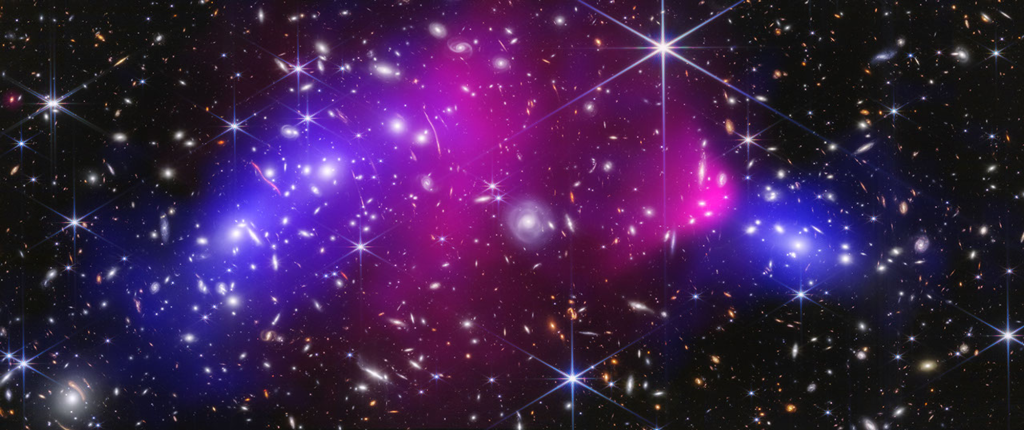
Figure 1: Bullet Cluster(NASA 2006)

While dark matter can help explain galaxy formation, dark energy remains more mysterious. The definition of dark energy is still unclear, but scientists label it as something that causes the universe to expand at a faster rate(Kazmierczak 2025). It does this by exerting negative pressure and pushing space outwards. One possible explanation for dark energy is vacuum energy, which is said to exist throughout space(Kazmierczak 2025). According to quantum field theory, space is not exactly devoid of energy and that there exist virtual particles, which consist of pairs of particles and antiparticles(Kazmierczak 2025). These particles are said to pop in and out of existence, an attribute deemed to be possible by dark energy(Kazmierczak 2025). However, there is a discrepancy in the calculation of the amount of vacuum energy, illustrating that there is a crucial piece missing in this puzzle.

Ultimately, the 96% of “invisible” matter that shapes our universe dictates everything we see and experience. As astronomical technology advances, scientists will gain tools to better understand these invisible components and, in turn, reveal how the universe came to be.

References

Agency, Canadian Space. 2022. “The Mysteries of Dark Matter and Dark Energy.” Canadian Space Agency, September 28. https://www.asc-csa.gc.ca/eng/astronomy/beyond-our-solar-system/dark-matter-and-dark-energy.asp.

Betz, Eric. 2020. “What’s the Difference Between Dark Matter and Dark Energy?” Astronomy Magazine, March 3. https://www.astronomy.com/science/whats-the-difference-between-dark-matter-and-dark-energy/.

Kazmierczak, Jeanette. 2025. “What Is Dark Energy? Inside Our Accelerating, Expanding Universe.” NASA Science, NASA, March 7. https://science.nasa.gov/dark-energy/.

NASA. 2006. Bullet Cluster: Direct Proof of Dark Matter. https://chandra.harvard.edu/graphics/resources/handouts/lithos/bullet_lithos.pdf.

Rubinobservatory.Org. n.d. “How Does Dark Matter Affect the Evolution of the Universe?” Accessed September 20, 2026. https://rubinobservatory.org/explore/science-goals/dark-matter.

ScienceDaily. 2026. “Scientists Just Mapped the Hidden Structure Holding the Universe Together.” https://www.sciencedaily.com/releases/2026/02/260203020205.htm.

Comments

6 Responses to “The Answers To The Universe: Dark Matter and Dark Energy”

  1. Swetha Subramanian Avatar
    Swetha Subramanian

    Hello iSci!

    I chose the topic of dark matter and dark energy, as I recall that was one of the first topics discussed in our first physics lecture. I was interested in the very fundamental causes that created our universe, beyond just the Big Bang. In iSci, we are taught to look beyond just the norm and truly investigate the cause-and-effect relationships in nature, so I believe this topic truly delves into how the “invisible” and complex forms of matter and energy contribute to shaping our universe. I’m looking forward to hearing your thoughts and feedback!

    – Swetha S

  2. Brianna Ankoma Avatar
    Brianna Ankoma

    Hello Swetha,
    Great blog post! I enjoyed learning more about our universe and dark matter! Here are some things you could do to improve your post
    In P2S2, I think there was supposed to be a period in between “universe together” and “this can be attributed to…”
    There are a couple of times where there is a space missing in between the last word in a sentence and the source. Make sure to fix that!
    In P2S, there are a couple of times where sentences could be combined. For example “Researchers are now saying that normal matter makes up only 4% of the universe, whereas dark matter and dark energy might comprise the other 96%” and “They acquired new effects, including the ability to convert gas into stars and create new galaxies, referred to as “halos”
    Make sure your figure caption is italicised
    Besides that your blog post was well done!
    Happy editing,
    Brianna

  3. Mansi Bhandari Avatar
    Mansi Bhandari

    Hi Swetha!

    I enjoyed reading this post about dark matter/energy as I didn’t know much about them before. You also wrote about a complex topic in a clear way!

    Here are a couple suggestions:
    – I would double check the spacing between your words and the punctuation (i.e., dark vs Dark) as it’s not always consistent.
    – Also, I would think about potentially changing the Bullet Cluster section to make it more clear how scientists determined that most of the mass was separated from hot gas. One idea that could help explain why this observation is evidence for dark matter is gravitational lensing.
    – Finally, P2 states that “dark matter is a catalyst for the development of planets and life” which was a little ambiguous to me because the article doesn’t talk about dark matter speeding up the process and not being consumed by itself so I thought it might have been an oversimplification. Perhaps it’s more accurate to just say it provided the gravitational structure that contributed to galaxy formation, which later allowed stars and planets to form.

    Overall, this was a great article! Hope some of my suggestions helped.

    Regards,
    Mansi

  4. Gurleen Hunjan Avatar
    Gurleen Hunjan

    Hi Swetha,

    I found your post very interesting!

    Feedback:
    – “These can be referred to as “halos.”(Rubinobservatory.Org, n.d.).” you can remove the period after “halos” in this sentence.
    – “Further imaging displayed that the majority of mass is separated from normal mass(shown in pink)(NASA 2006)” – “shown in pink” doesn’t need to be in parentheses. You can just put a comma after “mass” for clarity.

    Best,
    Gurleen

  5. Tsippora Brown Avatar
    Tsippora Brown

    Hi Swetha,

    This was such an interesting blog post to read! The topic you chose is super cool, and I learned a lot. Here are a few suggestions I had while reading:

    – Citing the statistic referenced (P2S1)
    – Consider adding a captione xplaining your figure (Figure 1)
    – Make sure there is a space between the paranthesis and the word before it (throughout)

    I look forward to reading the final post!
    – Tsippora

  6. Myan Nguyen Avatar
    Myan Nguyen

    Hi Swetha,

    Great blog post! I really enjoyed learning about the role of dark matter and dark energy, as these concepts are often harder to research. Here are a few suggestions to help with your editing:

    – Make sure your spacing is consistent. Your words and in-text citations, like “present(Rubinobservatory.Org, n.d.)” in P2S5, are sometimes left without spacing in between.

    – (Figure 1) I think it would be helpful to expand on the figure caption of figure 1. The things that are discussed in your writing, like the normal matter in pink, can be added and expanded in the figure 1 caption.

    – If space allows, consider expanding on how the Bullet Cluster is evidence of dark matter existing, you mentioned the x-ray as evidence but it would be helpful to readers if the link between this and the presence of dark matter was explicitly mentioned.

    – Consider using more peer-reviewed sources for your writing!

    Overall, great work! Happy editing 🙂

    Myan

Leave a Reply