Tuesday has no colour. At least, it shouldn’t. It’s just a day of the week, nothing more. You can’t point to Tuesday, hold it in your hands, or shine light through it. There is simply nothing there to see, and yet, the question doesn’t really feel meaningless.
Give it a moment, what colour is Tuesday?
For some, Tuesday might be yellow; the number 7 might be orange, a name might feel sharp while others feel strangely round. These seemingly arbitrary connections represent something interesting about the way we experience ideas. This is where ideasthesia begins.
Ideasthesia, meaning “sensing concepts,” describes the idea that meaning itself can trigger a sensory experience (Nikolić 2014). Rather than colour belonging to the word Tuesday or the shape of the number 7, it may be our understanding of what these concepts represent that gives them sensory qualities. (Mroczko-wąsowicz and Nikolić 2014). The idea grew from research into synesthesia, a phenomenon in which certain stimuli involuntarily evoke additional experiences, such as colours. Researchers began to question whether these experiences were really caused by a crossing of the senses, or whether it was something deeper.
To test whether meaning could actually influence these experiences, experts Jürgens and Nikolić (2012) taught people with grapheme-colour synesthesia 24 unfamiliar symbols from an invented writing system (see figure 1).
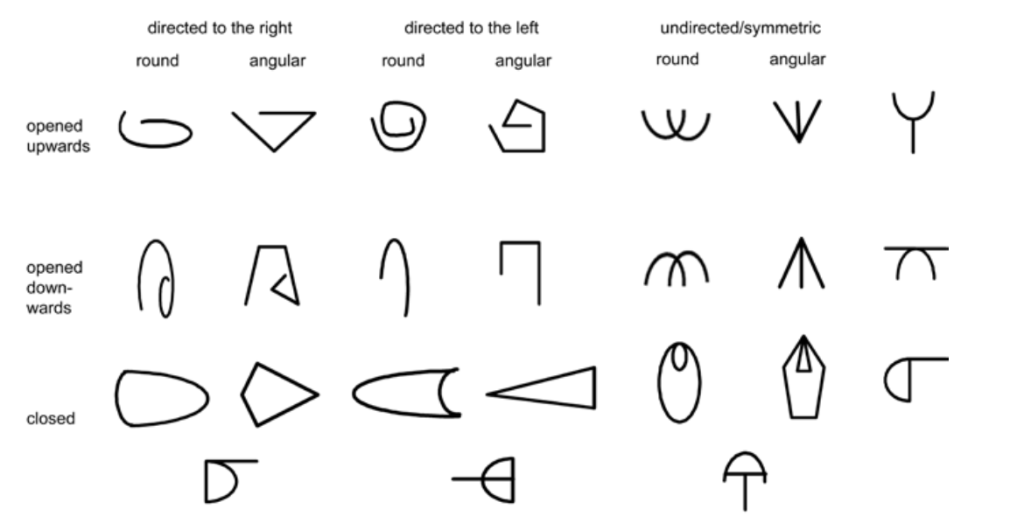
Participants learned the symbols by repeatedly writing them and using them to translate sentences, a process that only took 10-15 minutes. Afterward, 20 participants associated colours with at least half of the newly learned symbols, while six associated colours with all 24 symbols (Jürgens and Nikolić 2012). The researchers argued that these associations formed too quickly to result from new cross-wiring between sensory areas of the brain, instead suggesting a more flexible conceptual process.
That suggests that what we perceive could depend on more than what physically reaches our senses. In other studies, the same colour could be triggered by physically different representations of a number, including Arabic and Roman numerals, dots, dice patterns, finger counting, and number names, if they represented the sane quantity (Mroczko-Wąsowicz and Nikolić 2014). In these cases, what remained constant wasn’t necessarily the appearance of whatever stimulus was used, but rather its meaning. Ideasthesia therefore suggests that conceptual understanding could affect perceptual experiences.
So, what colour is Tuesday? Scientifically, the answer is still none. But maybe the more interesting question is why our minds give it one at all. Ideasthesia suggests that the boundary between understanding something and experiencing it may not be as clear as it seems. Tuesday may have no colour of its own, but the colour we assign it shows how meaning can become part of the way we experience the world.
References
Jürgens, Uta, and Danko Nikolić. 2012. “ideasthesia: Conceptual Processes Assign Similar Colours to Similar Shapes.” Translational Neuroscience 3 (1): 22-27. https://www.researchgate.net/publication/257909728_Ideaesthesia_Conceptual_processes_assign_similar_colours_to_similar_shapes
Mroczko-Wąsowicz, Aleksandra, and Danko Nikolić. 2014. “Semantic Mechanisms May Be Responsible for Developing Synesthesia.” Frontiers in Human Neuroscience 8: 509. https://pmc.ncbi.nlm.nih.gov/articles/PMC4137691/
Nikolić, Danko. 2014. “Ideasthesia: How do ideas feel?” TED-Ed, November 6, 2014. https://ed.ted.com/lessons/ideasthesia-how-do-ideas-feel-danko-nikolic


Leave a Reply
You must be logged in to post a comment.